


On this page 9 sections
Your guide
What you'll learn
We have all done it. Watched our friend, teammate, or favorite player go down and grab their knee. We’ve wondered aloud if it is the vaunted ACL tear and if there is any additional damage to go along with it. The ACL or anterior cruciate ligament gets most of the attention and is often the slowest healing structure involved when returning a player to their sport. However, there are a variety of other structures that can be injured in the knee that will play a significant role in an athlete’s recovery. These include the medial collateral ligament (MCL), the lateral collateral ligament (LCL), the medial and lateral menisci, as well as the cartilage that covers the bony surfaces of the knee joint. ACL and knee injuries in general often happen in combination and much research has been done into one particular combination of knee injuries called “the unhappy triad”. This article will examine the unhappy triad, its prevalence, mechanisms, and reasons for occurring as well as how it can affect recovery. We also will finish with unhappy triad knee rehab to give you insight on how you can recover from this injury properly if you have suffered one yourself!
So what is the unhappy triad?
The unhappy triad (also known as the terrible triad) was first described in 1964 by O’Donoghue. Back then, it was described as an injury to the ACL, MCL, and medial meniscus. It was estimated to occur in this combination in 25% of acute athletic knee injuries. O’Donoghue explained that this combination of injuries occurs due to the motion of the knee caving and rotating inward also known as the valgus moment that occurs during this injury.
Let’s look at these structures one by one:
- The anterior cruciate ligament runs through the middle of the knee joint limiting the shin bone from:
- Moving forward on the thigh bone
-
- Rotating on the thigh bone
-
- Caving inward relative to the thigh bone
- The medial collateral ligament runs along the inner or medial side of the knee joint from the thigh bone to the shin bone. It primarily limits the thigh and shin bone from opening up or being spread apart on that medial side.
- The medial meniscus does not serve as a primary limit to motion at the knee but rather as a cushion between the thigh and shin bone which protects the bone and the cartilage surrounding the bone from damage.
Recover From Your Knee Injury With Our Program

Have you recently suffered an unhappy triad knee injury? Rehab from knee injuries can be confusing. Some may have access to healthcare, with only a certain number of visits that may be covered by insurance companies. This knee rehab program will show you step-by-step how to take control of your own knee health, on your own time! Click HERE to get started today.
Which Meniscus Is More Often The Culprit In The Unhappy Triad?
Thus, when the knee caves inward excessively to the point of injury, it makes sense that the ACL & MCL would both be injured. As injury to the above structures creates a level of instability in the knee joint, logically the menisci which are anchored in between the 2 surfaces of the knee joint are also at risk of injury. However, as technology has improved and the invention of the arthroscope has increased the surgeon’s ability to view the knee joint, subsequent research has shown that the more common combination is injuries to the lateral meniscus.
- The lateral meniscus, much like the medial meniscus, does not serve as a primary limit to motion at the knee but rather as a cushion between the thigh and shin bone on the lateral (outside) rather than medial (inside) of the knee.
Thus, it appears that the more common version of the unhappy triad is more accurately described as a combination injury to the ACL, MCL, and lateral meniscus. At this point, the sports medicine community defines the unhappy triad as an injury to the ACL, MCL, and either meniscus.
READ: WHAT IS THE MENISCUS

Is There Really an Unhappy Tetrad?
While our focus has often been on the structures inside of the knee joint (intra-articular) more recently structures outside the knee joint have been receiving more attention. One of these, in particular, is the anterolateral ligament (ALL) which was only recently rediscovered. This ligament is part of the anterolateral complex, which are the structures stretching across the outside & front of the knee and which limit the shin bone from rotating inward. When this inward rotation persists after an injury it is called anterolateral rotational instability, often described as a “pivot-shift”, where the shin bone rotates forward and inward on the thigh bone. A recent study found that in 11 patients who underwent surgery for an unhappy triad injury, all 11 had injuries to their anterolateral complex as well.
A Better Way to Test Muscle Strength - The Tindeq Test
The Unhappy "Tetrad" Rather Than The "Triad"
Thus, although this is an area about which even the medical community knows little, there is good reason to suspect that there are actually FOUR structures involved in this mechanism of injury, thus making this an “unhappy tetrad”. These include the:
- ACL
- MCL
- Meniscus (medial or lateral)
- Anterolateral complex (most of the anterolateral ligament)
Why does this matter?
While the ACL is still the primary structure involved and the most important ligament for knee stability, there are some patients who have successful ACL reconstruction surgery but continue to deal with instability in their knees. In many cases, this is anterolateral rotational instability as described above. This continued instability can lead to less successful outcomes for the patient, as well as increased stress and risk to the ACL graft.
For this reason, surgeons are increasingly seeking to address this anterolateral rotational instability at the time of the initial injury. Currently, there are two surgical procedures gaining popularity.
- The Lateral Extra-articular Tenodesis (LET) procedure: This utilizes a portion of the iliotibial band (ITB) to reinforce the anterolateral complex and limit the internal rotation of the shin bone.
- The ALL Reconstruction: This often involves fashioning a graft similar to an ACL graft (often from the hamstring tendon) to replace the anterolateral ligament.
In many cases, the rehab from these additional procedures is very similar, just with an increased focus on protecting the integrity of these additional structures.
Unhappy Triad Knee Rehab
In most cases, if you are young, and looking to return to a high-level activity, surgical reconstruction of the ACL, with the potential of meniscal surgery will occur sooner rather than later. What is interesting is that more recently in regards to the timing of surgery, individuals have had more success if they allow the knee to "calm down" for a couple of weeks rather than immediately operating on the knee. This has a couple of benefits. Swelling can reduce, pain may be better modulated, and the MCL can begin to scar down. During this time, you can work on regaining adequate knee range of motion with light exercises prior to surgery.
Want to learn more ways how to improve knee flexion? Watch this video below!
How to Restore Knee Flexion After Surgery
Exercise 01 of 04
Exercise demonstration
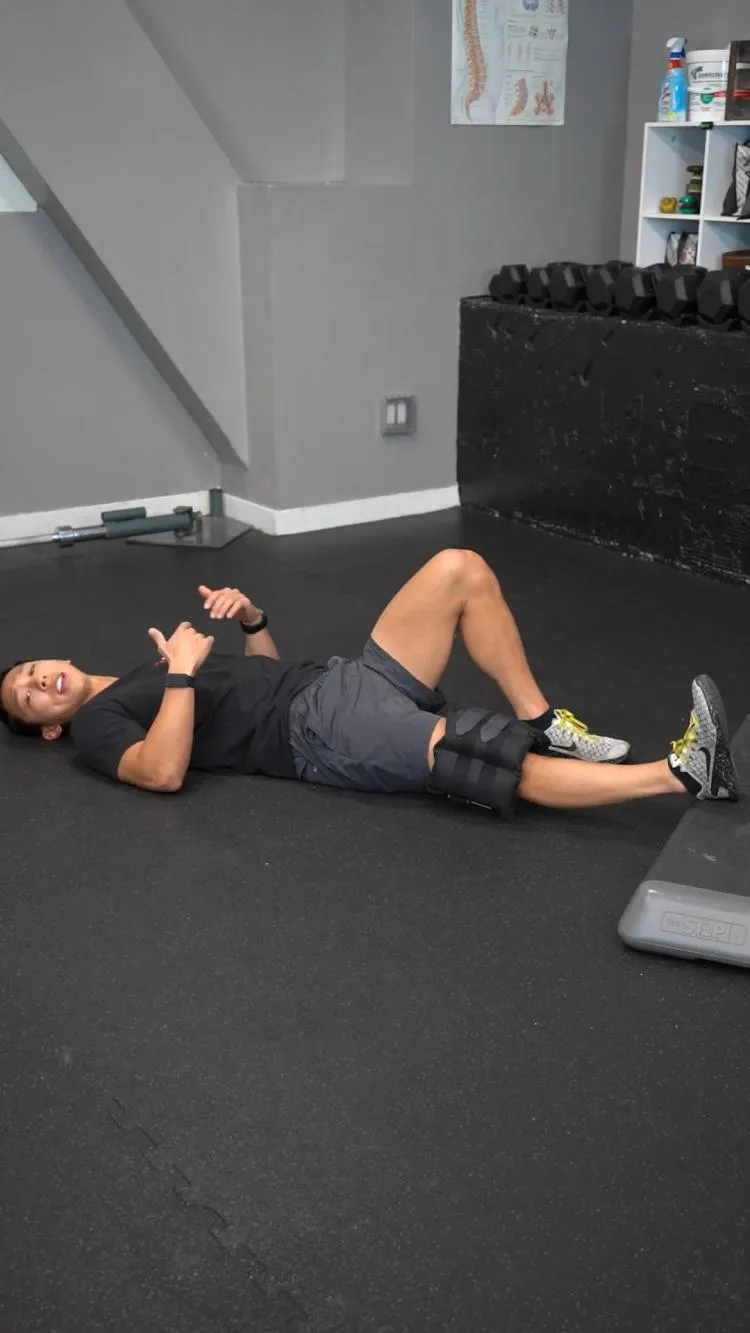
Supine Passive Knee Extension PROM With Overpressure - Ankle Weight
View exercise instructions
- HOW: While laying on your back, straighten your leg out and place your heel on an elevated surface. Typically lying back on your coach with your foot on the arm rest will suffice. Place the weighted object over your knee and let your leg relax. Hold that stretch for as long as prescribed.
- FEEL: You should feel a stretch in the back of your knee.
- COMPENSATION: Keep your knee relaxed and straight. Make sure the weight is centered over your knee. Don’t let your knee hit the ground while the weight is being applied. Keep your toe pointed up so your hip doesn’t rotate up.
Ensuring you have adequate straightening (knee extension) prior to surgery is very important, as any slight loss in this range of motion results in more difficulty with restoring your range of motion after surgery.
Post-Surgical Latter Phase Unhappy Triad Knee Rehab
Once you have had your surgery, tissue healing has commenced, your range of motion has been restored, and your quad muscle has demonstrated good activation, you can start to return to more closed chain exercises, and shift a focus on joint proprioception. Depending on which structures were operated on, weight-bearing may be protected in the early phase, especially if the meniscus was repaired.
Exercise 02 of 04
Exercise demonstration
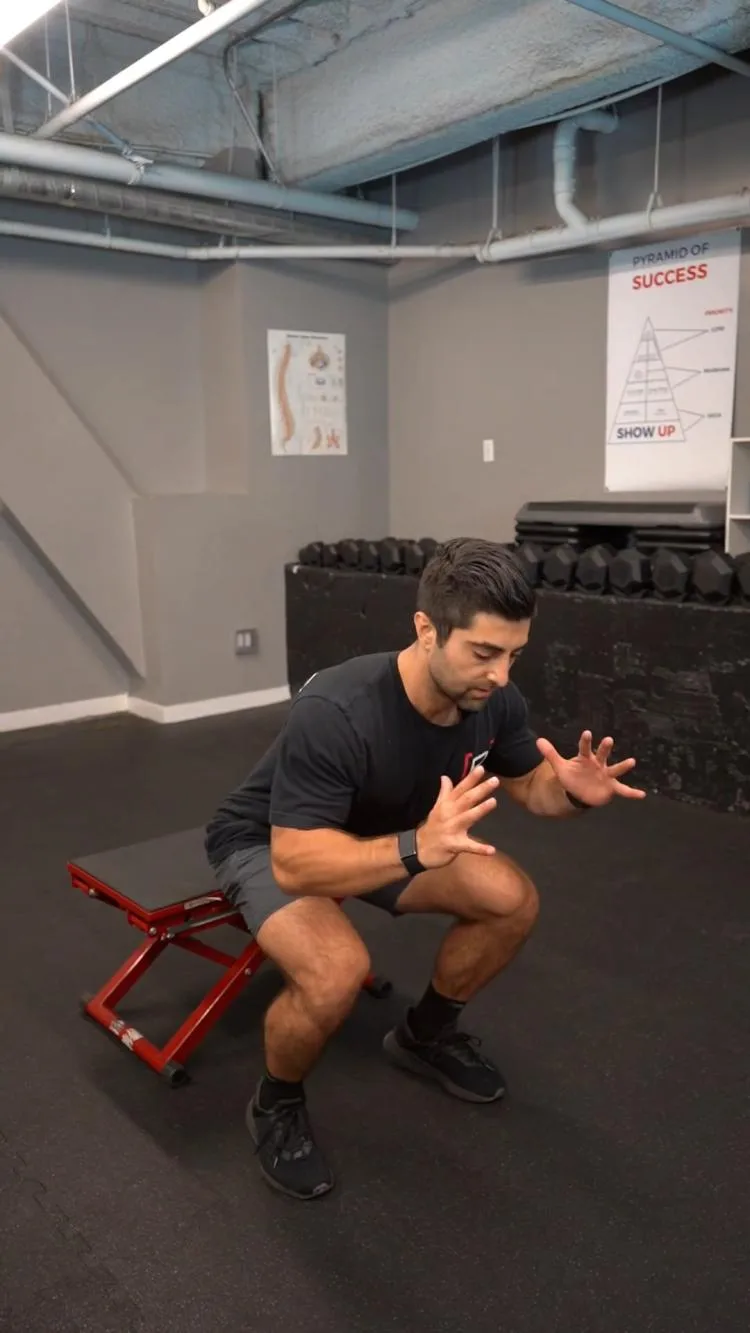
Depth Drop
View exercise instructions
- HOW: Begin by standing on an elevated surface. Step off of the surface with one foot and land with your feet about shoulder width apart. Absorb the landing by bending your knees and hinging forward at the waist.
- FEEL: You will feel all the muscles in your legs working.
- COMPENSATION: Landing Position. Make sure your knees are aligned over your toes. They should not dive inwards on the landing. Your goal is to absorb as much of the landing forces as you can and land softly. That means that you want your hips and knees to bend as much as they need to, to absorb the force. If you do not let them bend much, you will land "stiff" and hard. Let your hips go back and while keeping your chest up to help absorb the forces. Your toes should touch the ground first when you land and quickly your heels will follow. You should land in a "ready position" like you would if you were playing sports, with your weight ever so slightly forward on the balls of your feet. You should not fall forward or backwards after landing.
- For a detailed video on landing mechanics on two legs, click here: https://youtu.be/RThUCYRDyZw
Absorbing your landing is crucial for the protection and health of the knee joint, and poor landing mechanics has been highly correlated with knee injuries.
Exercise 03 of 04
Exercise demonstration
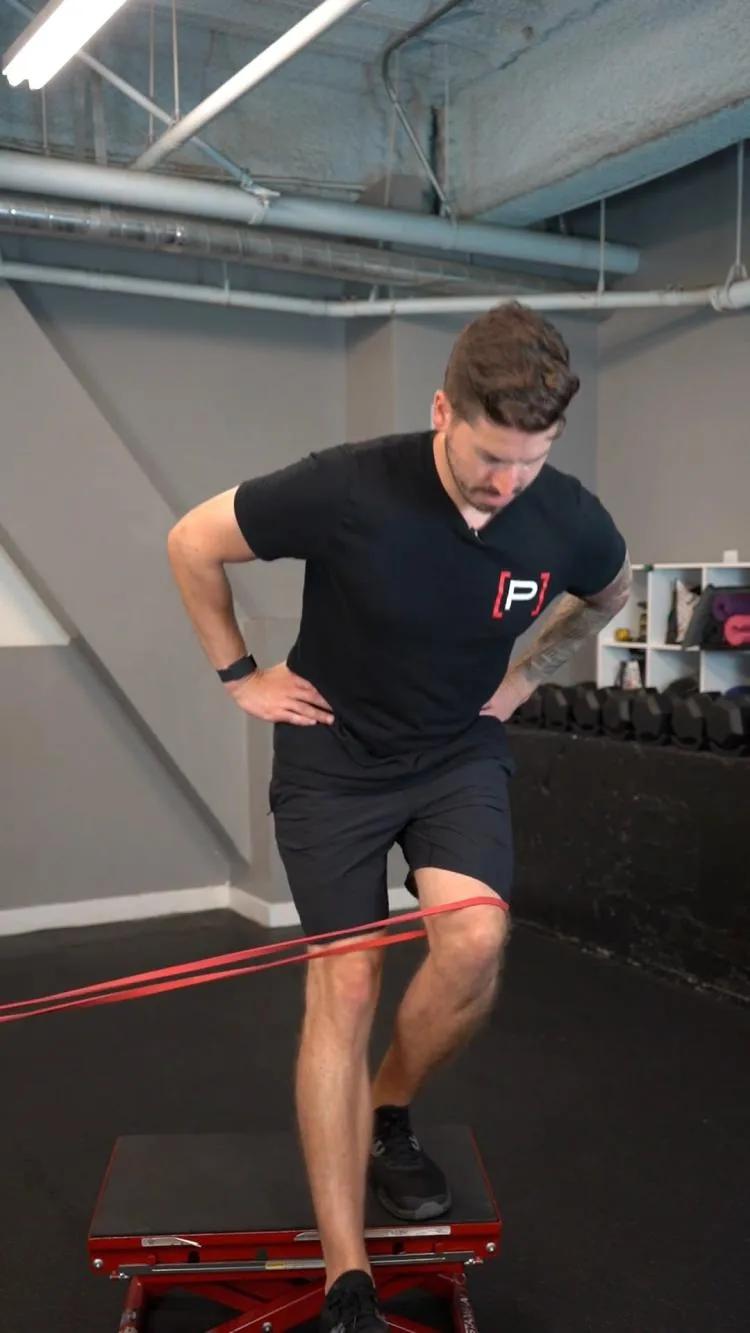
Anterior Step Down - RNT
View exercise instructions
- HOW: Start by standing on a step or elevated surface with a band around your knee. The band needs to be looped around just above your knee cap and should be wanting to pull your knee in. Your goal is to push your knee out the entire time while performing this exercise. The other knee should be behind the band. With your leg straight, begin to step forward off of the step and bend the knee that has the band around it. After you’ve reached a spot where you can not bend down anymore, push into the elevated surface and return to the starting position.
- FEEL: You should feel your glute and hip muscles working.
- COMPENSATION: Keep your back upright as you squat, don’t bend forward too much. Keep the knee that has the band around in line with your hip, don’t let the band pull your knee in.
This is a great exercise to focus on joint proprioception of the knee and maintaining proper alignment during a step down exercise.
Exercise 04 of 04
Exercise demonstration
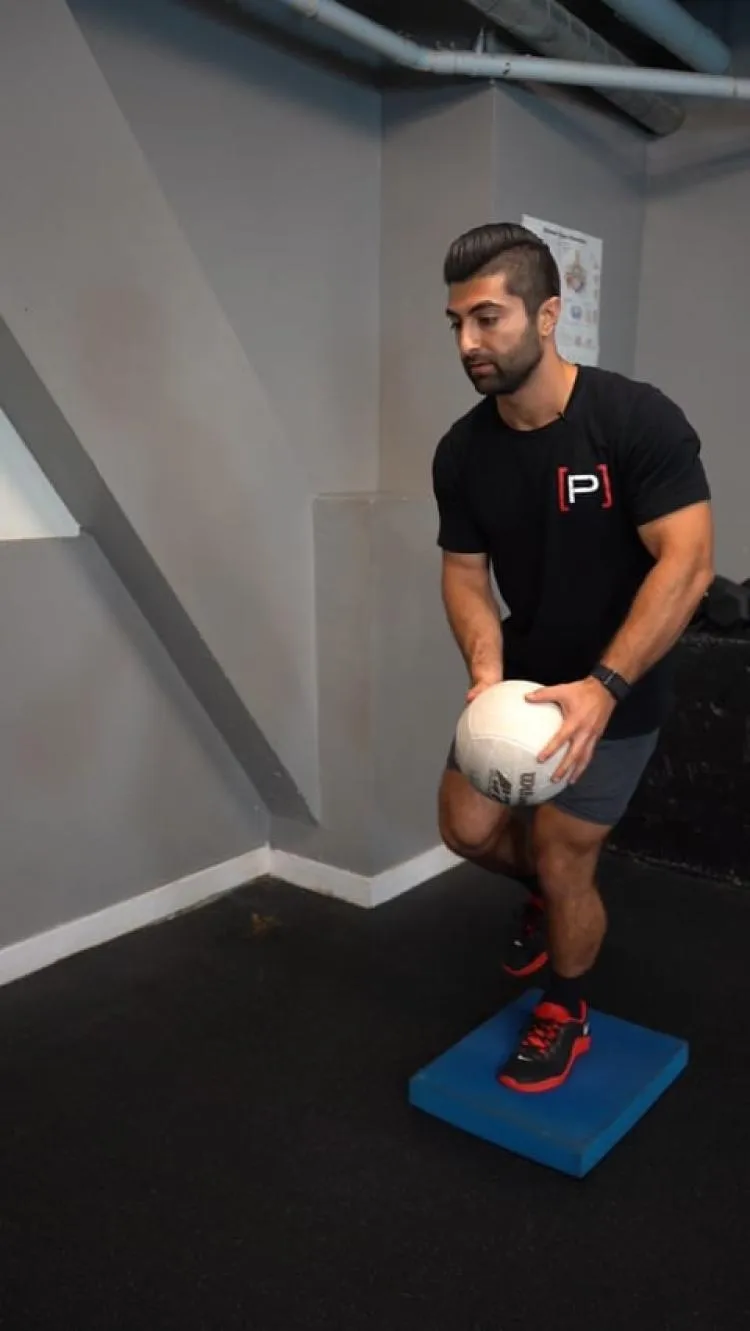
Single Leg Balance - Ball Toss Medial, Foam Pad
View exercise instructions
- HOW: Place a foam pad on the ground near a wall. Stand on the pad with the leg furthest from the wall with a ball in your hands. While balancing on the pad with a slight bend in your knee, toss the ball into the wall and play catch with it. Keep your hips facing forward as you throw the ball. The farther you are away from the wall the harder it will be.
- FEEL: You should feel your lower leg and foot muscles working.
- COMPENSATION: Keep your hips facing forward, don’t rotate your whole body while throwing the ball.
This is an example of a latter-phase rehab exercise, focusing on a sport-specific movement, incorporating a single limb stance, loading of the knee on an uneven surface, and dual tasking. If you want to learn more about balance and how to integrate it into your training, check out this podcast below.
LISTEN: HOW TO PERFORM BALANCE TRAINING

Closing Thoughts
The unhappy triad is a well-described phenomenon although its definition has continued to grow and expand over the last 50 years. Currently, the unhappy triad is defined as a combination of injury to the ACL, MCL, and either meniscus. The recent focus on the importance of rotational instability in the knee after ACL injury and surgery has led to consideration for expanding this definition to the unhappy tetrad. This would include the anterolateral complex in addition to the 3 structures described above. Awareness of this phenomenon is good for patients as newer surgical procedures can more readily address instances of anterolateral stability potentially leading to improved outcomes after ACL surgery. These procedures include the ALL reconstruction and LET procedure, both of which seek to limit the internal rotation of the shin bone about the thigh.
Take Control of Your Knee Health
The knees are true hard-nosed blue-collar workers! They get the job done when the hips and ankles may be taking some extra rest breaks. In this program, you will learn how to restore mobility, learn to get your powerful quadriceps cooperating with you, along with starting the journey to addressing the hip and ankle. In this program, you will learn how to restore mobility, learn to get your powerful quadriceps cooperating with you, along with starting the journey to addressing the hip and ankle.
References
- O'DONOGHUE DH. THE UNHAPPY TRIAD: ETIOLOGY, DIAGNOSIS AND TREATMENT. Am J Orthop. 1964;6:.
- Ferretti A, Monaco E, Ponzo A, et al. The unhappy triad of the knee re-revisited. Int Orthop. 2019;43(1):223-228. doi:10.1007/s00264-018-4181-7
- Barber FA. What is the terrible triad? Arthroscopy: The Journal of Arthroscopic & Related Surgery. 1992;8(1):19-22.
- Dacombe PJ. Shelbourne's update of the O'Donoghue knee triad in a 17-year-old male Rugby player Case Reports 2013;2013:bcr.01.2012.5593.
- Parsons EM, Gee AO, Spiekerman C, Cavanagh PR. The biomechanical function of the anterolateral ligament of the knee. Am J Sports Med. 2015;43(3):669-674. doi:10.1177/0363546514562751
About The Author
Tommy Mandala, PT, DPT, OCS, SCS, CSCS
Prehab Writer & Content Creator

Tommy Mandala is a Doctor of Physical Therapy, Board Certified Clinical Specialist in Sports & Orthopedics, and Certified Strength and Conditioning Specialist in New York City. He is the founder of ALL IN ACL, a digital coaching platform dedicated exclusively to helping ACLers return to the life they had before their injury with full confidence in their knee. Prior to that, he worked in the sports clinic at Hospital for Special Surgery, the #1 Orthopedic Hospital in the country. While there, he had the opportunity to hone his skills as an ACL specialist working closely with world renowned surgeons and evaluating patients from all over the world. He completed his sports residency training at the University of Delaware where he had opportunities to work with many of their Division I sports teams as well as the Philadelphia 76’ers NBA G-league affiliate, the Delaware Blue Coats. He also trained at Champion Sports Medicine in Birmingham, Alabama where he had the opportunity to learn from researchers in the American Sports Medicine Institute. Currently, Tommy works exclusively with ACLers through his digital coaching model. While many of these clients are athletes, Tommy works with ACLers of all different abilities helping them to build the strength they need to overcome this unique injury. One of his favorite aspects of his job is taking active clients who have never been a “gym person” before and showing them the amazing things that happen when they learn to strength train.