

On this page 5 sections
Your guide
What you'll learn
“And now, with this next act, I’ll make your pain decrease and your muscles stronger with just an isometric exercise.”
Pssh, yeah right. An exercise that diminishes pain but can also improve muscle strength and hypertrophy? Does it sound like magic? Well, it kind of is! Isometric exercise will challenge a disappearing rabbit trick any day.
Isometrics are a type of muscle contraction that has been shown to alter feelings of pain in tendinopathies while also having the ability to improve muscle strength and hypertrophy when incorporated into strength training routines. In this blog, let’s talk about what an isometric exercise is, the influence isometrics can have on tendinopathies, and the importance of isometric exercise in the way that it can influence muscle hypertrophy and muscle strength.
What are Isometric Exercises?
When a muscle is working, it is producing an effort in one of three ways. The muscle can be undergoing a concentric contraction, where the muscle shortens. Think about the curling motion in a bicep curl or a hamstring curl. The muscle can also function eccentrically, where the muscle is lengthening with effort. An example would be the lowering phase of a push-up or the lowering phase of a squat. Lastly, the muscle can work isometrically, where there is no change in length (1). A plank is an example of this, or a wall sit.
Thankfully, muscles can work with or without a load in all of these different ranges, allowing us to jump, sprint, pick up our kid, unload the dishwasher, climb down a 14er, and complete an Ironman.
Isometrics are unique in that they have proven to provide pain-modulating effects on tendons but also can improve strength at weak points of joint movements.
Isometric Exercises and Pain:
Isometrics have found a valuable and crucial role in the management of tendinopathies. Tendinopathies are overuse injuries that occur when the tendon isn’t strong enough to tolerate the physical demands of the task at hand. Often seen in athletes, tendinopathies of the patellar tendon and achilles tendon are frequently seen in sports requiring running and jumping.
READ: TENDINITIS EXERCISES AND UNDERSTANDING TENDINOPATHIES

Bring on the magic! Mid-range isometrics have been proven to be an effective method for pain reduction in individuals with patellar tendinopathy. One study determined that five repetitions of a 45-second quad contraction on a seated knee extension machine reduced pain for several hours in individuals with patellar tendinopathy. Other studies have shown that an isometric squat aka wall squat or Spanish squat reduced pain in multiple sports of in-season athletes (2).

Isometric exercises have also been found to be effective in the initial management of achilles tendinopathy. To allow for progressive loading of the achilles tendon, an isometric heel raise exercise is a beneficial stepping stone when heel raises are too difficult or painful to achieve. These can be performed in a standing or with a resistance band and will allow for loading of the tendon and pain modulation (3). What a trick to have up our sleeves!
Isometric Exercises and Strength:
So, you’ve used an isometric exercise to modulate tendon pain, now what? In addition to assisting in the management of pain, isometrics can be used to improve strength at various joint positions, build the capacity of muscle in sports that require various isometric holds, and can improve mobility due to injuries (4).
Let’s consider the benefit of isometrics to improve strength in various joint positions and the impact that can have on sports that may require isometric positions throughout the play. Studies have demonstrated that isometric strength training in athletes can allow for less muscle fatigue while also allowing for the specificity of sport-specific movements when compared to dynamic strength training (4). Think about it like this…if you’re a lineman on the football team, and you are consistently having to assume a starting position with knees bent ready to explode off the line, might it make sense to perform isometric squats in this position to strengthen the tissue? There is no doubt that working on power and explosiveness through dynamic movement is also crucial to the position of a lineman, but if we know we can make strength gains through isometric exercise, adding an isometric Spanish Squat to the lift might not be a bad idea!
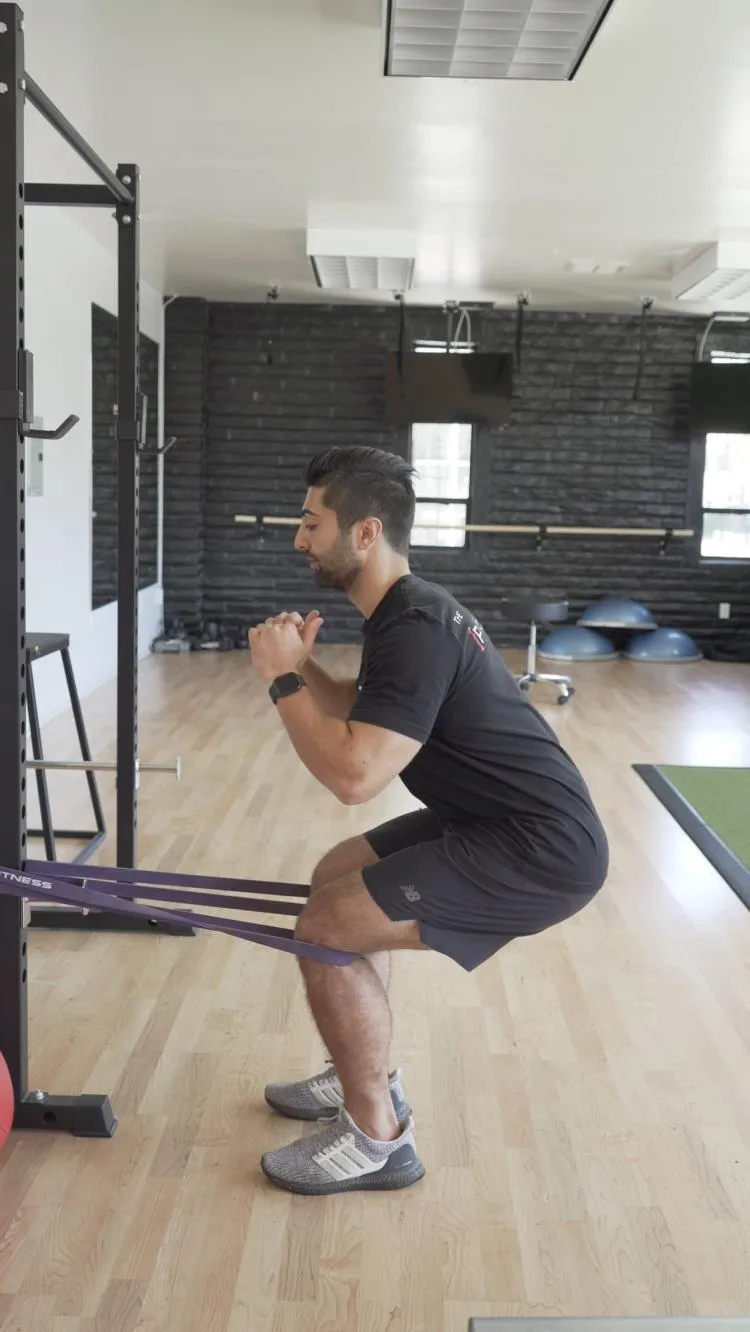
Check out the Spanish Squat below! This is a great way to improve quad dominant strength in a squat position and is also one of our favorite exercises for treating patellar tendinopathy, find it in our Patellofemoral Rehab Program!
Exercise 01 of 03
Exercise demonstration
Spanish Squat
View exercise instructions
- HOW: Anchor a band roughly knee height, and place the band around the back of your lower leg. You will then perform a squat while leaning into the band and keeping your trunk straight.
- FEEL: You will feel the muscles on the front of your thigh working with this exercise.
- COMPENSATION: Avoid leaning your trunk forward. The more you lean into the band the easier it will be to keep your trunk upright.
Consider the starting position for a track and field athlete or a swimmer out of the blocks. The runner or swimmer may be holding this starting position for several seconds before their race beginning. How can we use isometrics to strengthen the body in this position to allow for power and speed coming out of blocks? If you’re a coach, an athlete, or a recreational Sunday flag footballer, what opportunity does this open for you to incorporate isometrics into your strength routine?
LISTEN: TREATING ACHILLES TENDON PAIN

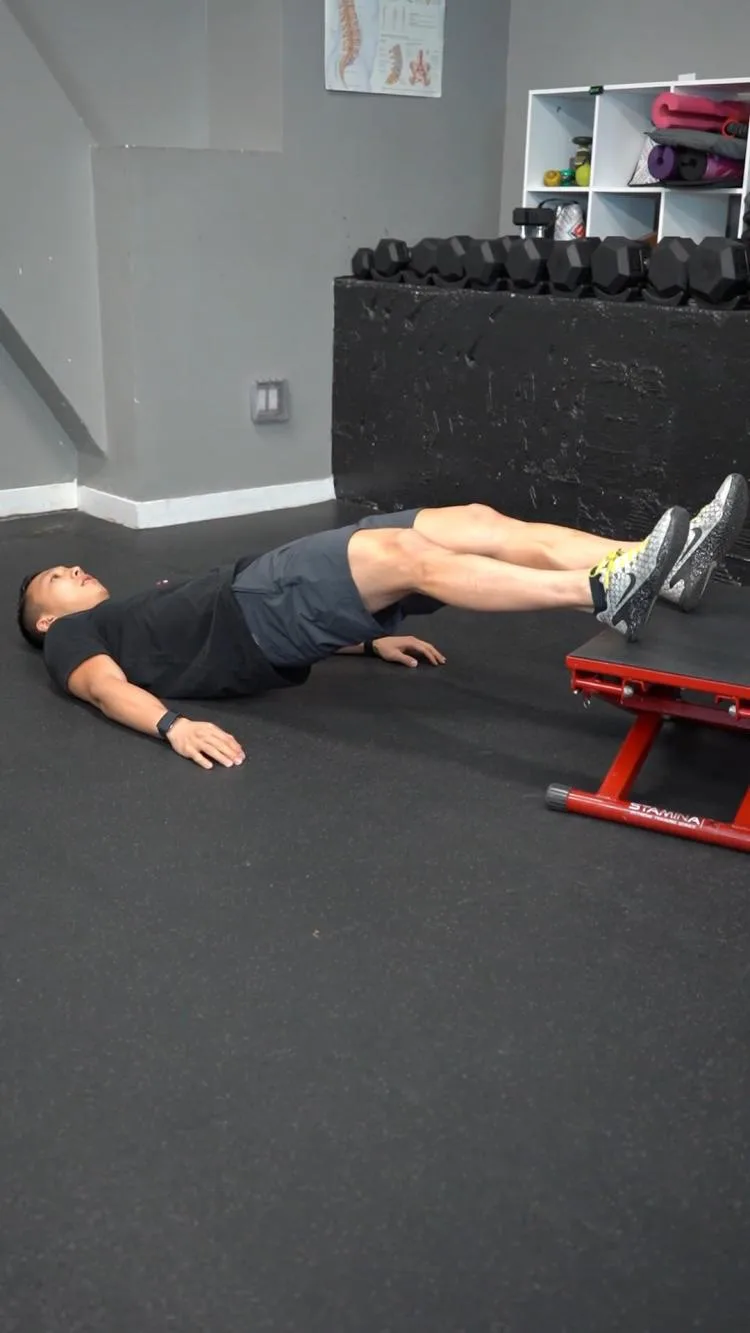
To see changes in muscle hypertrophy from isometrics, a muscle contraction should be performed at 70-75% of a maximum voluntary contraction (4). Muscles that are strengthened isometrically in a lengthened position also demonstrated greater gains in muscle hypertrophy compared to muscles strengthened in shortened positions (5). For example, if we are performing a bridge, we can lengthen the muscles in the back of the legs by straightening the knees. Performing an isometric bridge in this lengthened position can facilitate greater hypertrophy gains than with the knees more bent.
Exercise 02 of 03
Exercise demonstration
Isometric Elevated Bridge - Knee Straight
View exercise instructions
- HOW: Place both heels on elevated surface. Keep knees slightly bent and drive your heels into the elevated surface lifting your hips up. Keep your arms relaxed and use your core and hamstrings to keep your hips elevated for a prescribed amount of time.
- FEEL: You will feel your hamstrings and core muscles the most.
- COMPENSATION: Don’t use your hands or arms for support, keep them relaxed. Don’t straighten your knees all of the way out.
When performing isometric exercises, and to see changes in muscle hypertrophy, a sustained contraction should be held for 3-30 seconds per repetition with a total contraction duration of >80-150 seconds (4). So for that bridge, we were just chatting about, 5x30-second holds would do the trick! Check out the video above and give it a try!
To acquire changes in maximum strength through isometric strength training, the metrics look a bit different. It is recommended that isometrics be performed at 80-100% maximum voluntary contraction for a duration of 1-5 seconds. Therefore, a bit more effort but for a shorter period of time compared to muscle hypertrophy. Total contraction time should be about 30-90 seconds per session and it is recommended that joints are loaded at varying angles to truly improve strength (4).
Try adding in a 2-second hold at the bottom of your squat next time you are at the gym, a wall sit, or throw a 30-second plank into your routine. With proven changes to both muscle hypertrophy and overall strength, why not add it in?
Exercise 03 of 03
Exercise demonstration
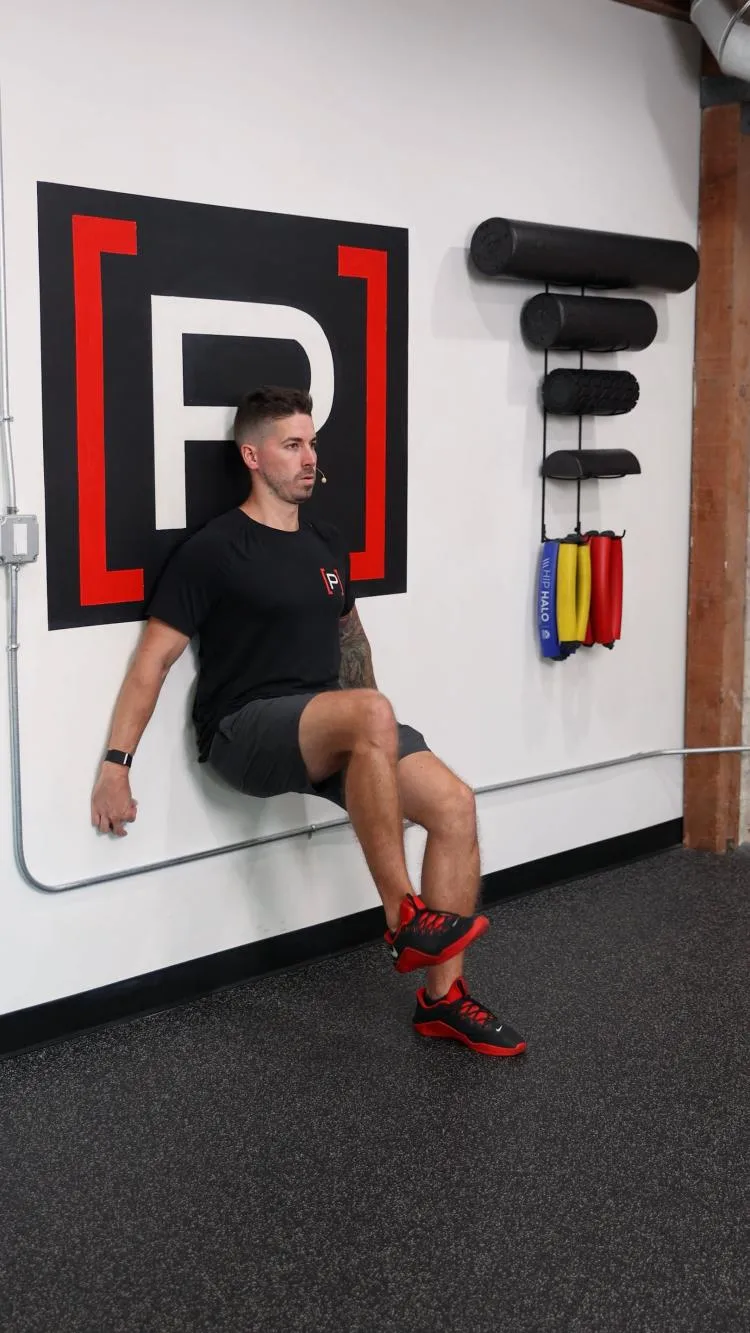
Wall Sit - March
View exercise instructions
- FEEL: You should feel your core muscles working as well as your quads and other muscles of the legs.
- COMPENSATION: Avoid rocking the body side to side. Keep your torso upright and still while making the motion just come from your legs and hips.
Above is one of our favorite variations of a wall sit. It's a tough one but a great challenge to work on isometric strength! Give it a go and let us know what you think!
Closing Thoughts:
Isometrics refers to the effort through the muscle without the muscle changing shape. A plank, wall squat, Spanish Squat, and bridge hold are all great examples of isometric exercise. Isometrics have proven to modulate pain seen in tendinopathies and also have been shown to improve muscle strength and hypertrophy. If that’s not enough to warrant the incorporation of isometric exercise into a strength training program, isometrics have the potential to allow for training specificity in sports that require the holding of a certain position for prolonged periods of time. For the runner who is having some aches while trying to ramp up mileage, the yogi who can’t quite reach their preferred depth in chair pose, the 400 m runner who craves a bit more power coming out of the blocks, isometric exercises could provide a little bit of magic.
After all, who needs the rabbit-in-the-hat trick when you’ve got isometrics?
LEARN MORE ABOUT OUR ACHILLES REHAB PROGRAM
References:
- Iversen VM, Norum M, Schoenfeld BJ, Fimland MS. No Time to Lift? Designing Time-Efficient Training Programs for Strength and Hypertrophy: A Narrative Review. Sports Med. 2021 Oct;51(10):2079-2095. doi: 10.1007/s40279-021-01490-1. Epub 2021 Jun 14. PMID: 34125411; PMCID: PMC8449772.
- Muaidi QI. Rehabilitation of patellar tendinopathy. J Musculoskelet Neuronal Interact. 2020 Dec 1;20(4):535-540. PMID: 33265081; PMCID: PMC7716685.
- Silbernagel KG, Hanlon S, Sprague A. Current Clinical Concepts: Conservative Management of Achilles Tendinopathy. J Athl Train. 2020 May;55(5):438-447. doi: 10.4085/1062-6050-356-19. Epub 2020 Apr 8. PMID: 32267723; PMCID: PMC7249277.
- Lum D, Barbosa TM. Brief Review: Effects of Isometric Strength Training on Strength and Dynamic Performance. Int J Sports Med. 2019 May;40(6):363-375. doi: 10.1055/a-0863-4539. Epub 2019 Apr 3. PMID: 30943568.
- Oranchuk DJ, Storey AG, Nelson AR, Cronin JB. Isometric training and long-term adaptations: Effects of muscle length, intensity, and intent: A systematic review. Scand J Med Sci Sports. 2019 Apr;29(4):484-503. doi: 10.1111/sms.13375. Epub 2019 Jan 13. PMID: 30580468.
About The Author
Lyndsay Provencio, PT, DPT
Prehab Writer & Content Creator

Dr. Lyndsay Provencio graduated from Colorado State University with a BS in Health and Exercise Science and a concentration in Sports Medicine. After multiple personal sports-related injuries and discovering a passion for healing through movement, Lyndsay attended Creighton University to receive her Doctorate of Physical Therapy. An avid runner herself, she has a particular interest in working with high school, recreational, and elite endurance athletes and has undergone specialty training in pelvic floor rehabilitation, postpartum care, and management of the female athlete to better serve her clientele. Through this specialty training, she has acquired a Certificate of Achievement in Pelvic Health Physical Therapy through the American Physical Therapy Association. Lyndsay now owns her own practice StrongHER in Park City, UT where she specializes in female athletics and care of pregnant and postpartum individuals. Additionally, Lyndsay is BSPTS C2 certified in scoliosis specific exercises and has found a niche working with adolescents with scoliosis to improve overall spinal health. No, you’re not seeing double! Lyndsay is an identical twin to Lauren Lynass, one of our Prehab rockstars. A native of Colorado, Lyndsay is an adventure seeker who loves to hike, camp, and race her twin sister on the mountain trails. When she isn't exploring Park City's outdoor playground, you can find her curled up with a cup of tea and a good book. Follow along @strongher_dpt on Instagram!