

On this page 5 sections
Your guide
What you'll learn
It’s a brisk December day and blue skies and fresh snow are tempting you to get outside for a run. It doesn’t take long for the running to go to sitting as you find yourself on your rear end in the blink of an eye. That sneaky ice gave no mercy to your mile PR or your tailbone, ouch!
Tailbone pain can occur for many reasons, and can often leave individuals very uncomfortable. From discomfort with sitting to pain with movement, tailbone pain can feel very disruptive to even the most monotonous task.
In this blog, we will break down potential causes of tailbone pain and what can be done to provide some relief so you can get back to your winter wonderland runs in no time.
What is the tailbone?
The tailbone is the last bone at the bottom of the spine. It sits just below the sacrum, and assists in providing stability to the hips when sitting and serves as an attachment point for several muscles and ligaments. Working with our two sit bones, the ischial tuberosities, the tailbone acts as a third point of contact to help us maintain balance when sitting (1). That’s right, this small bone carries some big weight as it assists in creating a tripod to keep us upright when sitting unsupported.

Additionally, several muscles including the gluteus maximus and levator ani attach to the tailbone. Not surprisingly, the gluteus maximus plays a huge role in many important hip movements including hip extension, abduction and external rotation.
READ: THE BEST GLUTE EXERCISES & WHY

Attaching to parts of the pelvis, sacrum, and tailbone, the gluteus maximus is a demanding, dynamic, and highly functional muscle that demands a sturdy attachment point! The levator ani muscle group comprises three muscles that create the pelvic floor. The pelvic floor muscles work as a sling to support the organs of urination, defecation and sexual function. Sound important? Yeah, they are. And their attachment point to the tailbone makes this small bony structure that much more valuable!
Add in the additional tendons and ligaments that attach to the tailbone and you’ve got yourself quite the anchor for pelvic stability! Small but mighty, the tailbone is a bony anchor that we can’t afford to lose.
How is the tailbone injured?
There are many causes for tailbone pain, with one of the most common being direct trauma to the bone. This often occurs when one slips and falls, directly landing on the tailbone. In these scenarios, the tailbone can be bruised or sometimes fractured.
Pelvic floor involvement can also directly cause tailbone pain. In fact, a recent study showed that almost 50% of women seeking pelvic floor physical therapy treatment for pelvic pain were experiencing tailbone pain (2). Tailbone pain related to the pelvic floor can occur from tension and tightness in the muscles, childbirth, or a history of pelvic floor trauma (3). A pelvic floor physical therapist can assist in creating a plan of care to best address tailbone pain related to childbirth or pelvic floor muscle tightness and pelvic pain.
Other causes of tailbone pain can include referral from the low back or hip muscles. As the tailbone is the furthest extension of the spine, and with several hip muscles directly connecting to the tailbone, it becomes an ideal target for referred pain. Therefore, it’s wise to consider the involvement of the surrounding bone and tissue when it comes to identifying the root cause of tailbone discomfort.
So your tailbone hurts, now what?
There are several mobility exercises and positional changes that can be made if you are experiencing tailbone pain. Give these a try!
1. When sitting, lean forward in your chair so your weight shifts forward off of the tailbone. The further you sit back, the more load your tailbone is going to take on, so lean forward a bit so you are feeling weight distributed evenly through your sit bones.
2. Try not to sit for more than 45-60 minutes at a time. Prolonged sitting can place a lot of unneeded stress and pressure on the tailbone, especially if it’s painful. Instead, try standing up or walking around every hour. And if you do have to sit for a longer period of time, take a towel and roll it into a donut shape. You can then sit so that your tailbone is in the center of the donut and offload it.
READ: THE BEST POSTURE

3. Relax any tight tissue! Diaphragmatic breathing can be a great way to mobilize and relax the hip muscles (check out that video below), back muscles, and pelvic floor muscles. As mentioned previously, a pelvic floor physical therapist can assist in determining the best plan of care for tailbone pain caused by the pelvic floor, but addressing any unnecessary tension in this area is a great place to start.
Exercise 01 of 04
Exercise demonstration
Diaphragmatic Breathing - Hook Lying, Pelvic Floor
To perform this exercise, lay on your back with your knees bent and feet resting comfortably on the ground. Breathe in through your belly, feeling your diaphragm fill with air, as you also think about relaxing and softening your pelvic floor. You should not feel any muscle contraction, but instead a lengthening sensation at the area in between your sit bones. Try 10 breaths and see how it feels!

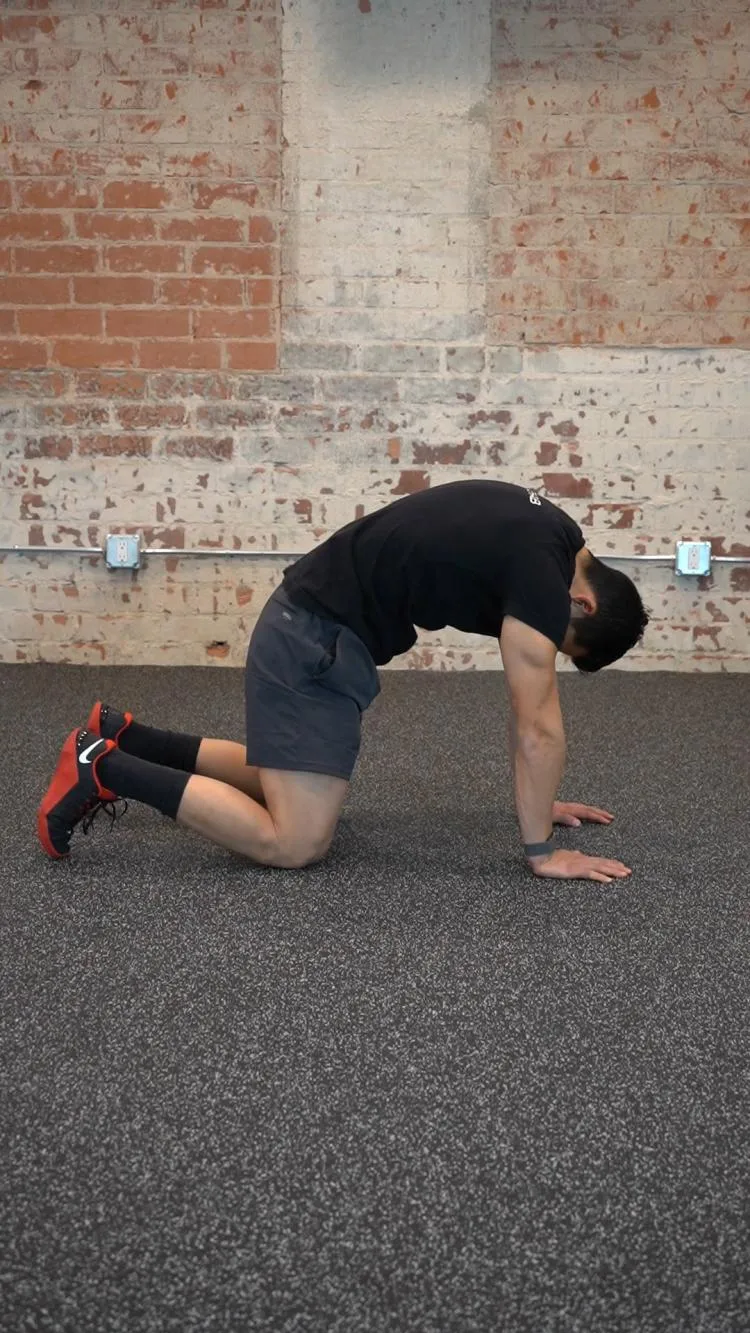
4. Try these exercises! Remember how we talked about the muscles of the hip and the spine play a role in tailbone pain? Cat Cow is an awesome exercise to address mobility in the spine. In a hands and knees position, round your back as you stretch into the “cat position”, then bring your belly button towards the ground and let your spine relax as you assume the “cow position”. Alternate between these two positions 10 times to get your spine moving and grooving.
Exercise 02 of 04
Exercise demonstration
Cat Cow - Full Spine
View exercise instructions
- HOW: Begin in the quadruped position. Your hands on the ground underneath your shoulders and your knees on the ground under your hips. Starting with a flat back, create a hump in your back as much as you can by pretending you have a tail and you’re tucking that tail in between your legs. Continue that hump in your mid and upper back while looking down with your neck. From here, reverse it and pretend like you are sticking your tail out as you arch your low, mid, and upper back while you attempt to look up.
- FEEL: You should feel the muscles in your lower, middle, upper back working/stretching as you push away from the ground creating the hump in your back and arching it.
- COMPENSATION: Keep your elbows straight, don’t bend them as you arch your back. Don’t rock back and forth with your hips.
Additionally, check in with the front of your hips, primarily your hip flexors. Tight hip flexors can pull your hip bones forward into an anterior pelvic tilt, which can put your tailbone into a vulnerable position. To stretch your hip flexors, try a Half Hneeling Hip Flexor Stretch. Take a knee, and place a hand on a wall or nearby object for balance if needed. In this half kneeling position, tuck your tailbone under you and gently shift your weight forward so you feel a stretch in the front of the hip. This exercise will leave you with happy hips and a happy tailbone!
Exercise 03 of 04
Exercise demonstration
Half Kneeling Hip Flexor Stretch

View exercise instructions
- HOW: Get set-up in a half kneeling position, the side you want to stretch should be the side with the knee down. To begin the stretch, perform a posterior pelvic tilt to flatten your lower back, this will help with the hip flexor stretch. To get a greater stretch, shift your weight forward. To get a greater quadriceps stretch, you can actively or passively bend your knee further.
- FEEL: You should feel a stretch in the front of your hip and thigh as well as above your knee.
- COMPENSATION: Do not arch your low back
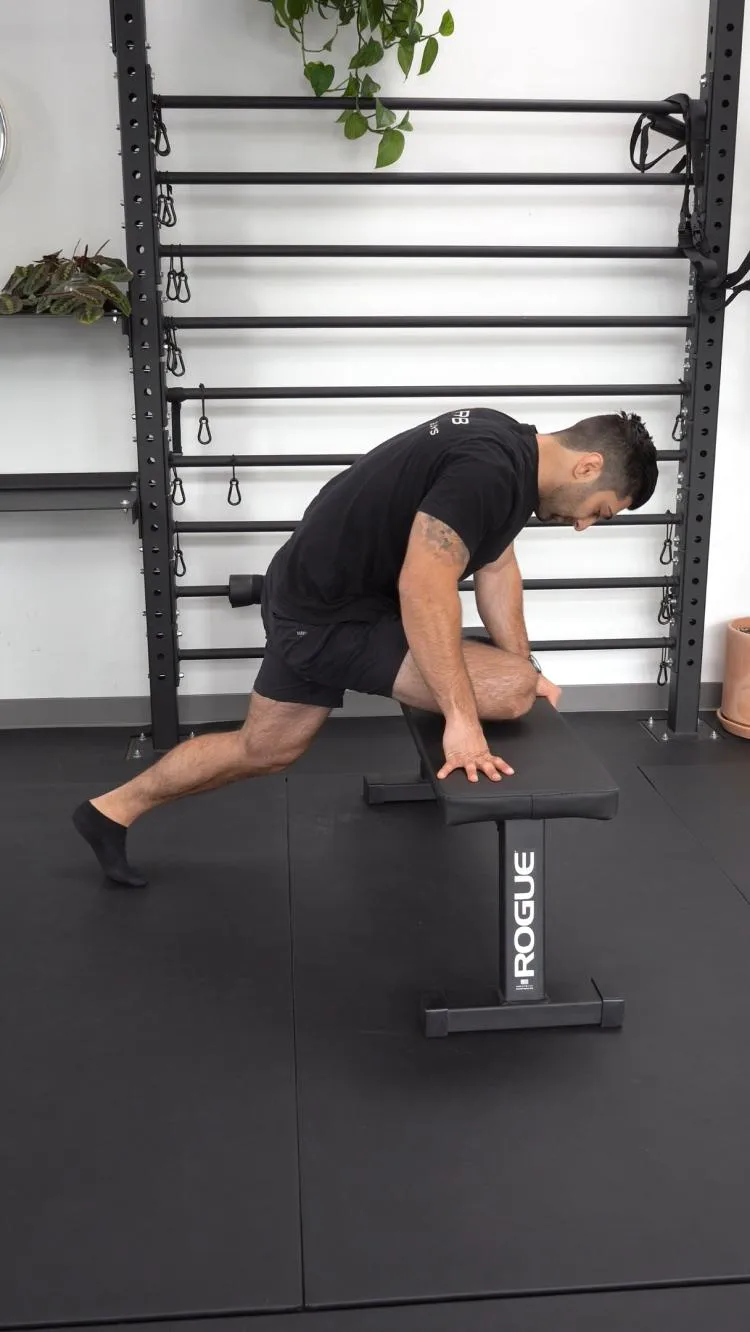
Lastly, stretch out your piriformis muscle. Your piriformis is a hip external rotator that attaches from the sacrum to the femur. This muscle can create a lot of tension in the glutes and hips and keeping it mobile can help with any tension in the sacrum and tailbone. While sitting, bring one leg up so it is in a figure four position. Gently lean your weight forward to find the stretch, this should feel welcoming and not painful! If the seated position is painful on the tailbone, try the piriformis stretch in a Pigeon Pose position either on the ground or standing with support as demonstrated below.
Exercise 04 of 04
Exercise demonstration
Pigeon Pose On Elevated Surface
View exercise instructions
- HOW: Place one leg up and across on an elevated surface. Your shin should be perpendicular to your body. Slowly sink down with your chest until you feel a pull in the back of the hip.
- FEEL: You will feel a deep stretch in the back hip on the elevated leg.
Closing Thoughts
Tailbone discomfort can be a real pain in the butt…literally! It can stem from a traumatic incident such as a fall to a not-so-traumatic incident such as sitting more in your new job. And the fact of the matter is, that for such a small bone, it can create some big problems.
Luckily, there are quite a few remedies for tailbone pain, the biggest being getting the bone moving and reducing any unnecessary pressure! The exercises listed above are a great starting point if trying to manage your tailbone pain, and if associated with pelvic floor muscle tension or childbirth, a pelvic floor physical therapist can get you on the right path.
Tailbone pain doesn’t have to ruin your December running plans. Let’s say goodbye to Jack Frost nipping at your nose and your tailbone, and get back to pain-free running, sitting, walking, driving, and, well you get it….living.
LEARN MORE ABOUT OUR LOW BACK REHAB PROGRAM

References
- Lirette LS, Chaiban G, Tolba R, Eissa H. Coccydynia: an overview of the anatomy, etiology, and treatment of coccyx pain. Ochsner J. 2014 Spring;14(1):84-7. PMID: 24688338; PMCID: PMC3963058.
- Neville CE, Carrubba AR, Li Z, Ma Y, Chen AH. Association of coccygodynia with pelvic floor symptoms in women with pelvic pain. PM R. 2022 Nov;14(11):1351-1359. doi: 10.1002/pmrj.12706. Epub 2021 Oct 22. PMID: 34533893.
- Márquez-Carrasco ÁM, García-García E, Aragúndez-Marcos MP. Coccyx pain in women after childbirth. Enferm Clin (Engl Ed). 2019 Jul-Aug;29(4):245-247. English, Spanish. doi: 10.1016/j.enfcli.2019.01.005. Epub 2019 Mar 9. PMID: 30862389.
About The Author
Lyndsay Centrowitz, PT, DPT
Prehab Writer & Content Creator

Dr. Lyndsay Centrowitz graduated from Colorado State University with a BS in Health and Exercise Science and a concentration in Sports Medicine. After multiple personal sports-related injuries and discovering a passion for healing through movement, Lyndsay attended Creighton University to receive her Doctorate of Physical Therapy. An avid runner herself, she has a particular interest in working with high school, recreational, and elite endurance athletes and has undergone specialty training in pelvic floor rehabilitation, postpartum care, and management of the female athlete to better serve her clientele. Through this specialty training, she has acquired a Certificate of Achievement in Pelvic Health Physical Therapy through the American Physical Therapy Association. Lyndsay now owns her own practice StrongHER in Park City, UT where she specializes in female athletics and care of pregnant and postpartum individuals. Additionally, Lyndsay is BSPTS C2 certified in scoliosis specific exercises and has found a niche working with adolescents with scoliosis to improve overall spinal health. No, you’re not seeing double! Lyndsay is an identical twin to Lauren Lynass, one of our Prehab rockstars. A native of Colorado, Lyndsay is an adventure seeker who loves to hike, camp, and race her twin sister on the mountain trails. When she isn't exploring Park City's outdoor playground, you can find her curled up with a cup of tea and a good book. Follow along @strongher_dpt on Instagram!