


On this page 8 sections
Your guide
What you'll learn
The quadriceps are one of the most powerful muscle groups in the entire body. They are made up of 4 different muscles which come together to form the quadriceps tendon, which in turn encompasses the kneecap and becomes the patella tendon which inserts on the shin or tibia. This creates a powerful pulley system that allows you to extend or straighten your knee. This pulley system is critical to allow you to run, jump, kick, go up and down stairs, and even walk normally. For this reason, quadriceps strains are common in sports such as soccer and basketball but can affect anybody. In this article, we will break down quad strain rehab and exercises!
Quadriceps Anatomy & Mechanics
The four muscles of the quadriceps include the vastus lateralis on the outside of the thigh, the vastus medialis on the inside of the thigh, the vastus intermedius in the middle of the thigh, and the rectus femoris on top of that, also in the middle of the thigh. The longest of these muscles is the rectus femoris which not only extends the knee, as all of the quad muscles do but also serves to flex the hip. Due to this fact, the rectus femoris is the most common culprit when a quad strain occurs. Injuries to the rectus femoris often occur during activities like sprinting or kicking.
While research bears this out, logic does as well if you think of the mechanics of sprinting. Sprinting includes repetitively moving from a position of hip extension and knee flexion, placing the rectus femoris on stretch, to a position of hip flexion and knee extension, a position achieved by the explosive activation of the rectus femoris from the latter position. Similarly, kicking a ball is simply a more exaggerated and less repetitive version of this. For this reason, these injuries are particularly common in soccer.
Not all Quadriceps injuries are the same
Like most injuries, quadriceps strains can be classified in many different ways. Two of the most important categories include the location of the injury and the severity of the injury. The location of the injury is described in 3 different categories which are simply the division of the muscle into thirds and include:
- The proximal third of the quadriceps (closer to the hip)
- The middle third of the quadriceps
- The distal third of the quadriceps (closer to the knee)
While the quadriceps muscles blend with your quadriceps and patella tendons, it is important to differentiate a strain of the muscle belly from a tendon issue or tendinopathy as the rehabilitation, treatment, and tissue healing timelines can differ considerably. This article focuses on strains of the muscle belly.

Strains of The Muscle Belly
Strains of the muscle belly can really be described as partial tears of the muscle fibers. This can often be shocking to most people as the phrase partial tear sounds more severe than strain. The Munich consensus statement recommended replacing the term strain with the term tear for structural injuries of this nature. They also recommended grading them on a scale from minor & moderate partial tears which are classified as anything less than 50% of the muscle diameter to subtotal and total muscle tears. In spite of this MRIs have been shown to provide little value in predicting recovery from muscle strains when compared to clinical examination. Thus when it comes to predicting a return to play timelines and directing rehab, the severity of symptoms and level of function often are the primary factors.
Don't Let Your Quad Strain Hold You Back!

The quad muscle gives crucial stability to the knee joint. If you are looking for direction on how to get back to 100 percent after a quad strain, this is the program for you! Click HERE to get started.
Rehabbing a Quadriceps Strain
No matter the severity of the quadriceps strain: rehab can start right away. In fact, even in those with severe muscle injuries, starting rehab 2 days after injury in comparison to 9 days allowed athletes to return to their sport 3 weeks earlier, without increasing their risk of reinjury. And rehab doesn’t mean ice, elevation, and massage. It means starting to re-activate and re-train that muscle to begin firing again. Watch this video below to learn more about what to do immediately after an injury.
Don't Just Ice After Injury
Furthermore, contrary to years of conventional wisdom. Rehab does not need to be pain-free! In fact, one study found that when comparing pain-free rehab to rehab that allows the pain of 4/10 or less, those in the pain-threshold group had no negative effects. Furthermore, they had 15% greater strength both at the time of return to play and when re-assessed 2 months later. This likely both improved their performance and decreased their risk of re-injury.
So what does Quad Strain Rehab look like?
Thus, the goals in rehabbing a quad strain are simple: start loading that quadriceps any way that you can tolerate with pain less than 4/10, as quickly as possible. Because of the structure and function of the quadriceps muscles, this will incorporate primarily knee extension exercises, as well as hip flexion exercises. This should start with simple isolated isometric exercises:
Exercise 01 of 06
Exercise demonstration
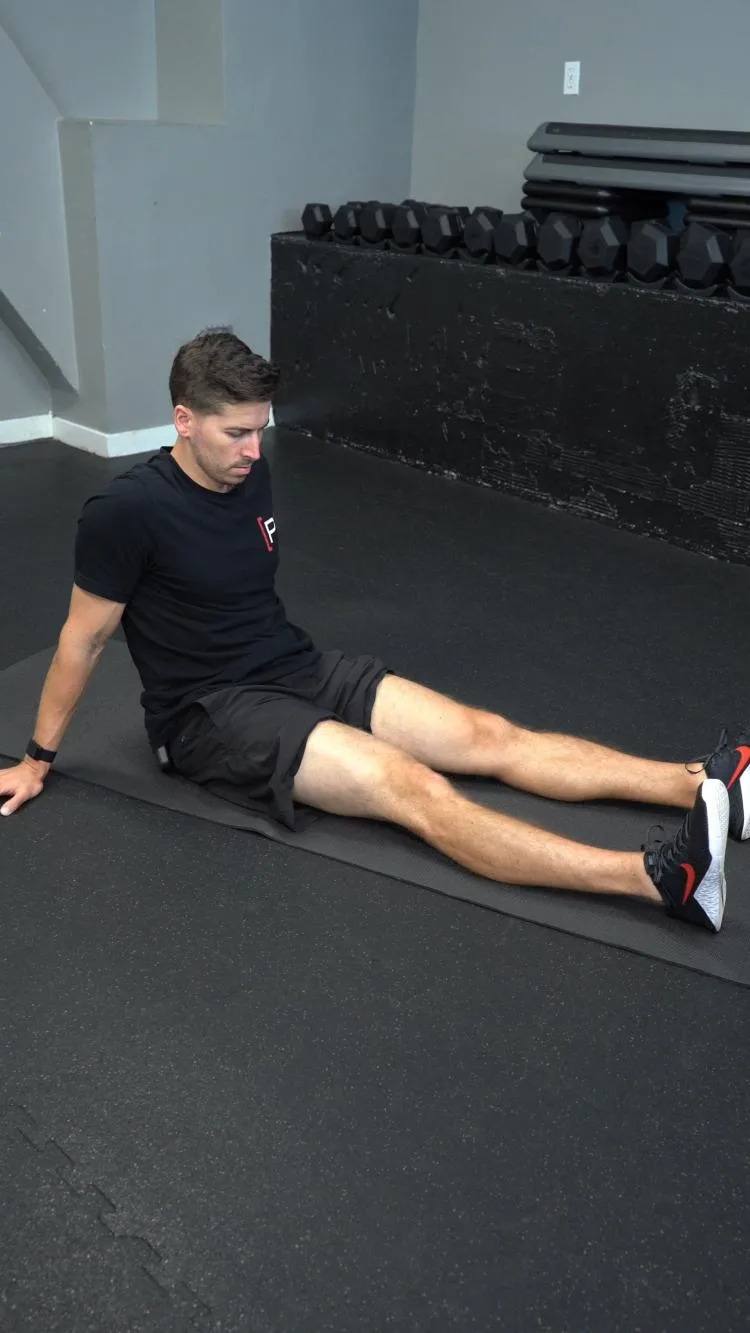
Quad Set
View exercise instructions
- HOW: Follow this foolproof guide to wake your quad back up! Laying on the ground or on a table with your knee straight and foot supported, attempt to push your knee down and lift your heel off the ground by squeezing your quadriceps muscle until your knee is fully straight. return to starting position and repeat.
- FEEL: Really focus on squeezing your quad. Sometimes touching the muscle, massaging it, or hitting it can help. Think about moving your kneecap up and towards your hip socket. Push your knee down into the ground. Move your shin bone in the shape of a “J” by moving your knee down and your heel up at the same time. Squeeze both quadriceps at the same time to improve the quality of the quad contraction.
- COMPENSATION: Do not lift your entire leg off the ground, focus on getting your knee fully straight similar to the other side.
Exercise 02 of 06
Exercise demonstration
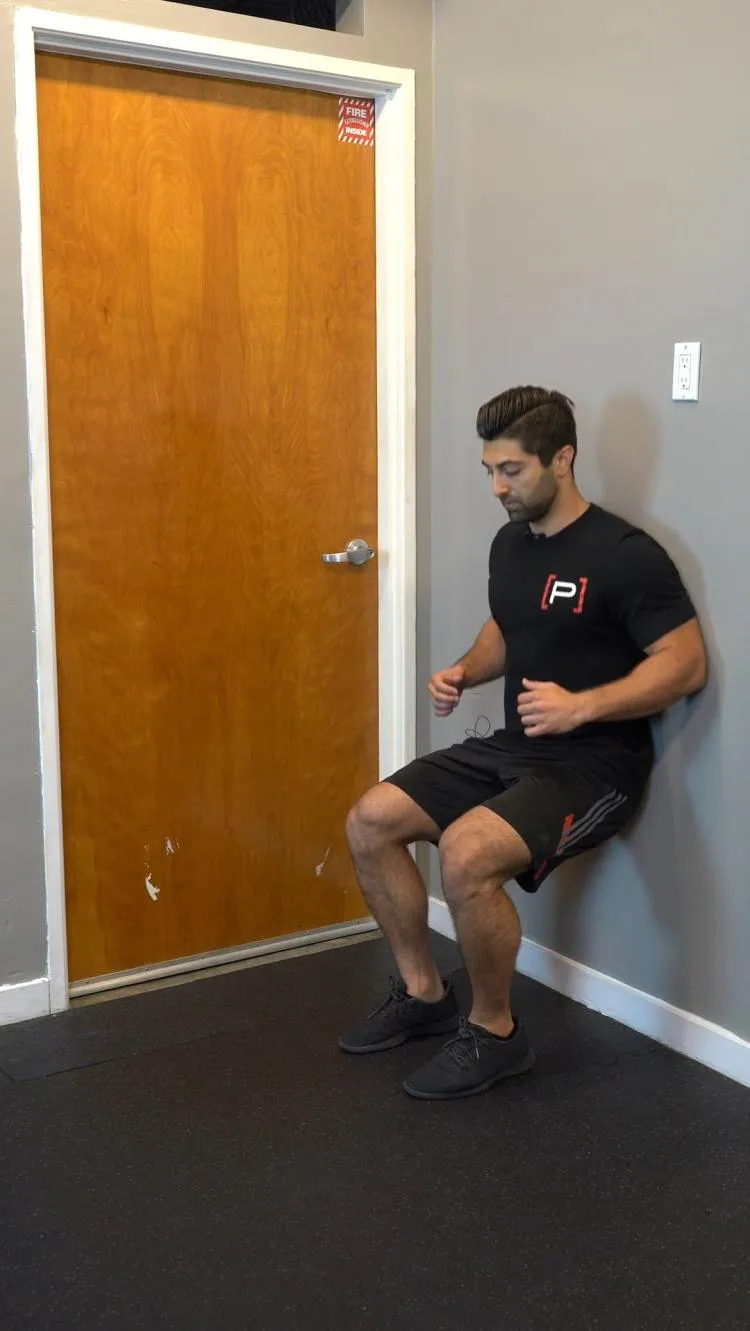
Wall Squat
View exercise instructions
- HOW: Begin in a standing position with your feet about hip-width apart, no more than a foot away from the wall, and your back supported on the wall. Next focus on lowering yourself down as far as you feel comfortable, then pull yourself up by using your thigh muscles. Make sure to keep your back on the wall for the entirety of this exercise. The further you bring your feet away from the wall, the more challenging this exercise will be.
- FEEL: You will the muscles in the front of your thigh working with this exercise.
- COMPENSATION: Avoiding rounding at the back as you lower yourself on the wall. Maintain a straight back as you lower yourself.
Once the initial loading has been mastered, it is time to progress toward heavier loading isolated exercises:
Exercise 03 of 06

Exercise demonstration
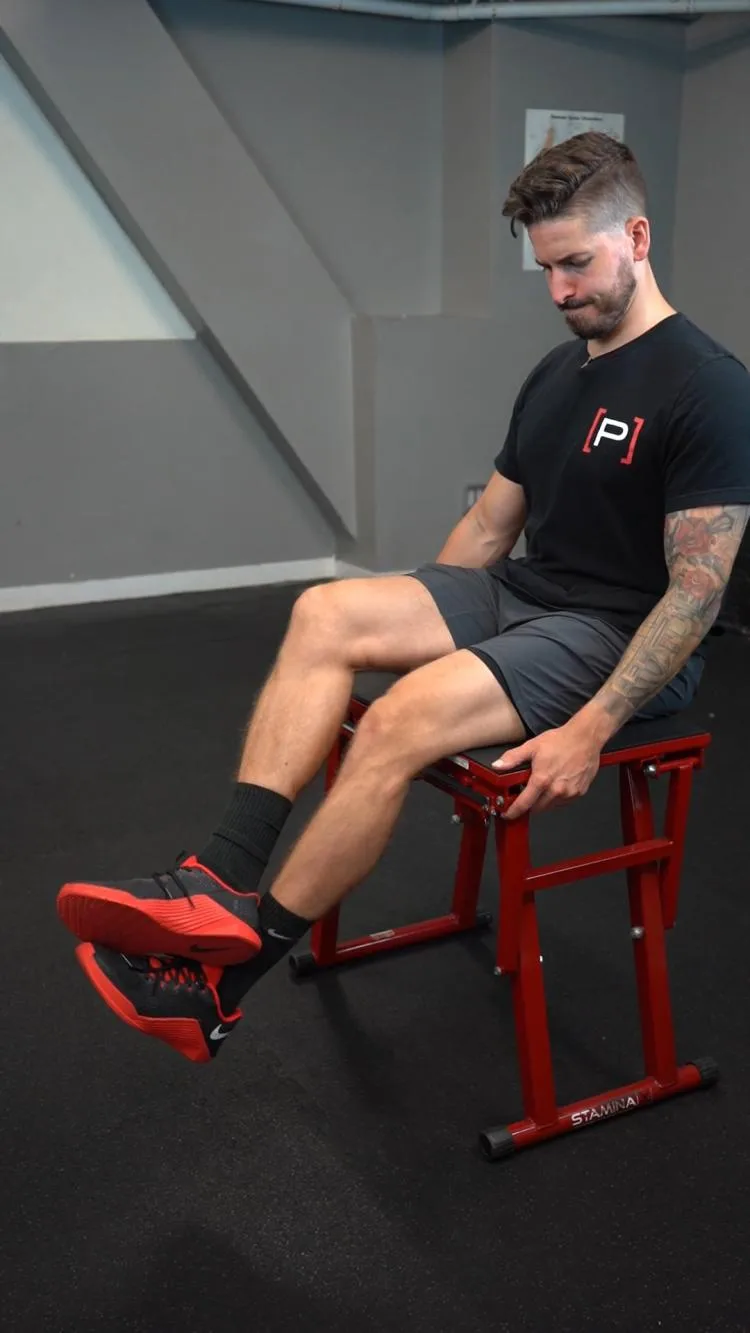
Eccentric Long Arc Quad
View exercise instructions
- HOW: Begin in an upright seated position with some clearance between your feet and floor. Kick one leg up all the way straight contracting your thigh muscles. Bring the other foot over the top of the straightened leg. The top leg should push down against the other leg creating resistance as you slowly lower the leg down to the starting position.
- FEEL: You should feel your thigh muscles working.
- COMPENSATION: Don’t lower the leg too fast.
Exercise 04 of 06
Exercise demonstration
Anterior Step Down - Wedge

View exercise instructions
- HOW: Place a wedge underneath your heel. Reach forward with the elevated leg as far as you can, tap the floor and return back to starting position.
- FEEL: You will feel the muscles in your legs working, particularly the muscles on the front of your thigh.
- COMPENSATION: Make sure the leg on the wedge is straight. The hip, knee, and ankle should be aligned.
Before incorporating heavier compound exercises:
Exercise 05 of 06
Exercise demonstration
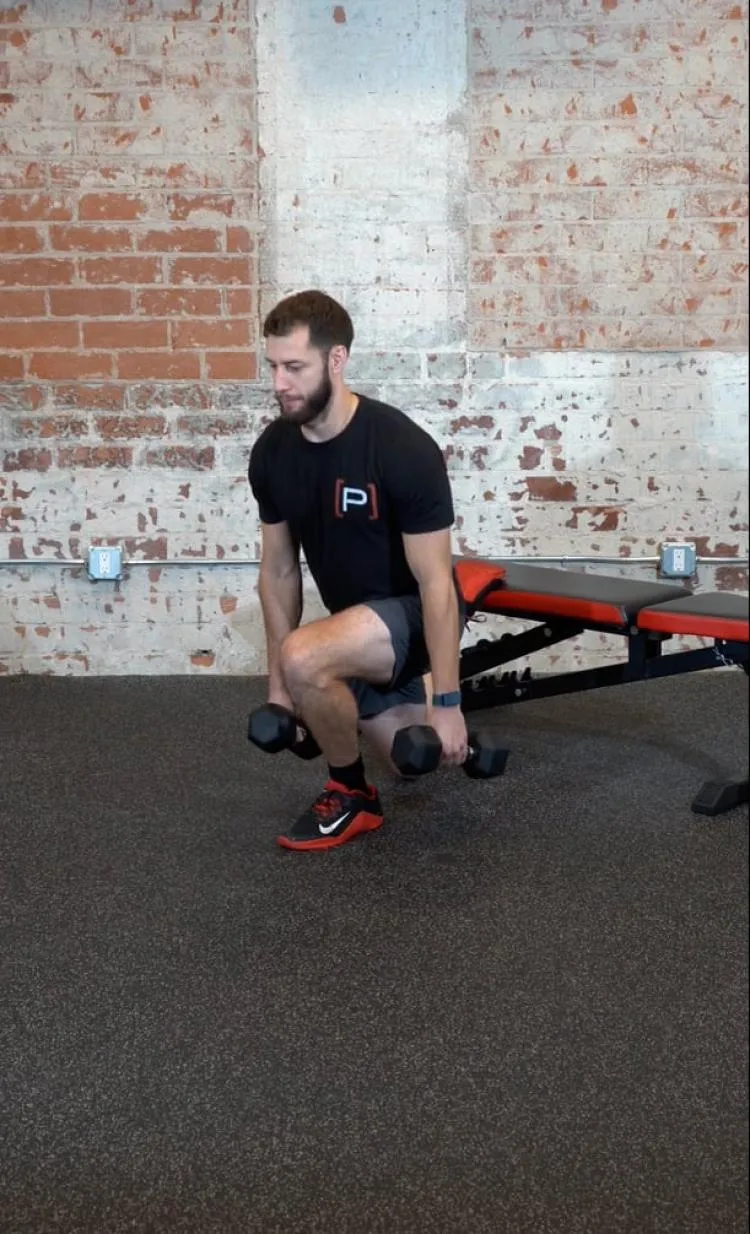
Bulgarian Split Squat- Dumbbell
View exercise instructions
Exercise 06 of 06
Exercise demonstration
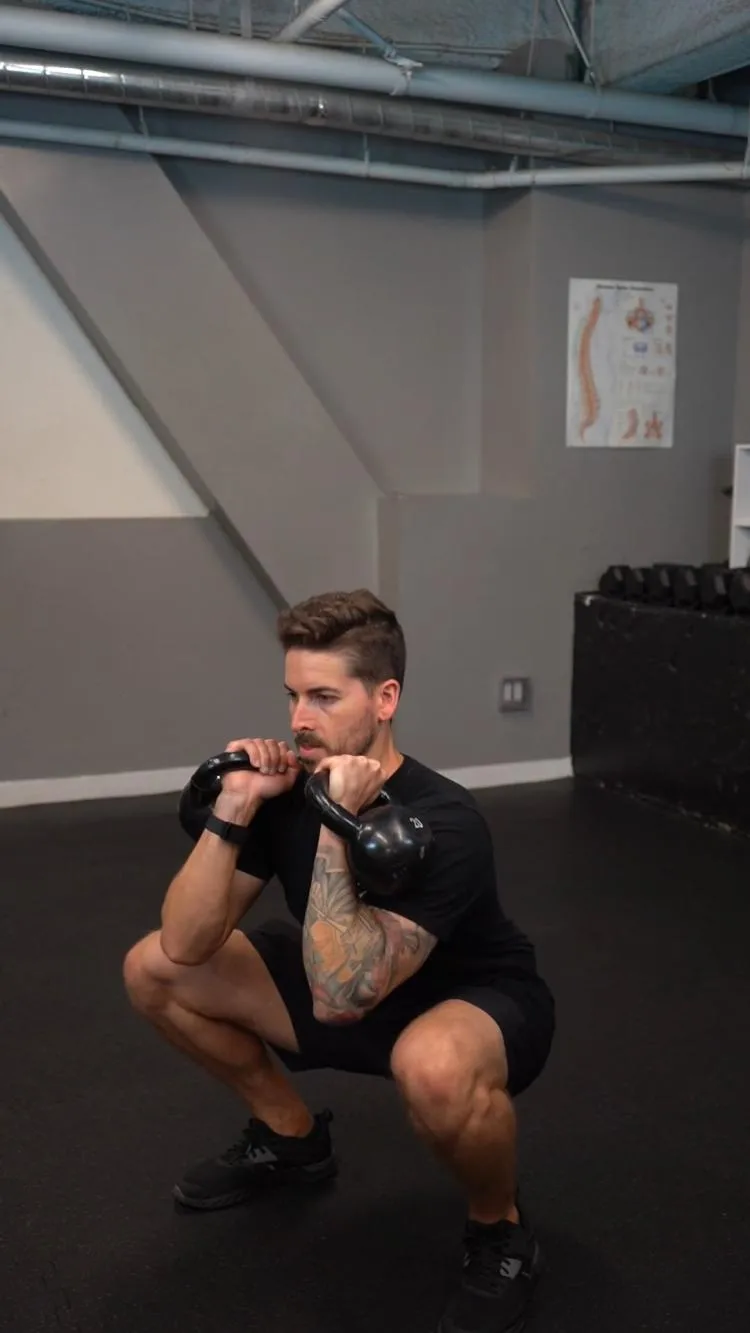
Front Squat - Kettlebell
View exercise instructions
- HOW: Start by holding a kettlebell in each hand in front of your shoulder with your knuckles facing up and your elbows under your wrist. Keep the elbows at your side and squeeze your shoulder blades back. While maintaining this position, bend your knees and hinge forward at the hips while keeping your chest up. Go as low as you feel comfortable with and keep your feet flat on the ground. At the low point, push into the ground with your feet and return to the starting position.
- FEEL: You should feel the muscles in your lower body working and shoulder.
- COMPENSATION: Keep your back upright and chest up. Keep your elbows in at your side as you squat.
Closing Thoughts
The quadriceps muscles are some of the most explosive and powerful muscles in all of the body. They play an integral role in everyday activities as well as sport-specific activities like running, jumping, and kicking. For this reason, they can often be susceptible to strains which are also known as partial tears. Rehabilitation of quadriceps strains should start as soon as possible and involve a gradual progression of the loads placed through the muscle, taking care not to avoid pain completely, but to keep pain at a level of 4/10 or less.
Don't Let Your Quad Strain Hold You Back!
The knees are true hard-nosed blue-collar workers! They get the job done when the hips and ankles may be taking some extra rest breaks. In this program, you will learn how to restore mobility, learn to get your powerful quadriceps cooperating with you, along with starting the journey to addressing the hip and ankle. In this program, you will learn how to restore mobility, learn to get your powerful quadriceps cooperating with you, along with starting the journey to addressing the hip and ankle.
Recommended Reads: If You Liked This Article, You May Also Like
References
- Mendiguchia J, Alentorn-Geli E, Idoate F, Myer GD. Rectus femoris muscle injuries in football: a clinically relevant review of mechanisms of injury, risk factors and preventive strategies. Br J Sports Med. 2013;47(6):359-366. doi:10.1136/bjsports-2012-091250
- Valle X, Alentorn-Geli E, Tol JL, et al. Muscle Injuries in Sports: A New Evidence-Informed and Expert Consensus-Based Classification with Clinical Application. Sports Med. 2017;47(7):1241-1253. doi:10.1007/s40279-016-0647-1
- Mueller-Wohlfahrt HW, Haensel L, Mithoefer K, et al. Terminology and classification of muscle injuries in sport: the Munich consensus statement. Br J Sports Med. 2013;47(6):342-350. doi:10.1136/bjsports-2012-091448
- Jacobsen P, Witvrouw E, Muxart P, Tol JL, Whiteley R. A combination of initial and follow-up physiotherapist examination predicts physician-determined time to return to play after hamstring injury, with no added value of MRI. Br J Sports Med. 2016;50(7):431-439. doi:10.1136/bjsports-2015-095073
- Bayer ML, Magnusson SP, Kjaer M; Tendon Research Group Bispebjerg. Early versus Delayed Rehabilitation after Acute Muscle Injury. N Engl J Med. 2017;377(13):1300-1301. doi:10.1056/NEJMc1708134
- Hickey JT, Timmins RG, Maniar N, et al. Pain-Free Versus Pain-Threshold Rehabilitation Following Acute Hamstring Strain Injury: A Randomized Controlled Trial [published online ahead of print, 2019 Jun 28]. J Orthop Sports Phys Ther. 2019;1-35. doi:10.2519/jospt.2019.8895
About The Author
Tommy Mandala, PT, DPT, OCS, SCS, CSCS
Prehab Writer & Content Creator

Tommy Mandala is a Doctor of Physical Therapy, Board Certified Clinical Specialist in Sports & Orthopedics, and Certified Strength and Conditioning Specialist in New York City. He is the founder of ALL IN ACL, a digital coaching platform dedicated exclusively to helping ACLers return to the life they had before their injury with full confidence in their knee. Prior to that, he worked in the sports clinic at Hospital for Special Surgery, the #1 Orthopedic Hospital in the country. While there, he had the opportunity to hone his skills as an ACL specialist working closely with world renowned surgeons and evaluating patients from all over the world. He completed his sports residency training at the University of Delaware where he had opportunities to work with many of their Division I sports teams as well as the Philadelphia 76’ers NBA G-league affiliate, the Delaware Blue Coats. He also trained at Champion Sports Medicine in Birmingham, Alabama where he had the opportunity to learn from researchers in the American Sports Medicine Institute. Currently, Tommy works exclusively with ACLers through his digital coaching model. While many of these clients are athletes, Tommy works with ACLers of all different abilities helping them to build the strength they need to overcome this unique injury. One of his favorite aspects of his job is taking active clients who have never been a “gym person” before and showing them the amazing things that happen when they learn to strength train.