

On this page 6 sections
Your guide
What you'll learn
The ability to squat deep is one of the clearest indicators of full-body mobility, strength, and movement quality. Whether you're an athlete trying to maximize performance, someone aiming to improve strength and longevity, or just looking to move with more ease, developing a deep squat is a worthwhile pursuit. The deep squat isn’t just a test of willpower or a “go lower” cue from your coach. It reflects how well your ankles, hips, knees, and spine are working together. And if one of those areas is limited, you'll notice it pretty quickly when trying to get low. In this post, we'll break down the key steps to developing your deep squat safely and effectively. We’ll cover why mobility matters, which muscle groups are involved, what mobility drills can unlock your range, and the must-do exercises to squat deep.
Why Squatting Deep Is So Important
Squatting deep isn’t just for people trying to lift heavy in the gym. It plays a role in everyday movement, injury prevention, and long-term joint health. A deep squat helps strengthen the lower body through a full range of motion, improves posture, and reinforces movement patterns that we often lose when we stop practicing them.
Training deep squats builds strength in the glutes, quads, hamstrings, and adductors. It also challenges your core and upper back to stay upright and stable. But to do all this well, your joints need to move well. This brings us to the first piece of the puzzle: mobility.
Why Mobility Matters for a Deep Squat
If you don’t have the range of motion to get into a deep squat without compensating, you’ll either tip forward, lose balance, or stress areas like your lower back or knees. For most people, these are the three most common mobility restrictions:
Exercise 01 of 06
Without good dorsiflexion (the ability for your ankle to bend forward), your heels might lift off the ground or your knees may not track over your toes. This forces you into a less stable position. Tibial mobility is also important here as it plays a role in our ankle mobility and ankle dorsiflexion.
Try this:
Exercise demonstration
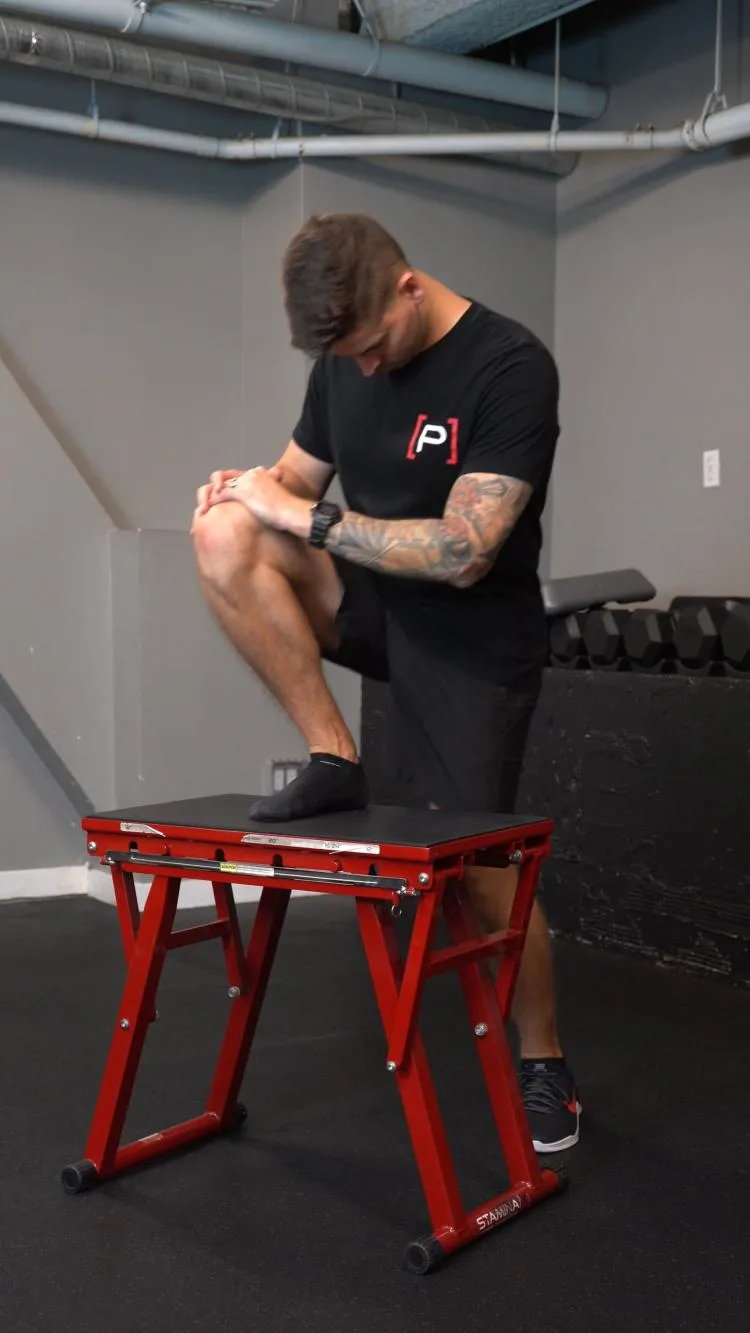
Ankle Dorsiflexion Mobilization - Dynamic, Box
View exercise instructions
- HOW: Get your foot set-up and supported on an elevated surface while balancing on the other leg. To perform the mobilization, bring your knee and shin bone forward over your toes while keeping your heel down on the ground. Follow along with the video to learn how to change the angle and direction based on what you need to improve with your ankle mobility.
- FEEL: You should feel a stretch in your calf and your ankle, you shouldn't feel a pinching pain in the front of your ankle, if you do back off and don't put as much pressure or weight through your foot.
- COMPENSATION: Keep your entire heel flat on the ground as best as you can
Aim for 2-3 sets of 8-10 reps, holding for a count of 5-10 seconds.
Exercise 02 of 06
Your hips play a huge role in how deep you can squat and how easily you can control that position. Limited hip rotation or tight hip flexors can stop you from reaching depth.
Try this:
Exercise demonstration
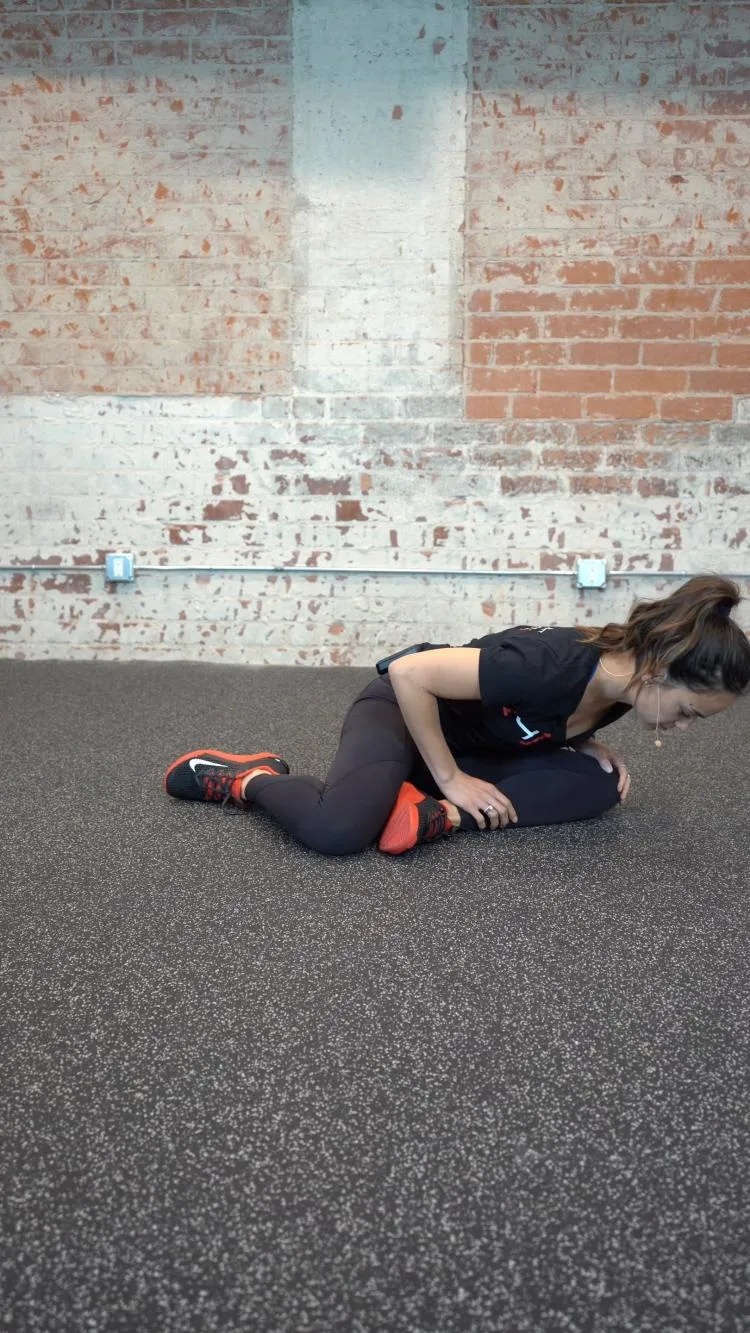
90/90 Hip Switch Stretch
View exercise instructions
- HOW: Begin in a seated position with both knees bent on the ground. One knee should be lying on its outside, and the other should be lying on its inside. Sit up tall, hinge forward at the hips and lean towards the knee lying on its outer edge and hold that stretch for about five seconds. Then, rotate to the other side while keeping your heels on the ground and rotate your legs in the other direction again hinging forward at the hip towards the knee laying on it’s outer edge.. Perform that stretch on each side for the prescribed amount of reps.
- FEEL: You should feel a stretch in each hip as you lean forward.
- COMPENSATION: Keep your back straight, don’t hunch forwards as you lean into each stretch.
Aim for 8-12 reps each, holding for a count of 2-5 seconds.
Exercise 03 of 06
If your upper back is stiff and you lack thoracic extension, your chest will collapse forward as you lower into the squat, throwing off your balance and form and preventing you from squatting deeper without toppling over. Shoulder mobility and thoracic mobility are key here, get started with the exercise below.
Try this:
Exercise demonstration
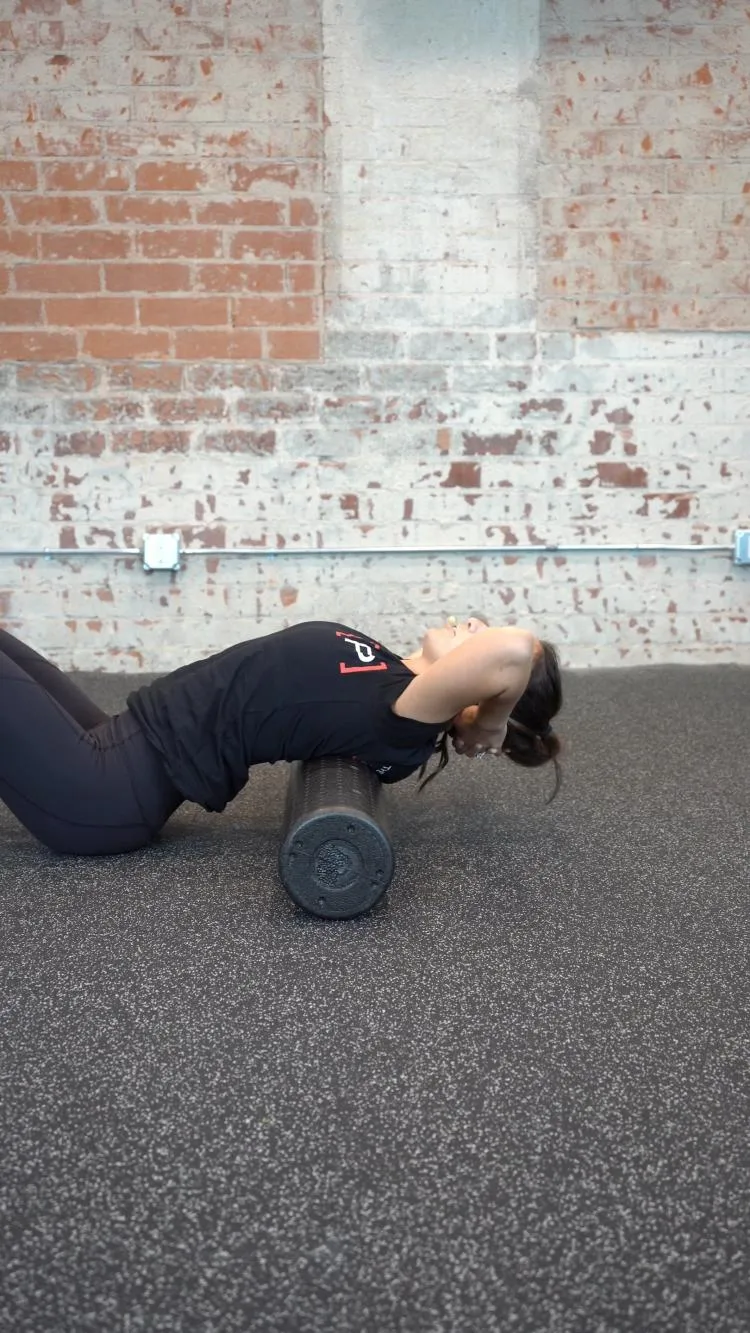
Thoracic Spine Extension Mobilization - Foam Roller
View exercise instructions
- HOW: Start in a sitting position with your knees bent, feet flat on the ground and a foam roller lying on the ground behind you at about shoulder level. You can either interlock your hands behind your neck or cross your arms across your chest. Keep your hips on the ground as you lean gently back into the roller bringing your shoulders, head, and neck down over the roller. Carefully work up and down the length of your mid back by lifting your hips up, rolling back, and extending over the foam roll.
- FEEL: You should feel some pressure and stretch in the middle portion of your spine.
- COMPENSATION: Don’t go too fast, go slow and controlled over the foam roller.
Aim for 45-60 seconds of working up and down the length of your back.
Improving mobility in these areas can dramatically change your squat, especially if you’ve been stuck at shallow depth for a long time.

Foundational Strength Exercises to Squat Deep
Once mobility is addressed, it’s time to start building strength and control through your new range of motion. Here are some of the must-do exercises to squat deep:
Exercise 04 of 06
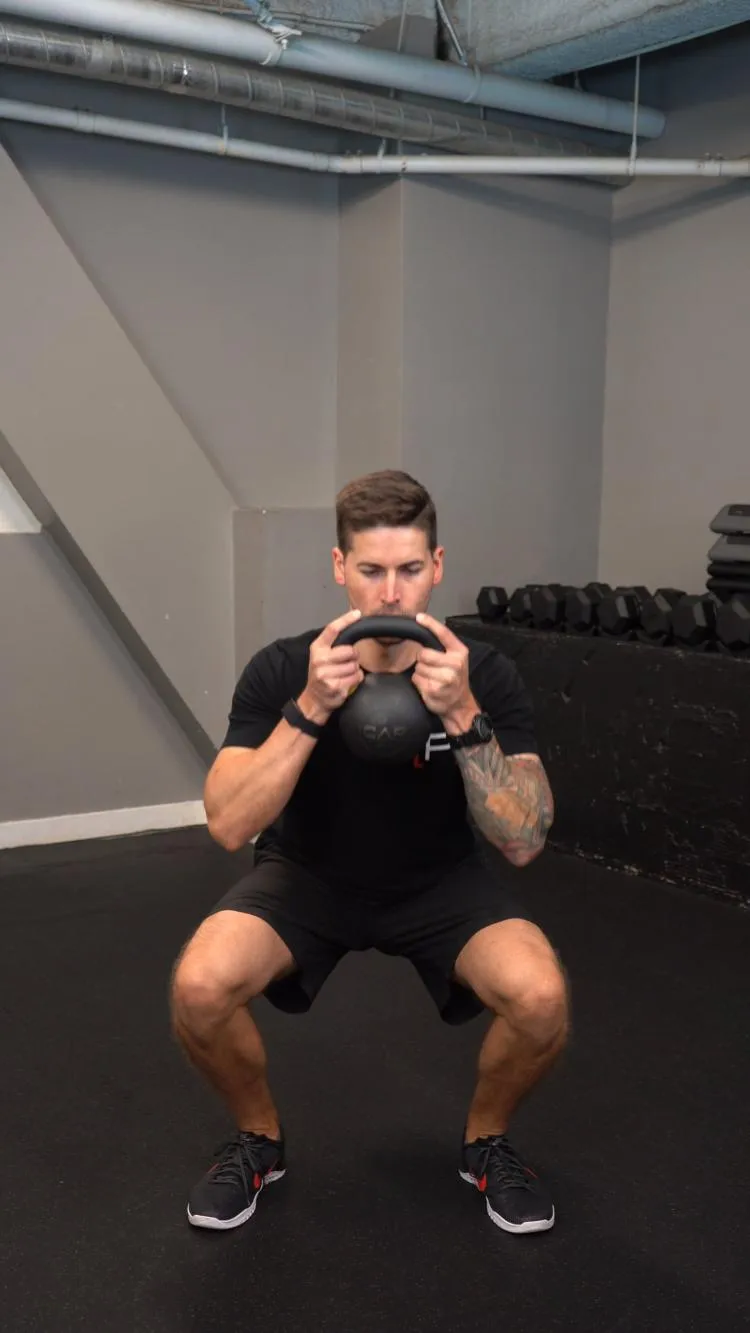
Goblet squats are an excellent starting point because they load the squat pattern without requiring a barbell. Holding the weight in front of your body helps maintain better posture and engage your core.
Exercise demonstration
Goblet Squat - Kettlebell
View exercise instructions
- HOW: Hold a kettlebell by the bell or the handles and keep it close to your chest as best as you can. Keep your shoulders lined up over your knees and ankles. Perform a squat while maintaining good form throughout your upper and lower body.
- FEEL: This should primarily be a leg workout as well as an upper-body workout as the KB gets heavier.
- COMPENSATION: Do not bend or arch your back excessively, do not lose form.
Start with 3–4 sets of 8–10 reps.
Want to feel confident with your squatting? Get started with our Fitness Fundamentals program

If your mobility is limited due to your ankles, midback or hips, this is the perfect program to get started with addressing all of those in an effort to feel confident with your new workout routine! The experts do the fundamentals well, become an expert today!
Exercise 05 of 06
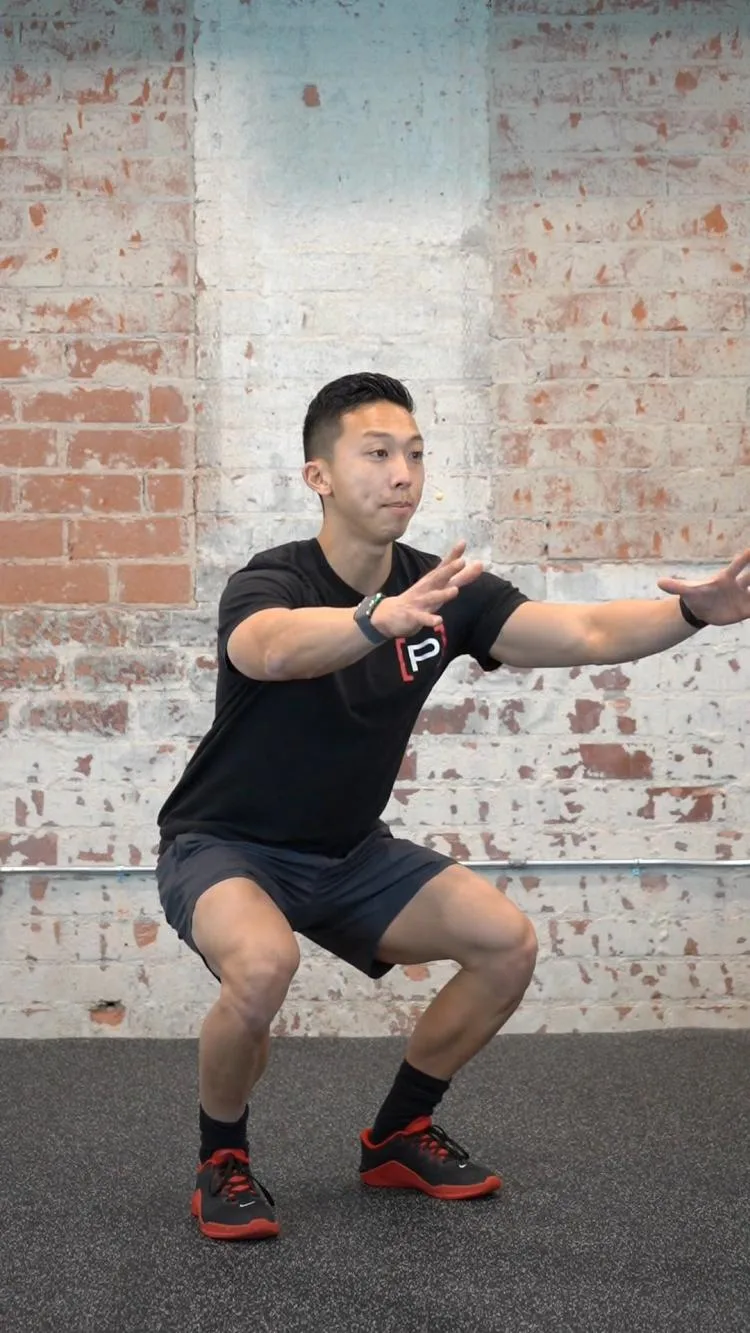
Slowing down the descent and pausing at the bottom builds strength, awareness, and positional control in these more challenging deep positions.
Tempo Squat
Exercise demonstration
Tempo Squat
View exercise instructions
- HOW: Begin in a standing position. In this example, the tempo relates to the time it takes to lower into a squat, hold the squat, come back up, and the time in between reps. 5-3-1-0 is used for this squat. Five seconds to bend your knees, hinge slightly forward at the waist, and lower into a squat. Three seconds to hold that squat at the bottom for an isometric contraction. One second to return to the starting position, and zero seconds in between reps. Perform this type of squat for the tempo that is prescribed to you.
- FEEL: You should feel your lower body muscles working during the squat.
- COMPENSATION: Don’t cheat yourself on the times prescribed.
Aim for 3–4 sets of 8 controlled reps.
Exercise 06 of 06
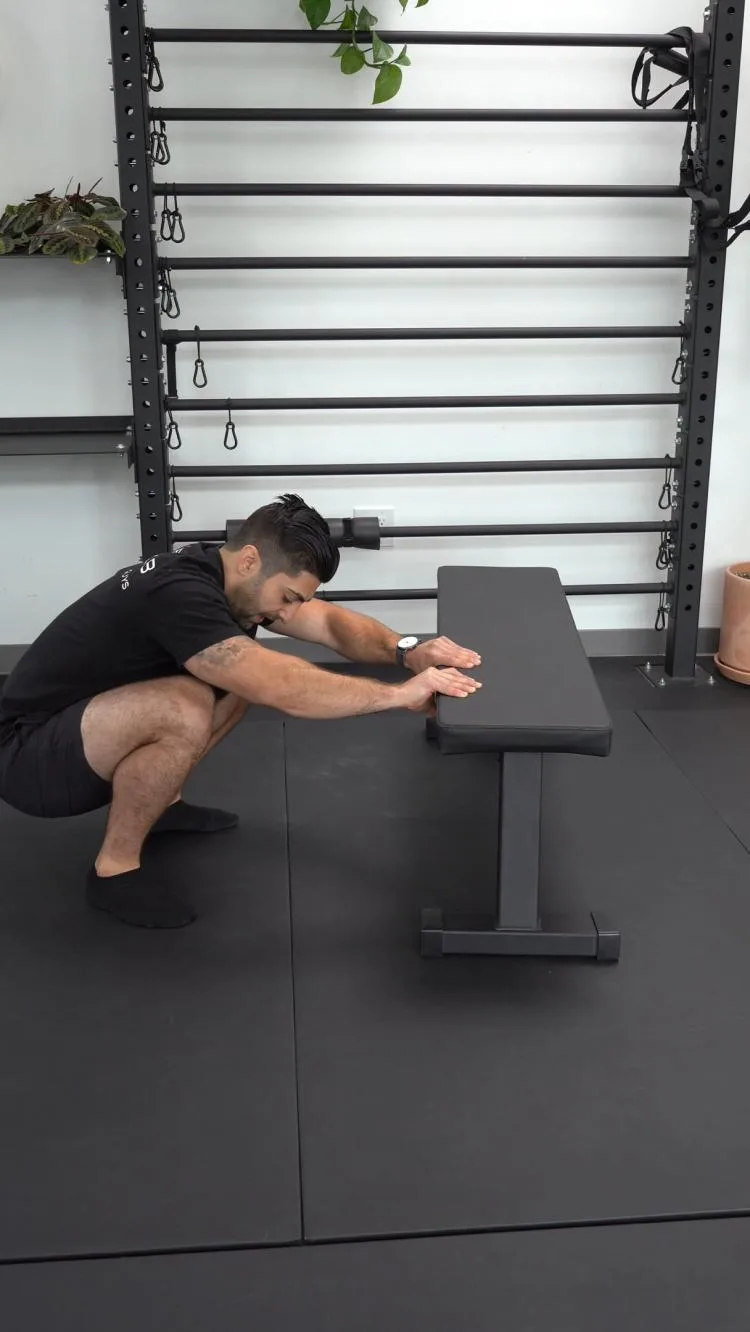
Spending time in the bottom of a squat helps your body adapt to the position. Using assistance allows you to feel stable and gradually improve your depth.
Deep Squat Weight Shift
Exercise demonstration
Deep Squat Weight Shift
View exercise instructions
- HOW: While in a deep squat position hold onto a stable surface. Slowly lean towards one side while driving your body and your knee forward. Repeat on the other side.
- FEEL: The more you drive your body forward the more you will bias a hip stretch. The further you bring your knees/shins forward, the more you will bias an ankle stretch.
- COMPENSATION: Keep your heels on the ground as you shift your weight to each side.
Hold for 30–60 seconds. Repeat 2–3 times as part of your warm-up or cool-down.
Progressing to Loaded Deep Squats
When mobility is solid and your body is strong in the bottom position, it’s time to start adding load. But don’t rush this step. Progression should always come with control.
Start with goblet or front squats, then build toward barbell back squats as your movement allows. If your form breaks down with load, scale it back and revisit the progressions.
READ: DIFFERENT TYPES OF SQUATS AND WHY TO DO EACH

Use depth markers like the safeties in a squat rack or box squats to guide you as you build confidence. Your goal isn’t to chase the deepest possible position, but to squat as deep as your body allows with good technique.
Deep Is Relative
This is one of the most important points I can make. Not everyone is built to squat to the same depth. And that’s okay.
Several factors influence how deep you can or should squat, including:
- Your individual hip structure and anatomy
- Any previous injuries or joint restrictions
- Rotational or pelvic asymmetries
For some, a parallel squat might be a safe, effective endpoint. For others, squatting well below parallel with great form is possible. What matters most is control, comfort, and safety. Don’t compare your depth to someone else’s. Instead, focus on improving your own capacity with the tools that make sense for you. It's not about how deep you can squat; instead, squat to a depth that is right for you.

Closing Thoughts
Squatting deep is not about brute force or pushing through pain. It’s about gradually earning access to new positions through mobility work, strength progressions, and a realistic understanding of your body.
Start by identifying your mobility needs. Then, practice the must-do exercises to squat deep that reinforce those improvements. Take your time, be consistent, and remember that progress often happens slowly but steadily!
Get started with our Fitness Fundamentals program
About The Author
Ryan Nosak, MS, CSCS
Prehab Writer & Content Creator
 Ryan was born and raised in Throop, Pennsylvania and he has worked in the world of fitness since he was 15 years old. Ryan realized he had a deep affinity for strength training and how it can alter the human mind, body, and spirit. He began his coaching career in high school by coaching his friends through strength training sessions, which inspired him to pursue a career in strength and conditioning.
Ryan spent 10 years as a Division 1 strength and conditioning coach with stops along the way at Penn State, Tennessee State, Vanderbilt, Robert Morris, Charlotte, and DePaul. He is a Certified Strength and Conditioning Specialist and operates RyNo Strength in Chicago, IL working as a personal trainer and online fitness coach. He specializes in fat loss, body composition, strength, and sports performance training programs.
Ryan received his Bachelor’s Degree in Kinesiology from Penn State and a Master’s in Sport Management from Western Carolina University. In his free time, Ryan enjoys training for bodybuilding, eating at amazing restaurants in Chicago, and spending time with his wife, daughters, and dog.