


On this page 4 sections
Your guide
What you'll learn
The pallof press is a staple core and back strengthening exercise that you'll find in many different settings. Whether it's Prehab, personal training sessions, group exercise classes, you name it, the pallof press is a common exercise for good reason. In this article, you will learn the value and reasoning behind the pallof press as well as different pallof press exercises.
What Is The Pallof Press?
The pallof press is an anti-rotation exercise designed to work the muscles that influence trunk rotation. Specifically, the pallof press works local and global muscles in an effort to limit any rotation of the spine. Most people think of the core as your six-pack, but in reality, the deep core stabilizers are essential to having healthy, optimal movement!
Anterior Core Musculature

Posterior Core Musculature

Take a look at the images above, did you know there were that many muscles in the trunk region?! You can also get an appreciation for the number of layers of muscle as well. So which ones are the local vs. global core muscles? How do they work with the pallof press? Great question, in the photos above, you can see some of the local muscles including the multifidus, rotator muscles, and transverse abdominis. Not pictured are the pelvic floor muscles and depending on who you ask the diaphragm.
READ: Pelvic Floor and Physical Therapy

Local core muscles are typically defined as muscles that cover small distances/segments and attach to the spine. The global muscles are often referred to as the rectus abdominis, erector spinae group, obliques, and even the lats. Global core muscles are typically defined as muscles that still contribute to stabilizing and controlling spine motion, but cover larger distances/segments and do not directly attach to the spine. With the traditional pallof press, all of these muscles are working isometrically to limit spinal rotation, which limits trunk rotation. Being able to control trunk motion and improve something called passive core stiffness can have performance benefits for athletes as well as rehab benefits for some cases of back pain (not all). Below you will find videos of how to introduce and progress the pallof press including some fun and different pallof press exercises!
Master The Pallof Press and More Core Exercises With Our Prehab Program

If you are looking to protect your back, optimize your pelvic tilt, improve your movement efficiency, and reach new levels of athletic potential then this is the resource for you! With over 17 weeks of programming, you will learn everything you need to know to build a rock-solid core! Click HERE to learn more.
Bulletproof Your Core! [3 Core Exercises]
Where To Start With Pallof Press Exercises?
Improve Passive Core Stiffness Phase 2
Tall kneeling is a great position to introduce the pallof press exercise. Taking the legs out of the equation limits any compensation from the lower body. You will also see anti-flexion and anti-extension variations in this video, which are also good when it comes to improving back and trunk strength and being able to control different types of motion.
Exercise 01 of 05
Exercise demonstration
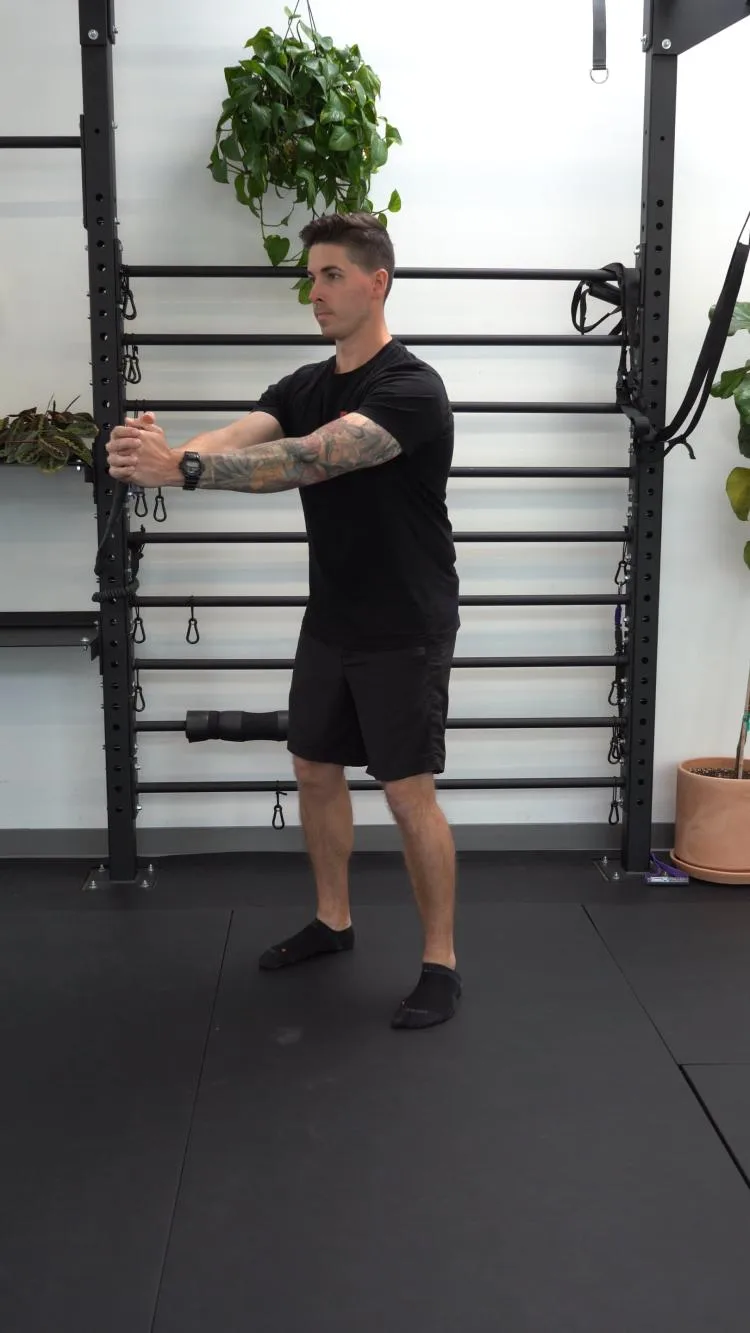
Pallof Press
View exercise instructions
- HOW: Get a band or cable anchored somewhere between waist and shoulder height. While standing perpendicular to the anchor and holding the handle with both hands, press your arms forward away from your chest until your elbows are fully straight. Hold that position for a moment while keeping your hips and shoulders square facing forward, then bring your arms in and repeat.
- FEEL: You should feel your core and back muscles working as well as your arm muscles to maintain optimal position and form.
- COMPENSATION: You should step away from the anchor until there is enough resistance that is challenging, but not too hard where you can't maintain optimal form. Do not let the band rotate your upper body, keep your arms straight and hips facing forward. Try to avoid twisting your back.
Exercise 02 of 05
Exercise demonstration
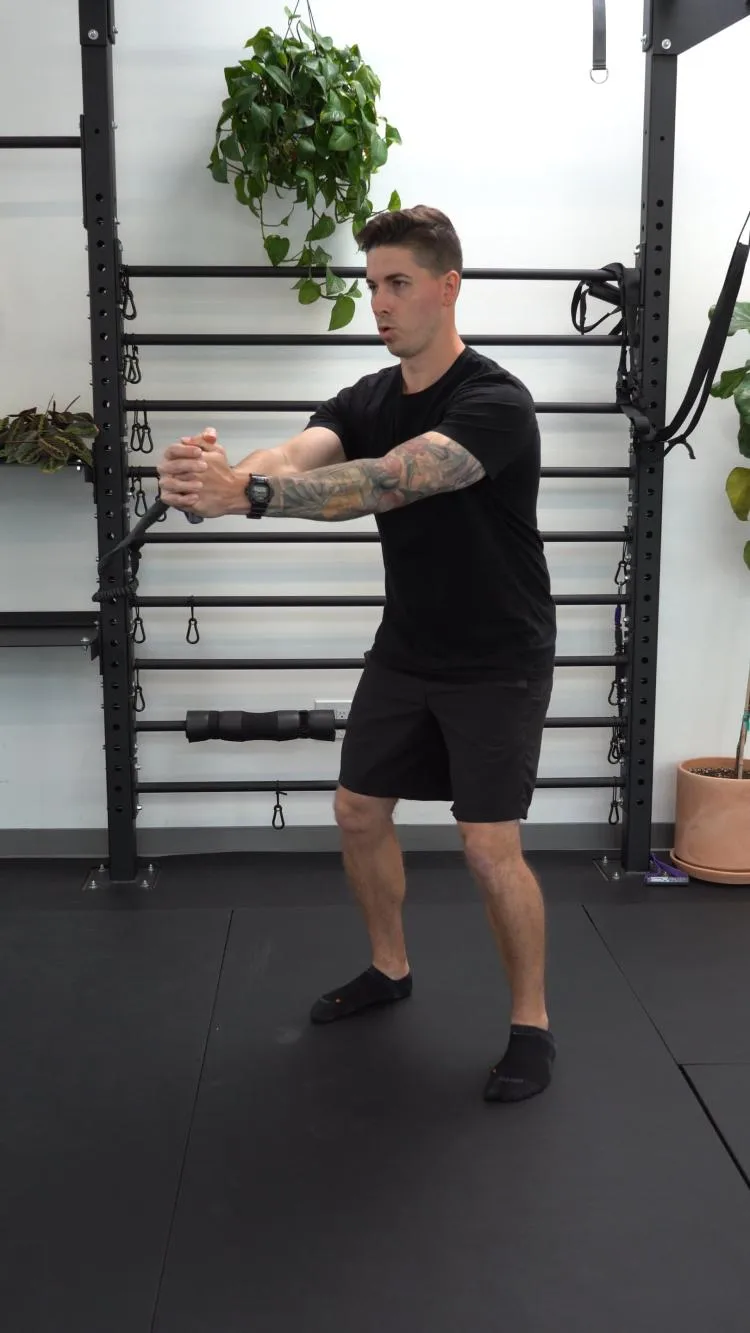
Pallof - Step, Press
View exercise instructions
- HOW: Get a band or cable anchored somewhere between waist and shoulder height. While standing perpendicular to the anchor and holding the handle with both hands close to your chest, step out to build tension in the band. Once there is enough tension, press your arms forward away from your chest until your elbows are fully straight. Hold that position for a moment while keeping your hips and shoulders square facing forward, then bring your arms in, step back in, and repeat.
- FEEL: You should feel your core and back muscles working as well as your arm muscles to maintain optimal position and form. You may also feel your hip and thigh muscles working as well to maintain position.
- COMPENSATION: You should step away from the anchor until there is enough resistance that is challenging, but not too hard where you can't maintain optimal form. Do not let the band rotate your upper body, keep your arms straight and hips facing forward. Try to avoid twisting your back.
Get a band or cable anchored somewhere between waist and shoulder height. While standing perpendicular to the anchor and holding the handle with both hands close to your chest, step out to build tension in the band. Once there is enough tension, press your arms forward away from your chest until your elbows are fully straight. Hold that position for a moment while keeping your hips and shoulders square facing forward, then bring your arms in, step back in, and repeat. You should feel your core and back muscles working as well as your arm muscles to maintain optimal position and form. You may also feel your hip and thigh muscles working as well to maintain your position.
LISTEN: LOW BACK DISCUSSION WITH PREHAB

Pallof Press Exercises: Add-In The Legs
Incorporating lower extremity loading can add great variation and difficulty to pallof press exercises!
Exercise 03 of 05
Exercise demonstration
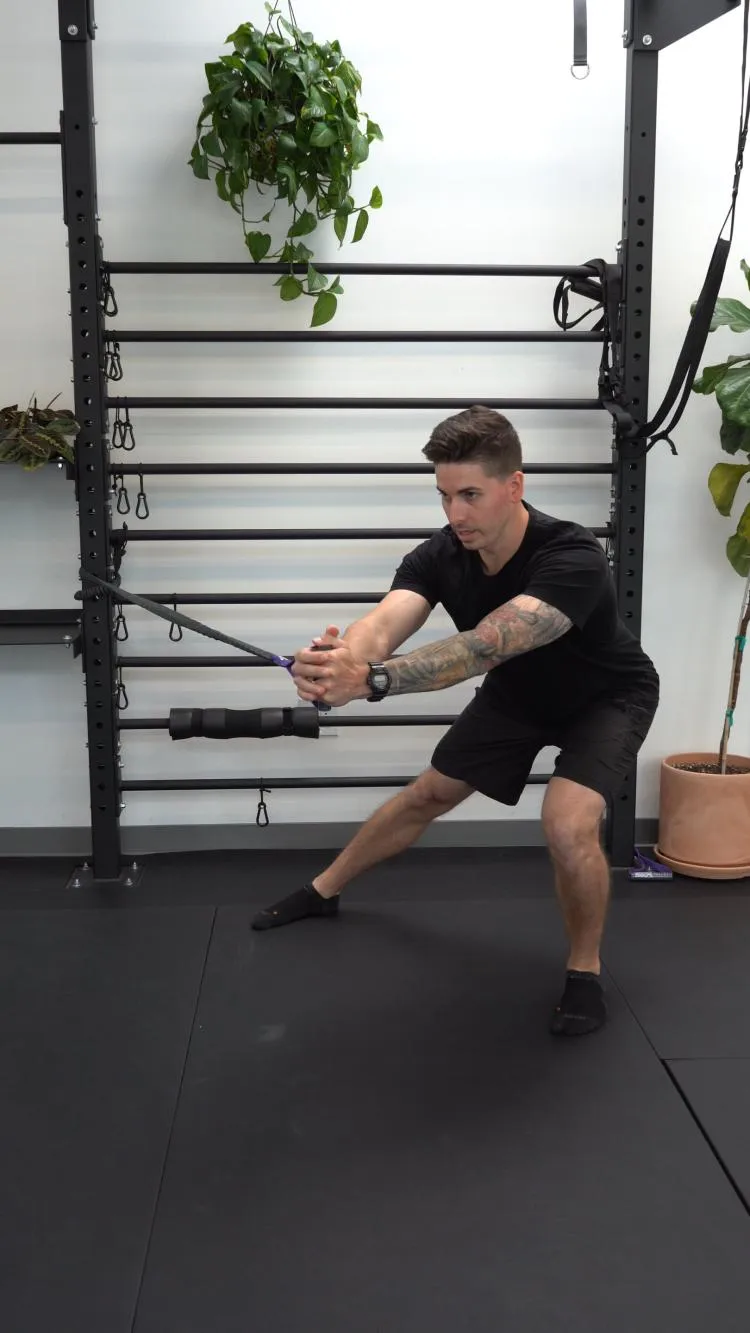
Lateral Lunge Pallof - Press
View exercise instructions
- HOW: Get a band or cable anchored somewhere between waist and shoulder height. While standing perpendicular to the anchor and holding the handle with both hands, press your arms forward away from your chest until your elbows are fully straight. Hold this position as you step and perform a lateral lunge away from the anchor while keeping your hips and shoulders square facing forward, then return to starting position and repeat.
- FEEL: You should feel your core and back muscles working as well as your arm muscles to maintain optimal position and form. You will also feel your hip and thigh muscles working as well to maintain position and to perform the lateral lunge.
- COMPENSATION: You should step away from the anchor until there is enough resistance that is challenging, but not too hard where you can't maintain optimal form. Do not let the band rotate your upper body, keep your arms straight and hips facing forward. Try to avoid twisting your back. Try to keep your leg closer to the anchor straight.
Mix It Up With These Variations
Here are some fun variations you can add to your workout routine!
Exercise 04 of 05
Exercise demonstration
Partner Core Workout Series - Modified Partner Pallof Press
This modified partner pallof press exercise is just the stimulus variation you need to spice up your core workout! With a partner, grab a resistance band and distance yourself from one another until there is tension in the band. Now for 30-60 seconds, you and your partner will write your names, the word pallof press, or any word you would like and repeat! Level 1 is a good place to start, but if you want to increase the challenge then progress towards level 3. If the quality of movement gets sloppy with too much trunk rotation or movement, then regress to a lower level or perform the movement slower. Learn more partner core exercises here!
Exercise 05 of 05
Exercise demonstration
Pallof Press 3D Variation
The standard Pallof Press can become dull and uneventful, so I decided to mix it up. Check this variation out! I decided to write my name and other words using a resistance band. The video is sped up 1.5x, but I am moving faster away from the anchor (concentric motion) and slower when the movement is toward the anchor (eccentric). Talk about an exercise that demands 3D strength! We don't only move in a straight line in life, why would you train that way? Hope you enjoyed the article!
Take Your Core Performance To The Next Level
The outcome of a great core program is NOT a 6-pack but it if does happen we are sure you wouldn't be upset! The core should be thought of as both a dynamic suitcase and an energy transfer center. The goal is to build a rock-solid suitcase for each aspect of the core and to improve its ability to transfer energy to and from the legs and arms.
About The Author
Craig Lindell, PT, DPT, CSCS
Prehab Co-Founder & Chief Content Officer
 Craig is a South Jersey native & Penn State Kinesiology Alumni. When the opportunity came, Craig packed his bags and drove to California to pursue his Doctorate in Physical Therapy from the University of Southern California. With Prehab, Craig oversees all digital content creation and multi-channel publication that reaches millions of people on a weekly basis. As a PT, Craig has a wide array of experience from working with various neurological conditions to working with collegiate & professional athletes across the Big Five in North American sports. Experiencing physical therapy first-hand as a soccer player in high school, Craig has a passion & special interest in adolescent athletic development working with young athletes to overcome injuries. In his spare time, Craig enjoys exercising, playing golfing, hiking, traveling, watching Philly sports, and spending quality time with his family.