

On this page 9 sections
Your guide
What you'll learn
Imagine it's leg day, and you walk into the gym, greeted by the sight of squat racks, leg presses, and free weights. The air is filled with determination as gym-goers power through their routines. But while the enthusiasm is noticeable, how many of these individuals are following a leg day program that’s not only effective but also safe? We've all heard the tales of skipping leg day or doing endless squats without seeing results. However, a leg day routine with the correct programming can become a cornerstone of your fitness journey, leading to impressive gains in strength, balance, and overall athletic performance. Read this article to learn the correct programming for your leg day routine!
The Importance of Leg Day
Leg day isn't just about aesthetics or avoiding the dreaded "chicken legs." Your legs are your body's foundation, playing a crucial role in everything from daily activities to athletic endeavors. According to the National Strength and Conditioning Association (NSCA), lower body strength training can improve balance, increase bone density, and enhance functional movement patterns.
Furthermore, a systematic review published in the Frontiers in Physiology Journal found that leg exercises like squats and lunges are essential for activating the large muscle groups in the lower body, which can boost metabolism and support weight management (2).
Core Components of a Correct Leg Day Program
A well-rounded leg day program should include exercises that target all the major muscle groups of the lower body, including the quadriceps, hamstrings, glutes, and calves. We emphasize the importance of incorporating both compound and isolation exercises to ensure comprehensive muscle engagement and prevent imbalances.
READ: THE BEST SQUAT WARM-UP ROUTINE

Warming up before a leg day workout is crucial for several reasons, ensuring both safety and effectiveness during the workout. It gradually raises your heart rate and increases blood circulation to the muscles, delivering more oxygen and essential nutrients, which helps loosen up muscles and joints, reducing stiffness and making them more pliable.
Warming up also activates the nervous system, enhancing muscle performance and coordination, and allowing for better response during complex movements like squats, lunges, and deadlifts (1). Additionally, it reduces the risk of injury by increasing muscle temperature and elasticity, making tendons and ligaments more prepared for the stress of weightlifting. This preparation improves the range of motion, allowing for exercises to be performed with proper form, and serves as a mental primer, helping you focus and set intentions for the workout. Overall, a good warm-up is an essential part of any leg day, providing both physical and mental readiness for the workout ahead.

Programming for Performance
To optimize performance, particularly in power and strength training, the sequence of exercises in your leg day routine is critical. Start with explosive activities like jumping or sprinting. These exercises are high-intensity and require maximal effort, making them ideal to perform when you're freshest at the beginning of your workout. Explosive movements are crucial for power production, as they train your muscles to generate force quickly, which is beneficial for athletes and anyone looking to enhance their physical performance.
After priming your muscles with explosive exercises, move on to compound movements such as squats and deadlifts. These exercises engage multiple muscle groups and are essential for building foundational strength and muscle mass. By performing compound lifts after explosive activities, you can take advantage of the heightened neuromuscular activation, allowing for more efficient lifting and muscle engagement.
READ: PLYOMETRIC PROGRESSIONS FOR REHAB

Finally, incorporate isolation exercises towards the end of your workout. These exercises, like leg curls, calf raises, and glute bridges, target specific muscle groups. Performing them later ensures that your primary energy and effort are directed toward the most demanding movements first. Isolation exercises also serve to fine-tune individual muscles, which can be particularly useful for correcting imbalances or targeting weaker areas. This structured approach not only enhances overall workout efficiency but also reduces the risk of overtraining specific muscles early in the session, which can lead to fatigue and increased injury risk.
Exercise 01 of 09
Exercise demonstration
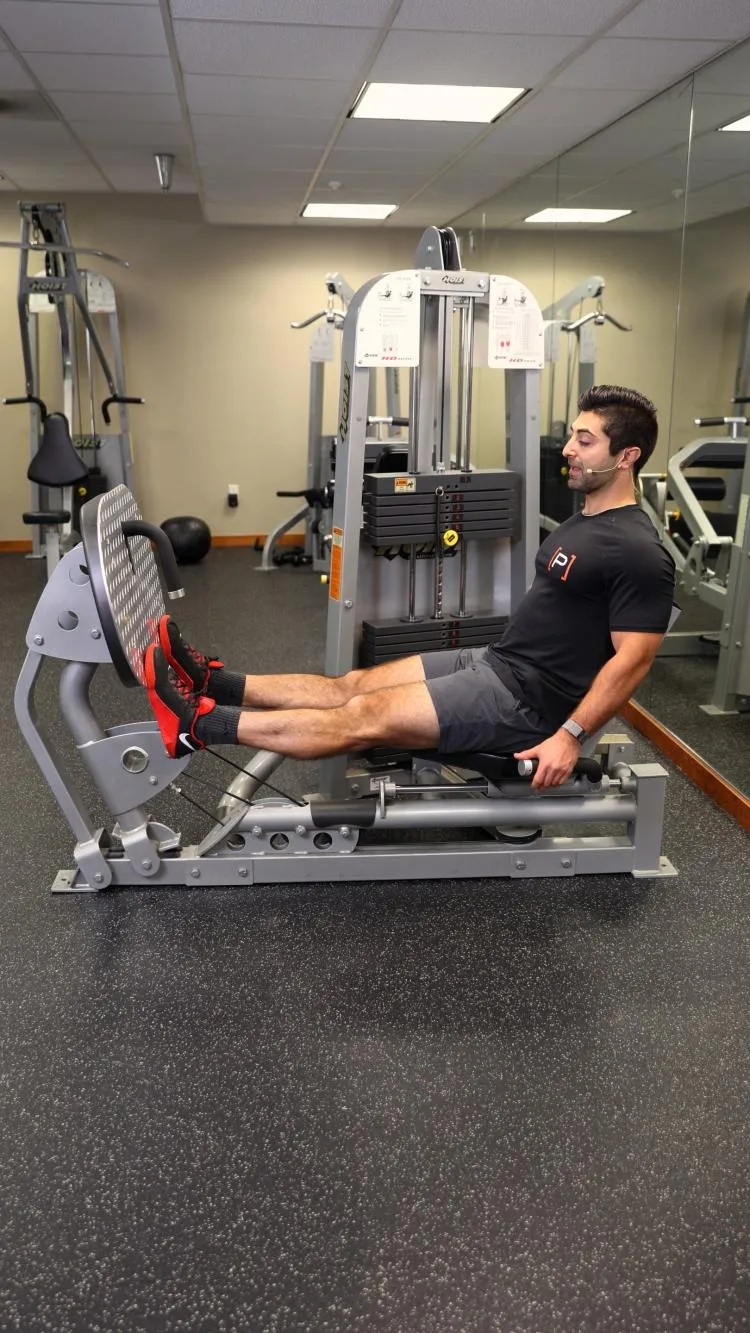
Double Leg Calf Raise - Leg Press Machine
View exercise instructions
- HOW: Sitting in the leg press machine, move the seat back as far as possible. Ideally you want to start with your knees as straight as possible.. Toes are facing up towards the ceiling and your feet are comfortable hip width apartUse the arms to stabilize the upper body and core. Press the machine as away from you using your toes. . Point and flex back and forth with the ankles.Repeat for the prescribed repetitions.
- FEEL: You should feel the back of the lower leg. Feel more tension at the top position and more stretch at the bottom. Can also feel work in the toes and feet.
- COMPENSATION: Do not let the knees bend. Do not let the legs rotate in or out.
Exercise 02 of 09
Exercise demonstration
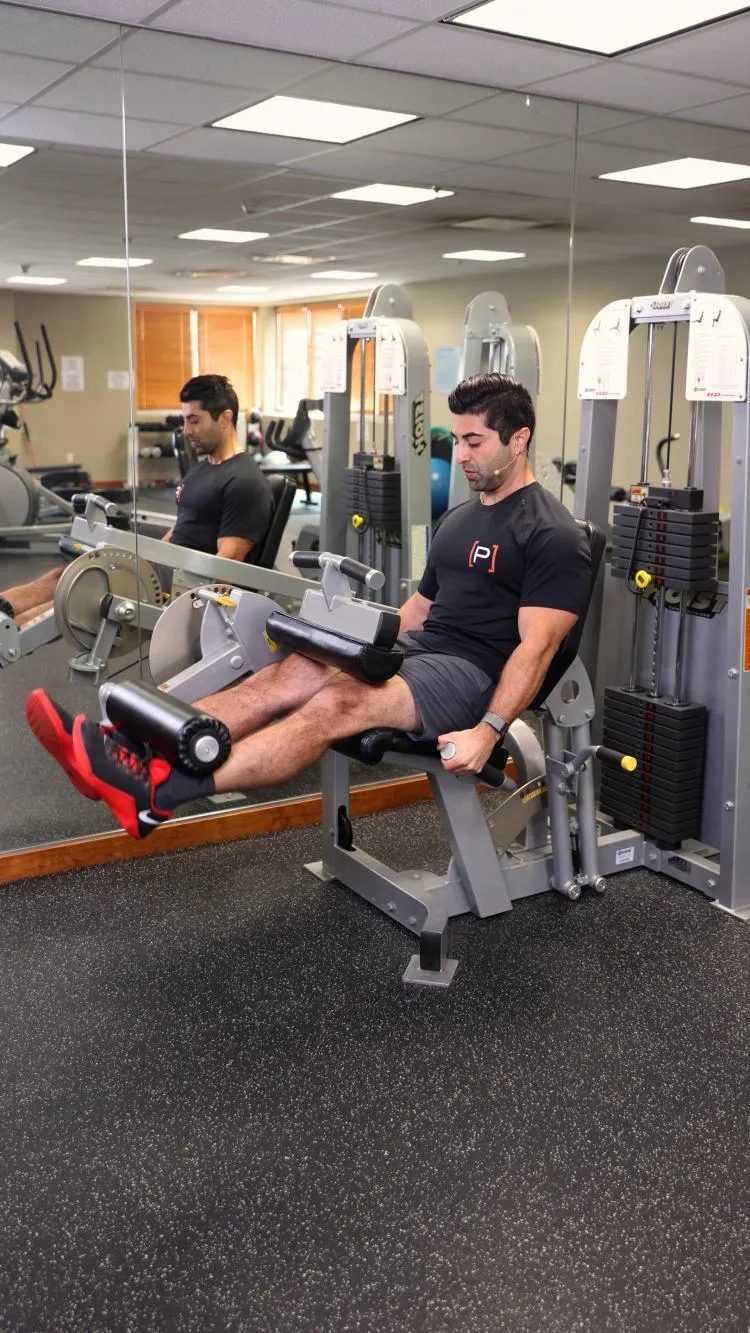
Knee Extension - Machine
View exercise instructions
- HOW: Get into a seated position in the knee extension machine. Place the pad just above your ankle joints. Make sure that the ankles are below the knee. Anchor and stabilize your upper body and core by grasping the handles. Push into the pads to straighten the knees. Slowly return back to the starting position.
- FEEL: You will feel the front of the thigh, the quadriceps.
- COMPENSATION: Do not move the torso. Do not rotate the leg.
Programming for Hypertrophy
When programming for hypertrophy, the goal is to maximize muscle growth by strategically manipulating volume, intensity, and exercise selection. One effective technique in hypertrophy training is the use of pre-fatigue. This involves starting your workout with isolation exercises to target specific muscles before moving on to compound movements. By pre-fatiguing the muscles, you can ensure that they are adequately targeted and stimulated even as larger muscle groups are engaged later on. This method helps to isolate and fully engage the muscles intended for growth, making each set more effective.
In hypertrophy training, volume and intensity are crucial factors. High volume, characterized by a greater number of sets and reps, coupled with moderate to high intensity, promotes muscle hypertrophy by creating significant mechanical tension and muscle damage—two key drivers of muscle growth. Typically, a hypertrophy-focused leg day might include 3-5 sets of 8-12 reps per exercise, ensuring that muscles are pushed to the point of fatigue and sometimes failure, which is crucial for stimulating growth.
READ: THE BEST EXERCISES FOR THE GLUTE MED

Hypertrophy training often includes a variety of exercises, many of which are performed in isolation. This approach allows for a comprehensive workout that targets all aspects of the leg muscles, including the quads, hamstrings, glutes, and calves. For example, a leg day focused on hypertrophy might start with leg extensions or hamstring curls to pre-fatigue the muscles, followed by compound movements like squats or leg presses, and finish with isolation exercises such as calf raises or glute bridges. The inclusion of more isolation exercises ensures that each muscle group is worked thoroughly, contributing to balanced muscle development and aesthetic appeal.
The Role of Volume and Intensity
Volume and intensity are key components in any training program, dictating the total workload and the effort level of exercises, respectively. Volume is quantified by the number of sets and reps performed, while intensity refers to the weight lifted or the difficulty level of the exercises relative to one’s maximum capacity. In training for performance, such as enhancing strength or power, the emphasis is often on maintaining high quality in each set, which means fewer sets are performed to preserve energy and ensure peak form and effort. This approach typically involves higher intensity with heavier weights and lower reps, focusing on maximizing power output and technique. Hypertrophy training aims to increase muscle size, which requires higher volume to induce muscle fatigue and growth. This involves more sets and reps, often in the moderate rep range, to work the muscles closer to failure, stimulating muscle adaptation.
Rest Periods
Rest periods play a crucial role in training, particularly in balancing performance and hypertrophy goals. When training for performance, where quality and maximal effort are paramount, longer rest periods are essential. This allows for full recovery between sets, ensuring that each lift or exercise is performed with optimal strength and technique. Typically, this means resting 2-5 minutes between sets. In contrast, hypertrophy training can benefit from shorter rest intervals, typically 30-90 seconds, which maintain a higher level of muscle fatigue and metabolic stress, both of which are key drivers of muscle growth. Shorter rest periods can enhance the metabolic effect, promoting greater muscle endurance and size by keeping the muscles under constant tension.
A Sample Leg Day Routine for Performance
Exercise 03 of 09
Exercise demonstration
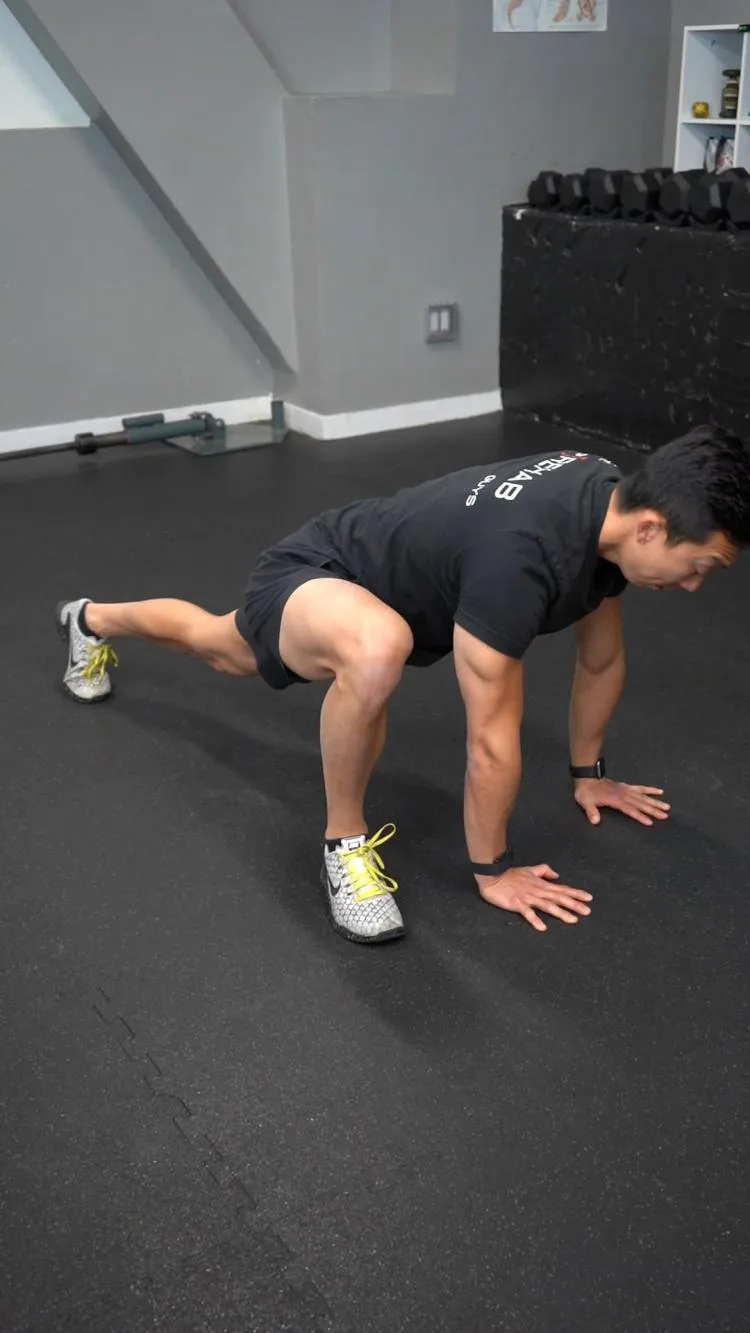
Runners Lunge
View exercise instructions
- HOW: Start in the plank position with your elbow straight and your legs straight with your toes pushing into the ground. Bring one foot as far front as your can up on the side of that arm. When the foot is as high as you can place it on the ground, drop your hips slightly and look up. Alternate this motion with each leg.
- FEEL: You should feel a stretch in your hip of the leg that is forward and even in the front portion of the hip that is behind you.
- COMPENSATION: Keep your back flat, don’t arch it as you bring your leg up.
Spiderman Lunge: 2 sets of 5 reps on each leg
Exercise 04 of 09
Exercise demonstration
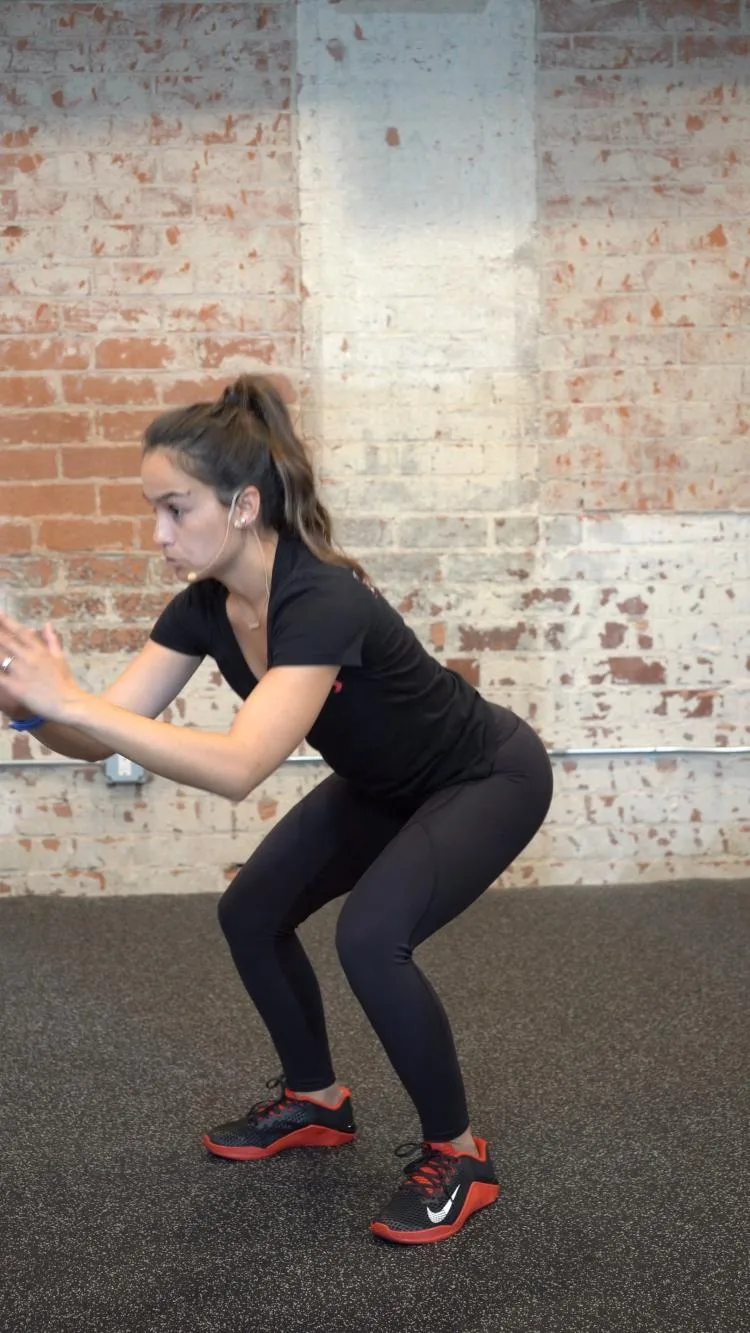
Air Squat
View exercise instructions
- HOW: Stand with your feet about shoulder-width apart. Keep both feet entirely on the ground throughout the movement. Place your hands in front of you about shoulder height to help counterbalance your weight. Hinge forward at the hips, and bend your knees as you sink your hips down. Bring them back up and repeat.
- FEEL: You should feel all of the thigh muscles and butt muscles working.
- COMPENSATION: Avoid letting the knees cave in or bow out. Keep equal weight distribution in both feet, and try not to let your hips shift left or right. Keep a neutral spine by keeping your core engaged to avoid having an over-arched or rounded back.
Air Squat: 2 sets of 10 reps
Exercise 05 of 09
Exercise demonstration
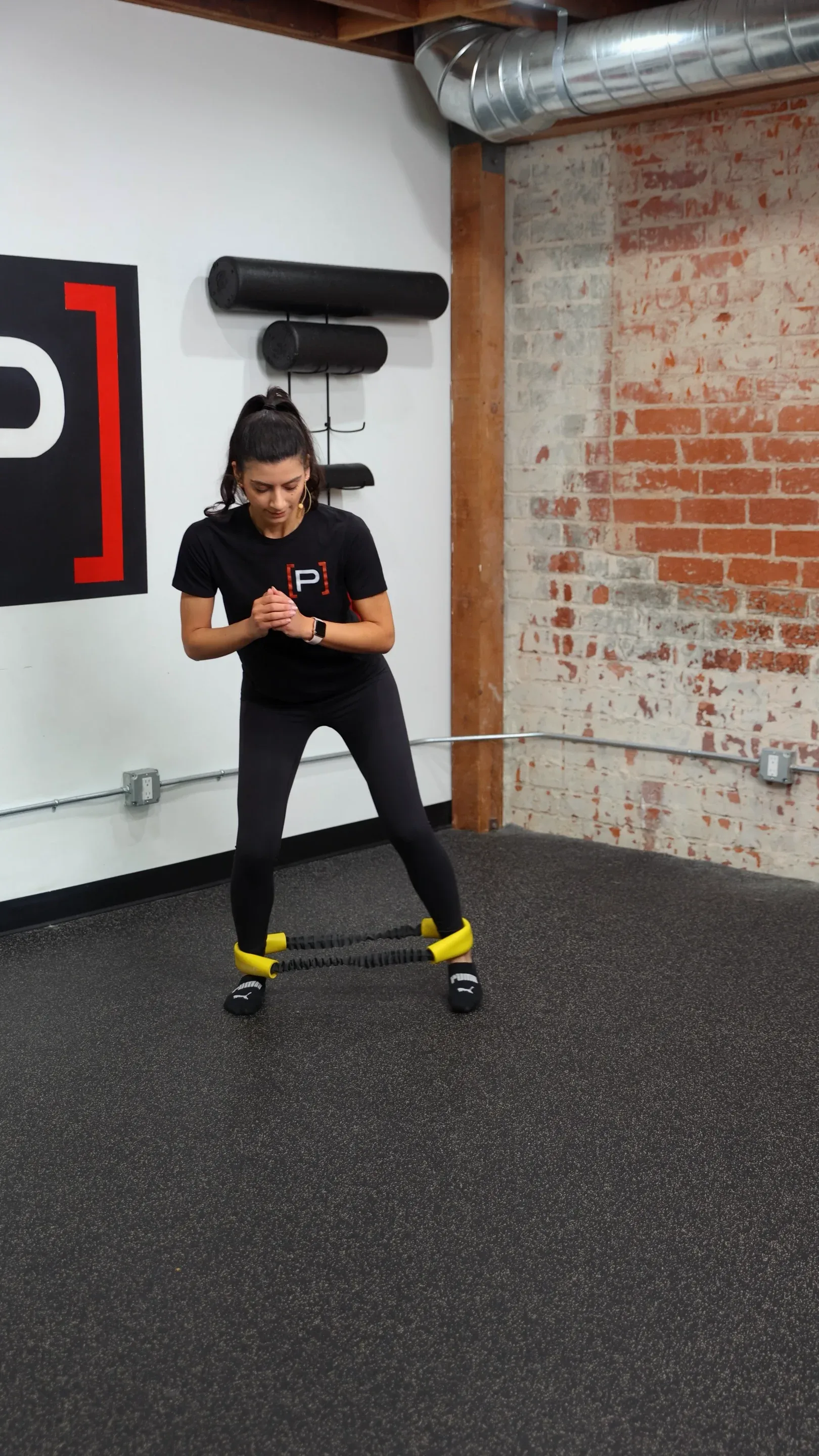
Side Step - Band, On Ankles
View exercise instructions
- HOW: Place a band around your ankles, slightly bend your knees, and hinge through your hips - this is the position you will be in throughout the exercise. Start with your feet hip width apart and step to the side. The trailing leg will follow to re-assume your starting position before you take your next step.
- FEEL: You will feel the side of your glutes working. Due to the sustained quarter-squat position, you may also feel your quads working a bit.
- COMPENSATION: Avoid overstepping with the trailing leg and positioning it narrower than hip width apart - you will lose tension in the band. Avoid rocking back and forth through the trunk and hips as you step.
Side Step: 2 sets of 15 reps
Exercise 06 of 09
Exercise demonstration
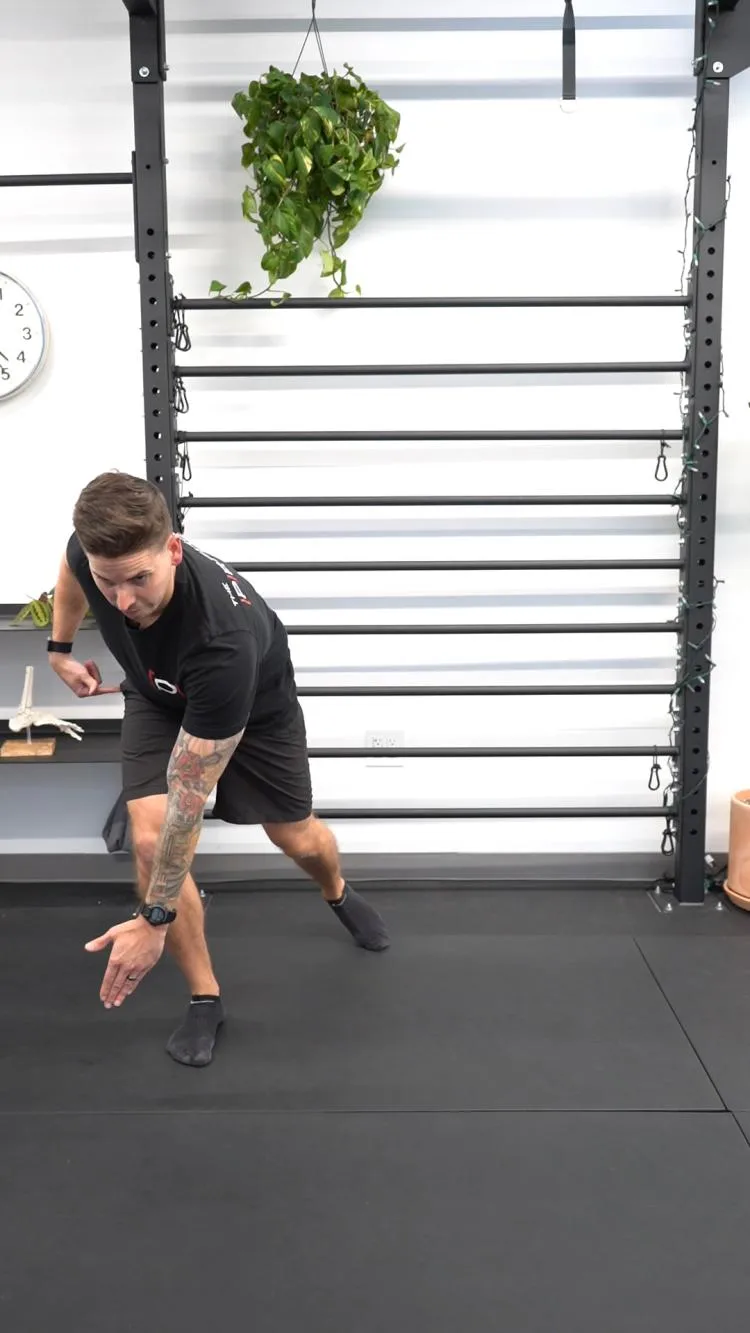
Continuous Lateral Bound
View exercise instructions
- HOW: Starting in a standing position balanced on one leg, hop laterally towards the other leg, stick the landing and simultaneously perform a skater squat. Repeat in the other direction.
- FEEL: You should feel your glutes, especially on the outside of your hips working a lot with this exercise. You will also feel your quads and adductors working as well.
- COMPENSATION: Do not lose balance or give up form for distance. Find a distance that is appropriate for you to perform the exercise with optimal form.
Lateral Bound- 4 sets of 5 reps to each leg. 60-second rest between sets.
Exercise 07 of 09
Exercise demonstration
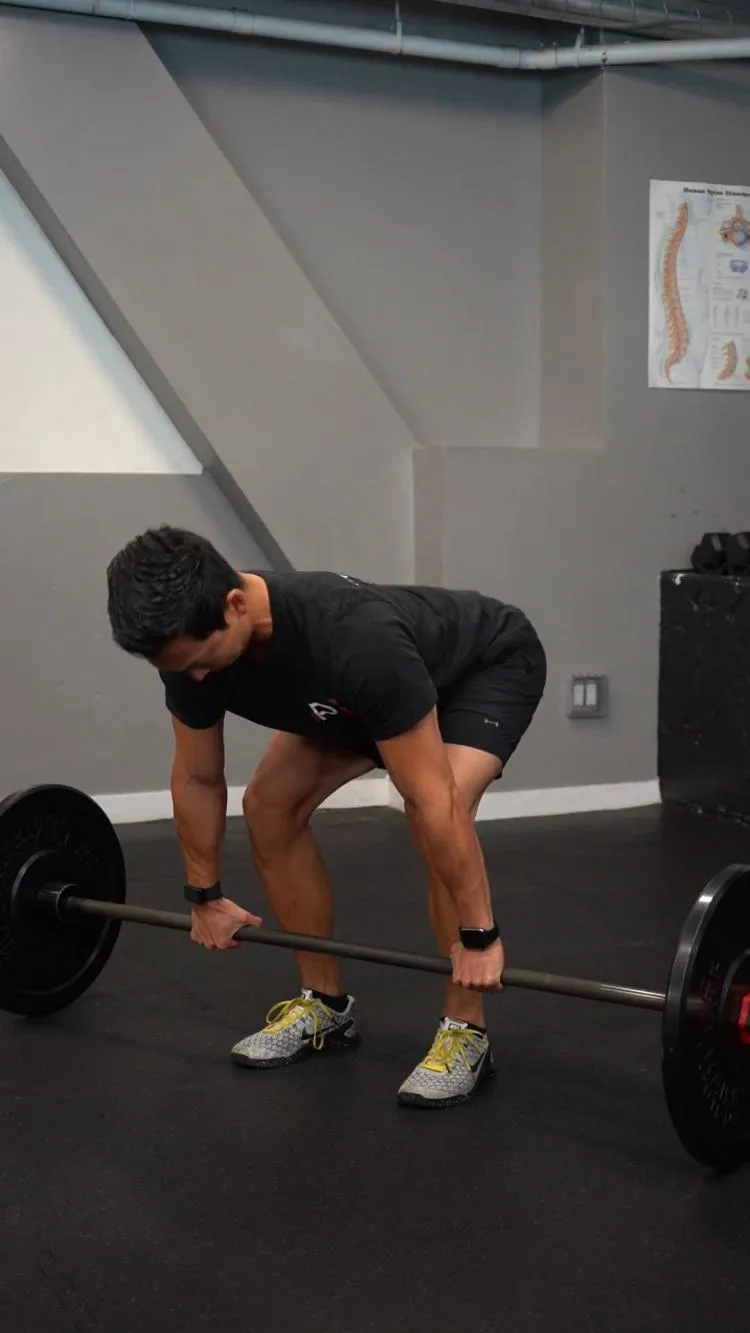
Deadlift - Barbell
View exercise instructions
- HOW: Position a barbell in front of you on the ground over the middle of your feet. Find your “power stance” with your feet roughly shoulder width apart. Grip the bar slightly wider than your knees, keep some tension in your legs with your knees bent, squeeze your shoulder blades back, push into the ground with your feet and lift the bar up to your waist.
- FEEL: You should feel your lower body muscles working as well as your glutes and back.
- COMPENSATION: Keep your back flat, don’t arch it. Control the weight going up and down.
Deadlift: Warm up to 3 sets of 5 reps at an 80% effort. 3 minutes rest between the last 3 sets.
Exercise 08 of 09
Exercise demonstration
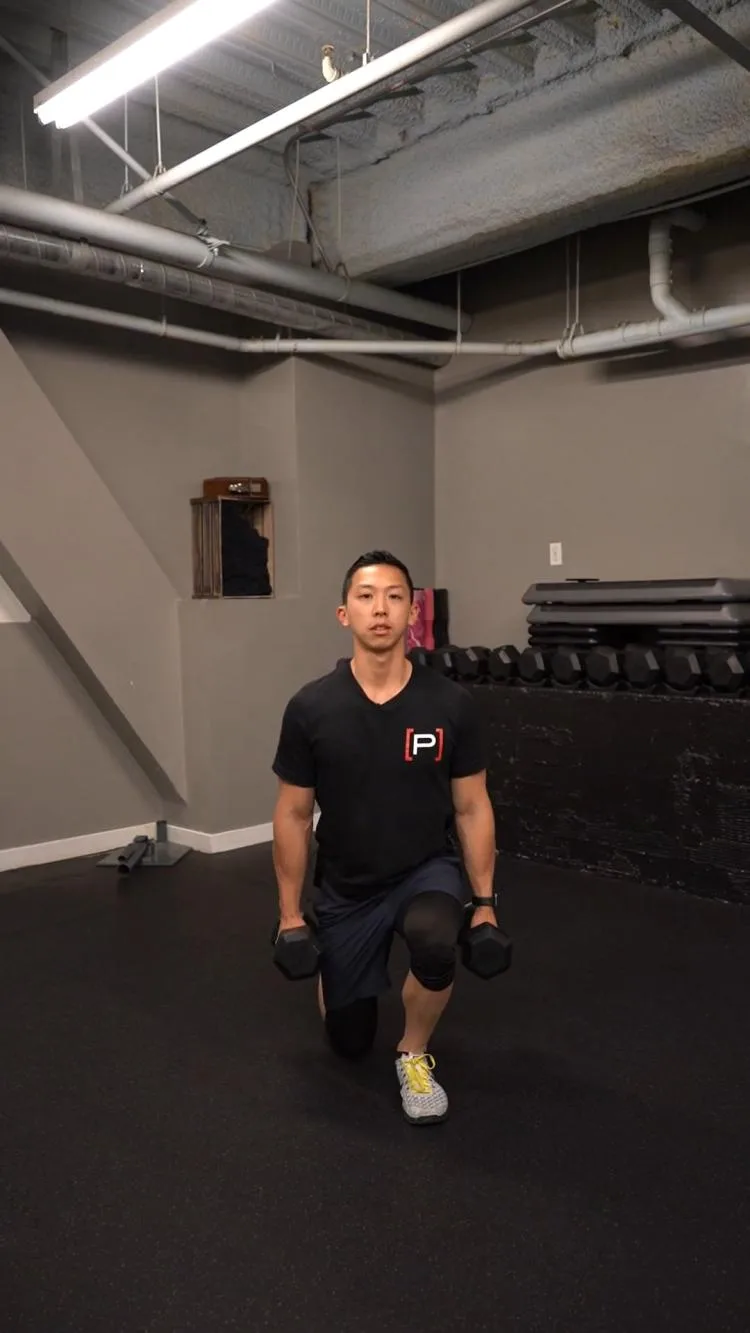
Posterior Lunge - Walking, Dumbbell
View exercise instructions
- HOW: Start by grabbing two dumbbells of the same weight. Take a step backwards with your left leg and descend into a lung position. Push yourself back up and backward using your back left leg. Then repeat on the right side. The key is that you are pushing yourself up with your back leg, not your front leg!
- FEEL: You should feel all the muscles in your legs working, but especially your quadriceps muscles. Your back leg should be doing most of the lifting.
- COMPENSATION: Do not push too much through your back leg. It is OKAY for your knees to go past your toes - that is normal!
Dumbbell Posterior Lunge: 3 sets of 6-8 reps on each leg. 2 min rest between sets
Exercise 09 of 09
Exercise demonstration
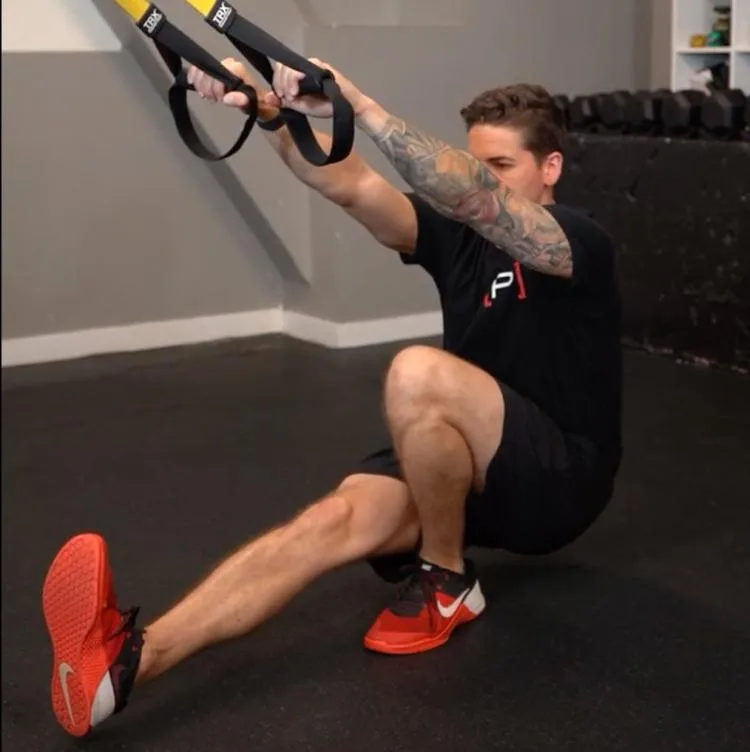
Pistol Squat - TRX
View exercise instructions
- HOW: Get set up in a standing position with a suspension trainer anchored in front of you. Start by holding the suspension trainer handles in each hand with a soft bend in your elbow. To begin the exercise, balance on one leg and have the other leg supported in the air in front of you with the knee straight as best as you can. Perform the exercise by bending your hip and knee to perform a single leg pistol squat, as you lower down focus on keeping your other knee straight supported in the air. Lower down as far as you can control, then focus on pushing the ground away to return to starting position and repeat. Only use the suspension trainer for minimal assistance as needed.
- FEEL: This should feel like a full lower body workout, specifically your quads, glutes, and hamstrings. If you feel your upper body working hard, you're relying on the suspension trainer too much. You will also feel your quad and hip flexor working hard on the side that you're holding your leg in the air.
- COMPENSATION: Do not over-rely on the suspension trainer and lean back on it with all of your weight. Only use the suspension trainer as needed. Focus on good single leg pistol squat form, keep your knee stacked over your foot and maintain and a level pelvis. Do not let your knees cave in or hips/pelvis rotate. Do not lean side-to-side with your trunk.
Pistol Squat - TRX: 3 sets of 10-12 reps. 60-second rest between sets.
Closing Thoughts
Correct leg day programming is not just about choosing the right exercises; it's about ordering them in a way that maximizes your goals. For performance, starting with explosive movements sets the stage for power development, while compound exercises build overall strength and muscle mass. Finishing with isolation exercises allows for targeted muscle work, ensuring a comprehensive leg workout. If you are training for hypertrophy, it looks different than training for performance as it includes more of an emphasis on isolation exercises, as well as increased sets and reps. So, the next time you step into the gym for leg day, remember to think about your exercise sequence: Are you optimizing your workout routine for your current leg day goals?
LEARN MORE ABOUT OUR LOWER EXTREMITY PERFORMANCE PROGRAM

References
- Baechle, T. R., & Earle, R. (2016). Essentials of strength training and conditioning: National Strength and Conditioning Association. Human Kinetics.
- Liu, X., Gao, Y., Lu, J., Ma, Q., Shi, Y., Liu, J., Xin, S., & Su, H. (2022). Effects of different resistance exercise forms on body composition and muscle strength in overweight and/or obese individuals: A systematic review and meta-analysis. Frontiers in Physiology, 12. https://doi.org/10.3389/fphys.2021.791999
About The Author
Ryan Nosak, MS, CSCS
Prehab Writer & Content Creator
 Ryan was born and raised in Throop, Pennsylvania and he has worked in the world of fitness since he was 15 years old. Ryan realized he had a deep affinity for strength training and how it can alter the human mind, body, and spirit. He began his coaching career in high school by coaching his friends through strength training sessions, which inspired him to pursue a career in strength and conditioning.
Ryan spent 10 years as a Division 1 strength and conditioning coach with stops along the way at Penn State, Tennessee State, Vanderbilt, Robert Morris, Charlotte, and DePaul. He is a Certified Strength and Conditioning Specialist and operates his own training practice, RyNo Strength, out of Studio DelCorpo in Chicago, IL. He specializes in fat loss, body composition, strength, and sports performance training programs.
Ryan received his Bachelor’s Degree in Kinesiology from Penn State and a Master’s in Sport Management from Western Carolina University. In his free time, Ryan enjoys training for bodybuilding, eating at amazing restaurants in Chicago, and spending time with his wife, daughter, and dog.