

On this page 4 sections
Your guide
What you'll learn
The ability to reach behind your back does not seem so important until it is taken away from you. Washing your back, grabbing your wallet, taking off your bra, putting on a belt, you name it. All of these simple activities of daily life can become quite difficult the moment you can no longer do them without an issue! However, you can get this motion back with the right exercises, discipline, and ultimately - patience. In this article, you'll learn high-quality strategies on how to improve reaching behind your back.
What Is This Motion? Improve Reaching Behind Your Back

Reaching behind your back involves physiologic motion at the shoulder and the shoulder blade. Specifically, shoulder extension and internal rotation as well as physiologic motion in all planes of movement at the shoulder blade. This includes scapular rotation, elevation, depression, and abduction/adduction depending on where you're reaching. Ideally, you should be able to reach behind your back and place your hand on your opposite shoulder blade.
Improve Reaching Behind Your Back By Bulletproofing Your Shoulders

If you are having difficulty with your shoulder mobility such as reaching behind you, we have a solution for you! This program will teach you how to strengthen your rotator cuff, and shoulder blade stabilizers, as well as improve mobility, all of which will bulletproof your shoulders. Get started with our program today!
Why Do We Lose This Motion?
Ultimately, why someone would lose the ability to reach behind their back can be due to a few things. We are going to explain why this could be due to boney changes, shoulder capsule restrictions, or soft tissue mobility deficits. However, it is important to note with these different etiologies of motion loss, the amount of range of motion loss and the amount of pain may not be the same across the board.
Bone

Humeral and glenoid retroversion is a common osseous adaptation in overhead athletes, especially baseball pitchers, due to the torsional forces exhibited on the throwing arm with repetitive motions and stress. This is believed to occur within a specific time frame (adolescent ages) while the growth plates are still open. Humeral/glenoid retroversion leads to an increase in shoulder external rotation and a decrease in shoulder internal rotation range of motion (ROM). However, this is not necessarily an issue as long as there is a normal side-to-side total shoulder ROM (sum of internal and external ROM). This may not be as big of an issue with reaching behind your back as say capsular tightness would be. On the other hand, shoulder osteoarthritis is a separate type of boney change that can definitely limit reaching behind your back. You can learn more about humeral retroversion by clicking here
Understand The Shoulder Capsule
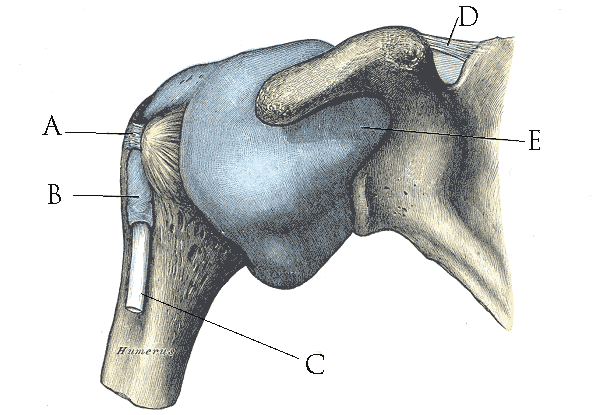
Above is an appreciation of the glenohumeral (shoulder) joint capsule. Think of the capsule as a big sock around the shoulder that covers it. The shoulder capsule is made up of strong, fibrous connective tissue. This is a good thing as it provides stability to the shoulder, which is inherently a less stable joint. However, if there is an insult to the capsule that causes a clinical condition such as adhesive capsulitis (frozen shoulder), then the capsule can become very stiff and less pliable. This ultimately restricts physiologic shoulder motion and reaching behind your back can be very restricted.
Understand Shoulder Soft Tissue

A more likely culprit, especially if you are suddenly having difficulty with reaching behind your back, is soft tissue flexibility deficits. Looking at the image above, the post cuff musculature can limit shoulder internal rotation. Specifically, the teres minor and infraspinatus muscles. Also, you could argue muscles in front of the shoulder that contribute to shoulder flexion and horizontal adduction such as the pecs could limit shoulder internal rotation. The good part about this is that if it is truly soft tissue flexibility deficits, a handful of stretches that are performed correctly and consistently will do the trick!
Sometimes, a loss in our shoulder range of motion may not only lead to difficulties with reaching behind your back, but with other upper extremity-related tasks, such as bench pressing or push ups for example. We have a previous podcast where Arash dives into how you can warm-up properly before performing bench presses or push ups and ultimately avoid pain with these activities!

How Do You Improve Reaching Behind Your Back?
Regardless of the reason, if reaching behind your back is limited and painful, it can be a real burden. Don't fret! Below are various exercises focused on improving motion in different areas of the body that ultimately can improve reaching behind your back. You will find we start with the thoracic spine followed by a combination of shoulder and shoulder blade movements in efforts to improve reaching behind your back.
Exercise 01 of 05
Exercise demonstration
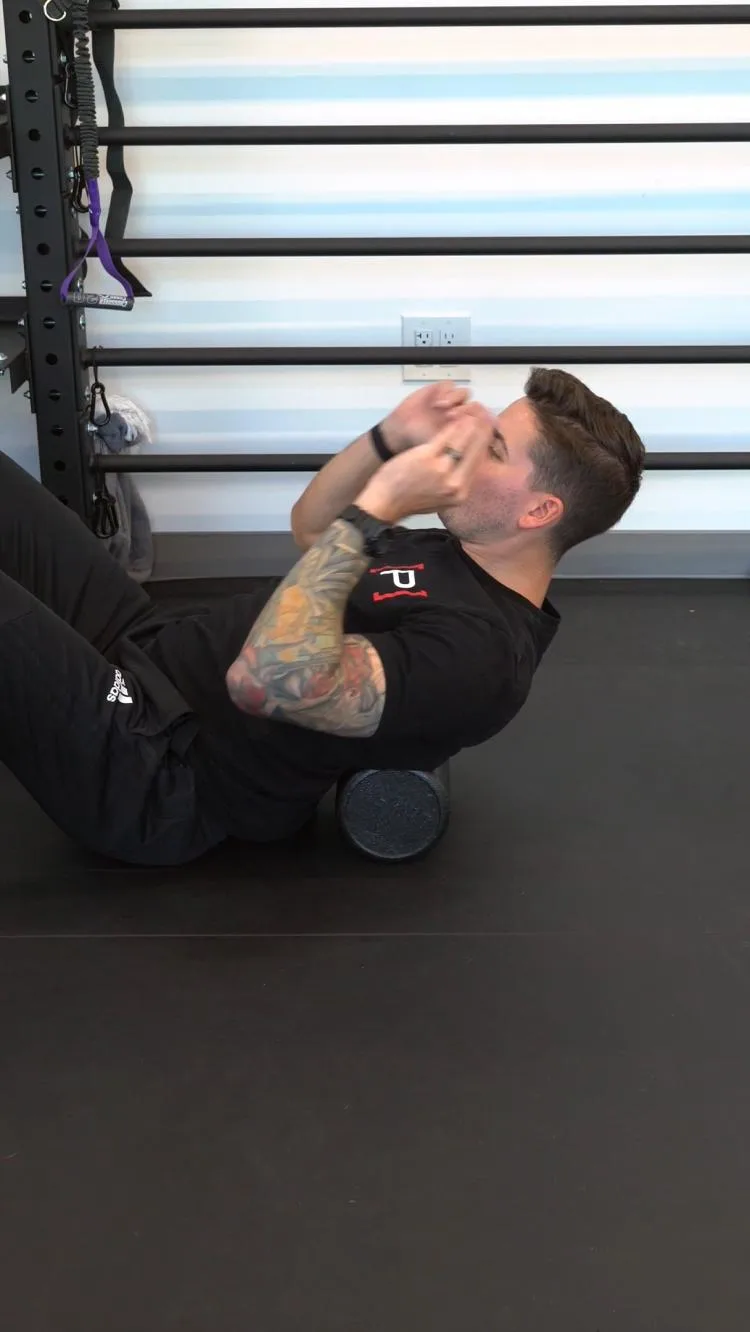
Thoracic Spine Foam Rolling
View exercise instructions
- HOW: Get set-up with your butt supported on the ground with a foam roller supporting your mid back. The goal is to make a ‘fulcrum’ that we can use to mobilize your mid back. Position the foam roller in your mid back and drive the upper half of your back “over” the foam roller while exhaling. Move the object to different areas of your mid back to mobilize multiple segments.
- FEEL: You should feel moderate amounts of pressure in your mid back. If you feel a “pop”, that is totally normal and okay.
- COMPENSATION: Do not put the foam roller on your lower back, just your upper back. Keep your core engaged and do not overly arch in your lower back.
Getting the mid-back moving more and moving well is a crucial first step in reaching behind your back. The mid back is known anatomically as the thoracic spine. Often times, due to prolonged sedentary positions, this area of the body can become stiff, and motions can become restricted if we do not move it! Moreover, as we elevate our shoulder such as when reaching above our head, our thoracic spine has to extend, sidebend, and rotate as well! Just try reaching behind your back and then think about it, your mid back moves too! As a result, if our thoracic spine mobility is limited, this may lead to limited shoulder mobility as well.
How to Improve Reaching Behind Your Back
Exercise 02 of 05
Exercise demonstration
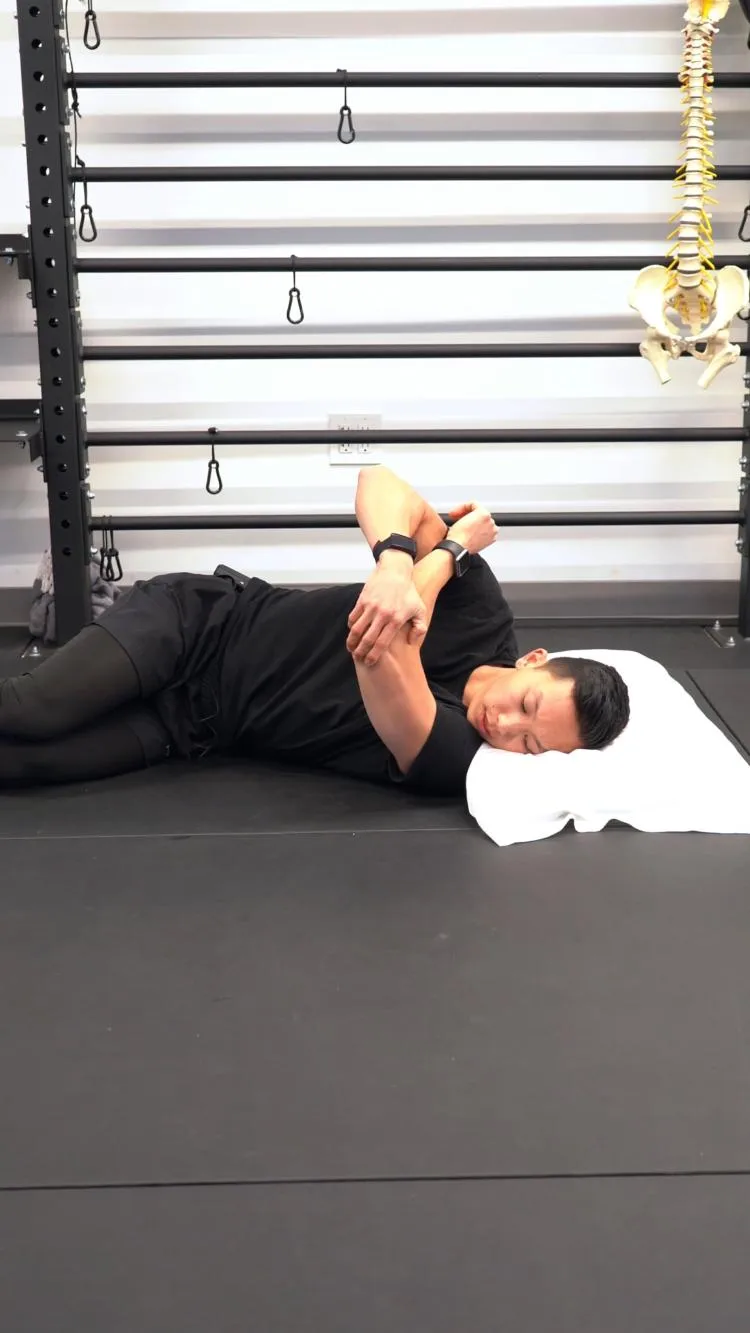
Side Lying Shoulder Cross Body Stretch
View exercise instructions
- HOW: Lie on your side with the shoulder you want to stretch closest to the ground. You can put a pillow under your head for neck support if you want but it is not necessary. Bring your elbow to your side up to shoulder height. Using your bodyweight to pin your bottom shoulder down, slowly lift your elbow straight up with your opposite hand.
- FEEL: You should feel a deep stretching sensation in back of your shoulder on the ground. You do not want to feel any pinching sensations or pain in the front of your shoulder.
- COMPENSATION: If you are not feeling the stretch in the right area, try putting your elbow slightly higher than your shoulder. You can also try rotating your body backwards just a bit.
This is a really good stretch to directly target the posterior rotator cuff muscles that were referred to earlier in this article. The traditional sleeper stretch is tough for people who are working on the ability to reach behind their back as they typically have shoulder internal rotation limitations. Try this one out instead!
Exercise 03 of 05
Exercise demonstration
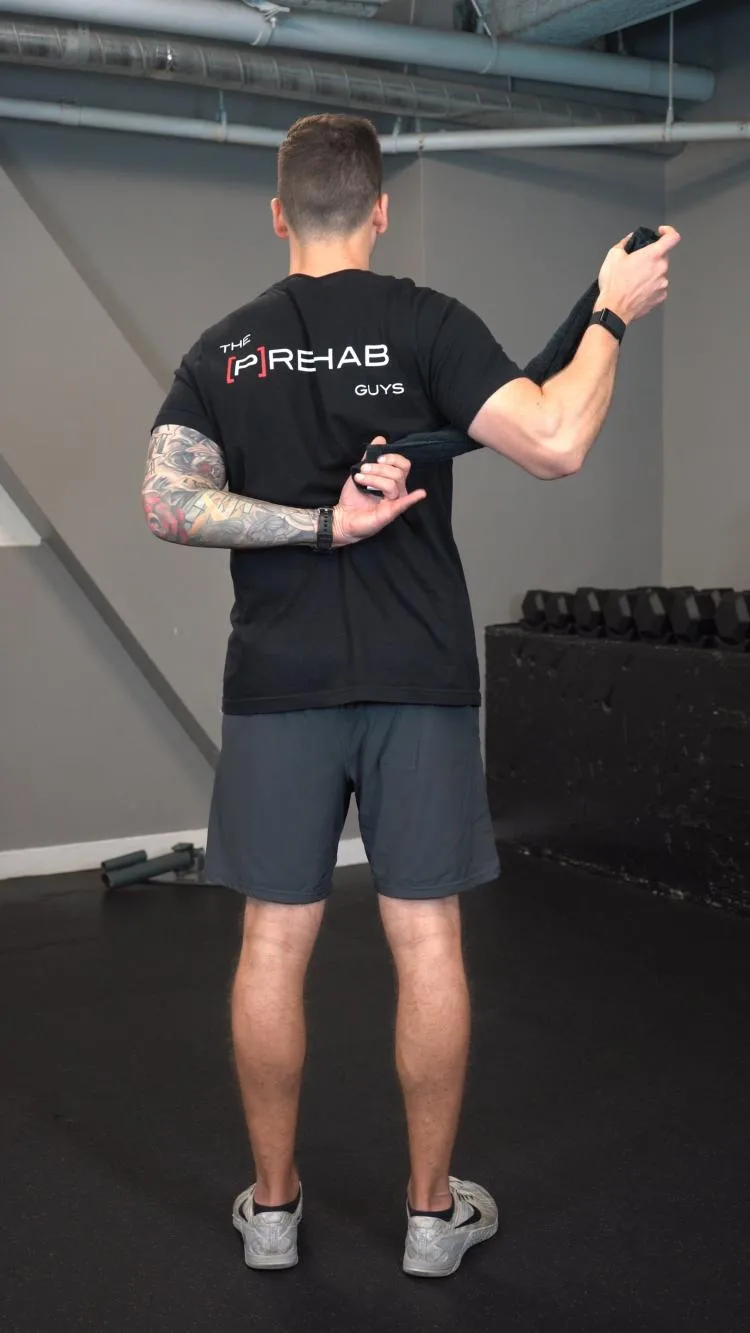
Shoulder Hand Behind Back - PROM
View exercise instructions
- HOW: On the side you want to work on reaching behind your back, hold a towel with your palm facing backwards. Hold the towel with your other hand and depending on your range of motion, you can have the towel positioned behind the waist or draped over the opposite shoulder. Using the opposite arm, pull on the towel so that it moves the target arm further behind your back, move as far as you feel comfortable with and hold for the prescribed time and repeat.
- FEEL: This should feel like a shoulder stretch, likely in the front and all around your shoulder.
- COMPENSATION: Try to limit motion to your shoulder and shoulder blade, try not to lean or bend too much with your trunk and upper body.
Sample Shoulder Prehab Program Exercise Video
Once reaching behind your back is tolerated and the stretches are going well, it's time to directly start working on the range of motion. I often start this exercise at the same time as the stretches, I will just recommend people to do the stretches first! Let your arm go for a ride with the towel if actively reaching is too much. However, as you get more comfortable with this exercise you want to start helping and directly assist the motion.
Exercise 04 of 05
Exercise demonstration
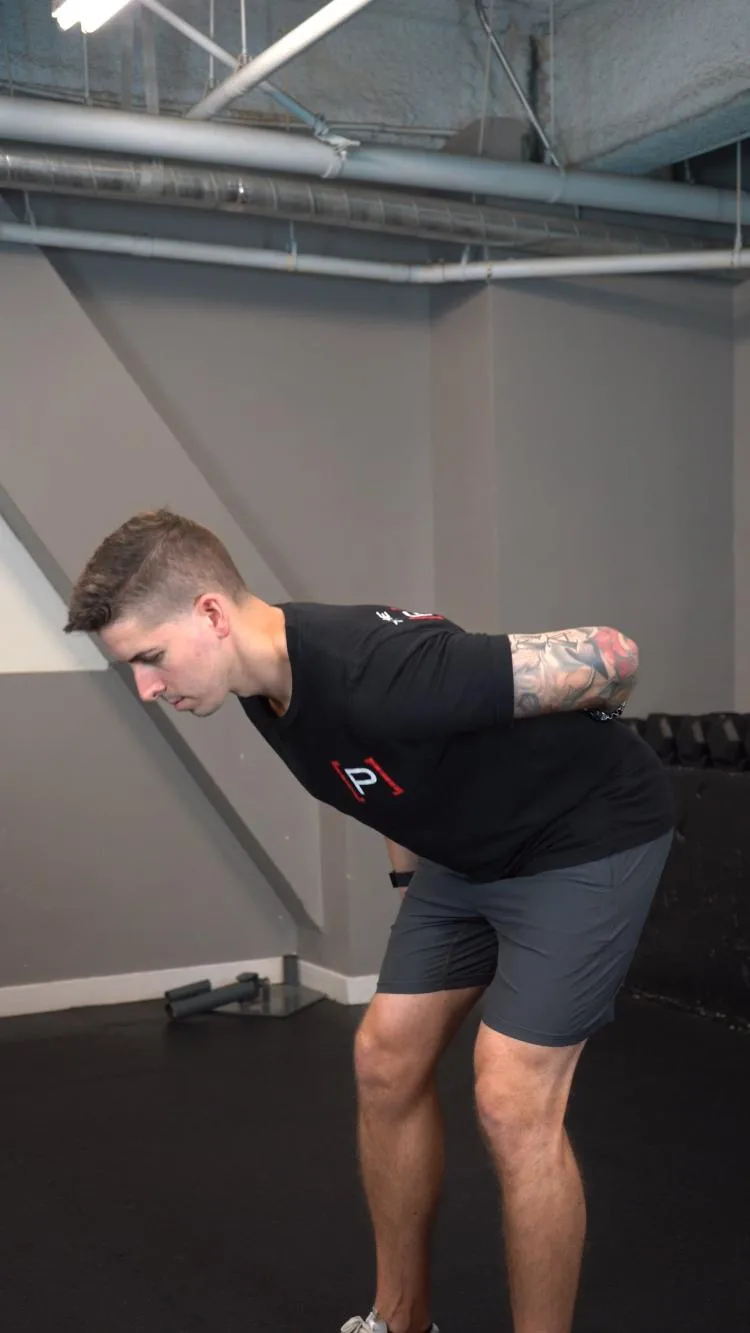
Hip Hinge - Hand Behind Back
View exercise instructions
- HOW: Get set up standing with your hand resting behind your back in a comfortable position. Begin the exercise by performing a hip hinge followed by standing tall and reaching out and back behind you with the other arm to stretch your pecs. Repeat
- FEEL: This should feel like a shoulder and pec stretch, likely in the front and all around your shoulder.
- COMPENSATION: If you can tolerate it, try to keep your shoulder blade back when you stand tall on the side you have your hand behind your back. Otherwise, just focus on the hip hinge and stretching with your other arm.
This is a really good exercise to try if the towel assist or any of the hand lift off exercises below are giving your shoulder some trouble. This exercise focuses on indirectly improving hand behind back motion by moving and stretching other areas, including the opposite pec muscles. Try it out and see how your hand behind the back motion is before and after!
Exercise 05 of 05
Exercise demonstration
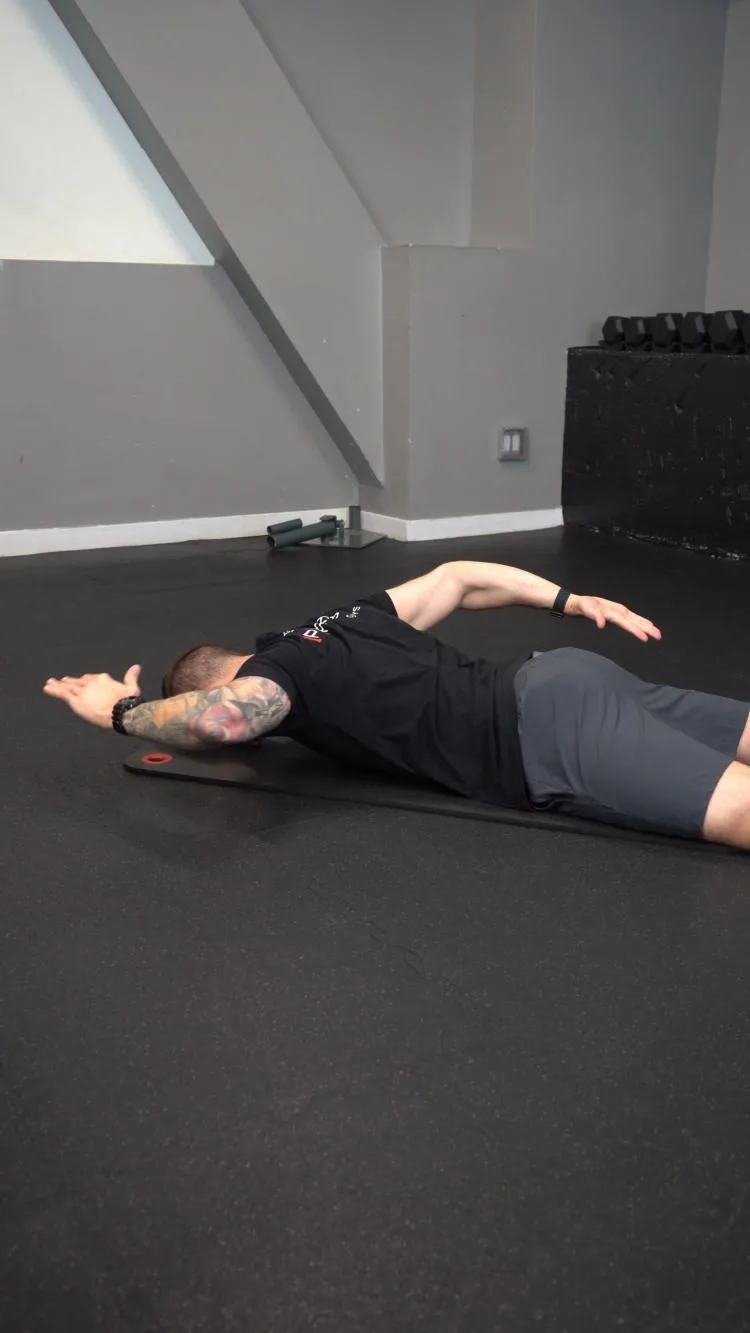
Prone Shoulder IR/ER Switch
View exercise instructions
- HOW: Get set up on your stomach with one arm behind your low back and the other behind your head. Begin the exercise by squeezing your shoulder blades back and then lifting your hands off your back/head. Refer to the video for how the transition occurs - but switch positions with your arms/hands while keeping your hands lifted up in the air. Lower your hands down to your head/low back, repeat.
- FEEL: This should feel like a shoulder and shoulder blade exercise working the muscles in and behind your shoulders and in between your shoulder blades. You also may feel a stretch in the front of your shoulder.
- COMPENSATION: Try to limit motion to your shoulder and shoulder blade, fight the urge to arch in your low back or move from the rest of your body.
Sample Shoulder Prehab Program Exercise Video
Reserved for the advanced that have good ROM and want to improve their shoulder strength and mobility, I give you prone hovers! This is an excellent shoulder and scapular strengthening exercise that works on shoulder internal rotation as well as external rotation!
Closing Thoughts
I cannot reiterate this enough - improving the ability to reach behind your back takes time. Ask anyone that has dealt with this limitation before, you have to be patient, you cannot rush it, and often times it does not feel great. However, this ultimately depends on the underlying reason why reaching behind your back is limited. Stay disciplined and you will find some level of success!
Take Control of Your Shoulder Health
To win an NBA championship in this current era it seems at least 3 superstars are needed on the team. Behind these 3 superstars includes the entire support staff that takes care of the day-to-day operations allowing the stars to perform. Sounds like they are using the model of the shoulder! You will learn how to create balance among the support staff which will allow the 3 joints of the shoulder to perform to their superstar abilities!
About The Author
Craig Lindell, PT, DPT, CSCS
Prehab Co-Founder & Chief Content Officer
 Craig is a South Jersey native & Penn State Kinesiology Alumni. When the opportunity came, Craig packed his bags and drove to California to pursue his Doctorate in Physical Therapy from the University of Southern California. With Prehab, Craig oversees all digital content creation and multi-channel publication that reaches millions of people on a weekly basis. As a PT, Craig has a wide array of experience from working with various neurological conditions to working with collegiate & professional athletes across the Big Five in North American sports. Experiencing physical therapy first-hand as a soccer player in high school, Craig has a passion & special interest in adolescent athletic development working with young athletes to overcome injuries. In his spare time, Craig enjoys exercising, playing golfing, hiking, traveling, watching Philly sports, and spending quality time with his family.