


On this page 6 sections
Your guide
What you'll learn
Summertime is here and you want the hard work you've been putting in the gym to be recognized when you are outside enjoying the sunshine with your friends. You've been doing the same training routine since high school and feel like you have hit a plateau for gaining muscle. While you want to change things up, you are worried you may get hurt while trying to gain muscle. "Ain't nobody got time for that!" In this article, we will help you understand strategies to gain muscle without injury!
What Is Muscle Hypertrophy?
Saying you want "hypertrophy" is the fancy way of saying you want to add muscle. "Skeletal muscle growth during periods of resistance training has traditionally been referred to as skeletal muscle hypertrophy, and this manifests as increases in muscle mass, muscle thickness, muscle area, muscle volume, and muscle fiber cross-sectional area" (Haun et al 2019). While it's often assumed that the main way to increase hypertrophy is by lifting more weight than before, the current research shows that many factors contribute to the process including mechanical tension, muscle damage, and metabolic stress (Schoenfeld 2010). Of these factors, mechanical tension likely contributes the most to hypertrophy and it will be the main focus throughout the rest of this article.
Increasing your training volume over time will have one of the highest effects on increasing mechanical tension. Your volume consists of the number of sets, reps, and weights you are using to perform the exercise. The biggest mistake I see people make when increasing training volume is increasing the number of sets and reps on the same day. For example, one of your upper body workouts looks like this:
Monday
- Barbell bench press- 3 sets of 6 reps
- Incline dumbbell bench press- 3 sets of 8 reps
- Decline bench press- 3 sets of 10 reps
- Dumbbell flys- 3 sets of 12 reps
- Push-ups- 3 sets to failure
This is 15 sets targeting the chest on the same day which is a lot of work and may increase the risk of overuse and injury. However, taking this same amount of work and spreading it across two days will yield better results since you are now increasing the frequency of the stimulus being applied to the muscle without overdoing it during one workout. A good rule of thumb for an advanced trainee is to perform 12-20 sets of a muscle group per week. 40-70 reps per session is likely a sweet spot for most individuals. If you are a beginner, I recommend starting on the lower end of these recommendations since it won't require as much volume in order for you to see results.
Are You Ready To Gain Muscle, Endurance, And Take Your Fitness To The Next Level?!

At Team Prehab we have spent the past 10 years merging exercise science with physical therapy allowing us to create the ultimate full-body fitness program which will not only build your physical body safely and effectively but will also change the way you workout & approach exercise forever.
How To Perform A Safe & Smart Alternative To 1 Rep Max 1RM Strength Testing!
So let's apply these guidelines and re-write this training plan in a way that can help us gain muscle without getting injured:
Monday
- Barbell bench press- 3 sets of 6 reps
- Decline bench press- 3 sets of 10 reps
- Dumbbell flys- 3 sets of 12 reps
Thursday
- Incline dumbbell bench press- 3 sets of 8 reps
- Push-ups- 3 sets to technical failure
Do You Need To Train To Failure?
For the sake of this article, it's important that we discuss two aspects of training to failure:
- Absolute failure- training to the point where you can no longer complete any repetitions.
- Technical failure- training to the point where you may be able to perform more repetitions, but only with poor technique.
It's important to note that every single set of exercises you perform does not need to be the most challenging set of your life! We love to glorify the grind and intensity with workouts, but what really matters is that you are putting effort in overtime and being consistent with your training plan. The drawbacks of failure include longer recovery time between workouts, increased fatigue, and increased likelihood of injury. My practical recommendation is to train with about 1-2 reps left stopping short of technical failure. The research shows that training close to failure results in similar effects as compared to training to failure (Schoenfeld & Grgic 2019).
Since the goal is to keep you as healthy as possible and prevent injuries, I recommend only using technical failure if you choose to train to failure. The risk-to-reward ratio is small based on the research we have available, and the risk of injury greatly increases especially during compound movements like the squat, bench press, and deadlift. As mentioned, mechanical tension is one of the main drivers of hypertrophy. An easy way to think about mechanical tension is training until fatigued with high levels of effort. When you train until fatigued, the last few reps are moved slower. The slower you move while having to work really hard causes a lot of mechanical tension. It's these final reps stopping just short of failure that will provide the greatest stimulus for gaining muscle.
Training to failure has been popularized since it fits the criteria for increasing mechanical tension. However, many trainees often let ego get in the way since training to failure is viewed as "hardcore" and think they need to perform all sets of every exercise to failure. If you are an advanced trainee who feels the need to train to failure, I recommend incorporating training to a technical failure on exercises where you can perform 30 reps or more, on isolation exercises where the risk of injury is decreased, or towards the end of a training cycle. This will help minimize the drawbacks of failure and help continue with your goal of gaining muscle without injury.

Are You Using Momentum Or Your Muscles To Lift The Weight?
Another mistake when training to gain muscle that can result in injury is lifting too fast and using momentum instead of using the target muscles. The best way to solve is this problem is to perform your movements on a tempo. Tempo is the total amount of time it takes to complete an entire repetition. Here is an example!
Exercise 01 of 04
Exercise demonstration
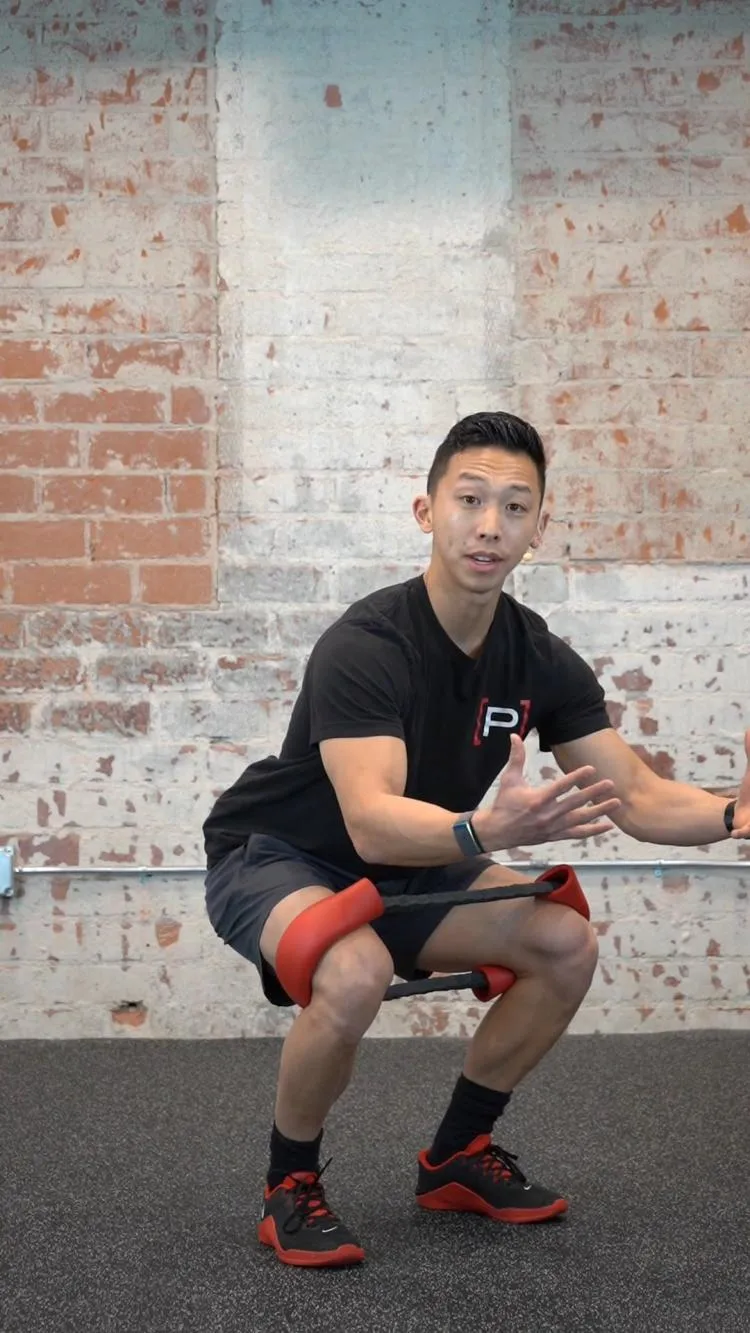
Tempo Squat - Band
View exercise instructions
- HOW: Loop a band just above your knees in a standing position. In this example, the tempo relates to the time it takes to lower into a squat, hold the squat, come back up, and the time in between reps. 5-3-1-0 is used for this squat. Five seconds to bend your knees, hinge slightly forward at the waist, and push out on the band as you lower into a squat. Three seconds to hold that squat at the bottom for an isometric contraction. One second to return to the starting position, and zero seconds in between reps. Perform this type of squat for the tempo that is prescribed to you.
- FEEL: You should feel your lower body muscles working during the squat. You should also feel your hip muscles working extra to push the band outward.
- COMPENSATION: Don’t cheat yourself on the times prescribed.
Exercise 02 of 04
Exercise demonstration
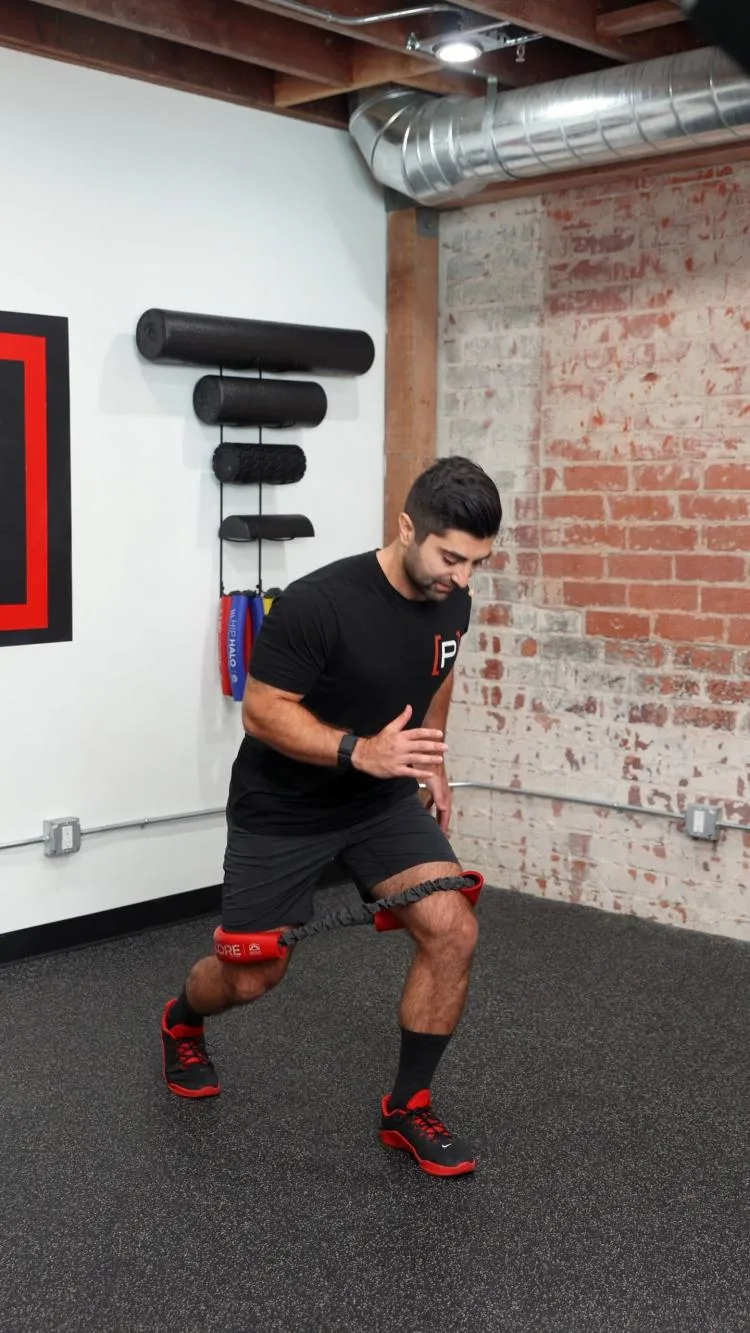
Tempo Split Stance Lunge - Band
View exercise instructions
- HOW: Begin by placing a band around your knees just above your knee cap. Place one foot in front and the other leg extended back with your back toes pushing into the ground. Keeping your torso straight up, lunge forward and down for 5 seconds, hold that position for 3 seconds, and push back up into the starting position. In this example, we used a 5310 tempo. Tempo exercises consist of 4 different numbers. In the example of a 5310 split stance lunge:
- 5 is the lowering or eccentric portion
- 3 is the pause at the bottom or isometric portion
- 1 is the rising or concentric portion
- 0 is the rest between reps at the top.
- Sometimes you will use an “X” to denote as fast as possible.
- FEEL: You should feel your quadriceps and glute muscles working. You should also feel a stretch in the front of your hip with the back leg.
- COMPENSATION: Keep your back upright, don’t slouch forward. Make sure to bend both knees as you lunge forward and keep that bend as you go down.
Want to learn some more lunge variations? Check out this article!
Exercise 03 of 04
Exercise demonstration
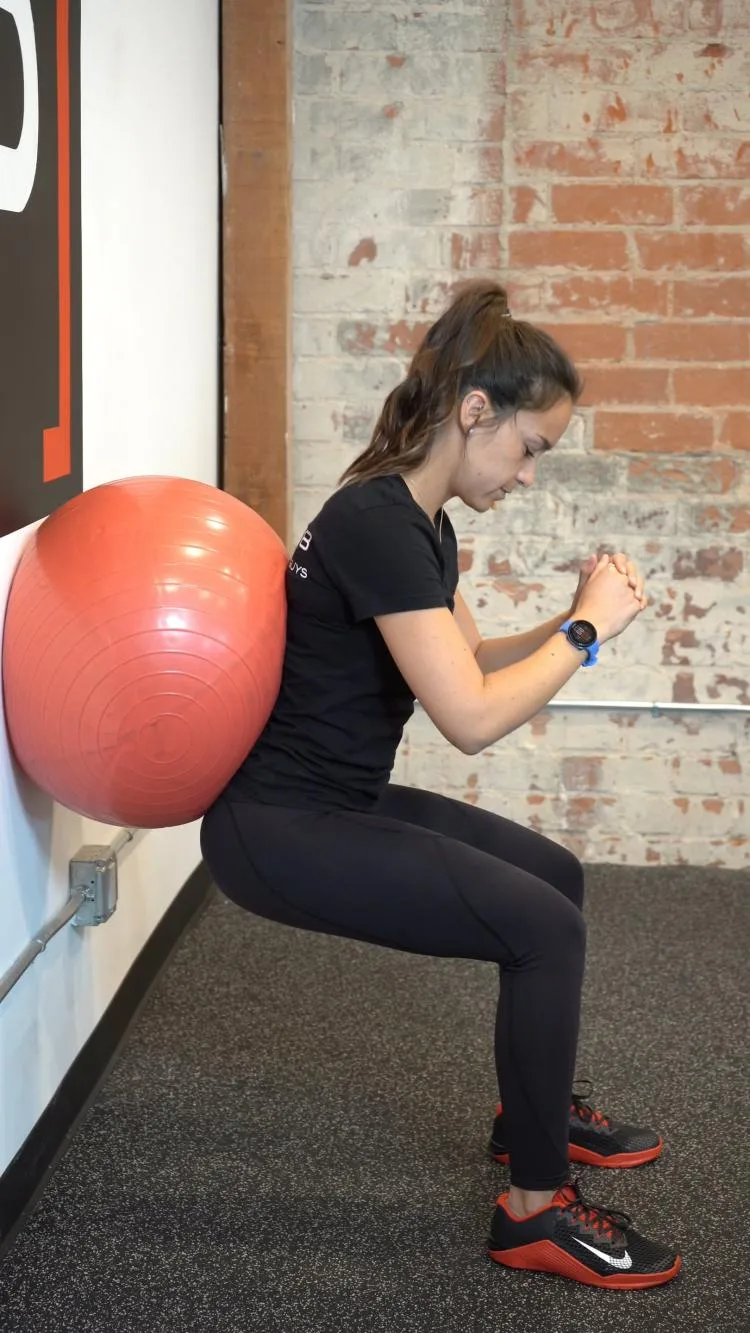
Eccentric Squat - Wall Supported, Swissball
View exercise instructions
- HOW: Place a swissball on a wall and position the middle or small of your back on the ball. Lean into the ball while keeping your chest up. Walk your feet out and have them about shoulder width. From here, sit down like you're sitting in a chair going slowly on the way down, then push into the floor back up into the starting position.
- FEEL: You should feel you glutes, hamstrings, and quadricep muscles working
- COMPENSATION: Keep pressure against the ball the entire time.
Exercise 04 of 04
Exercise demonstration
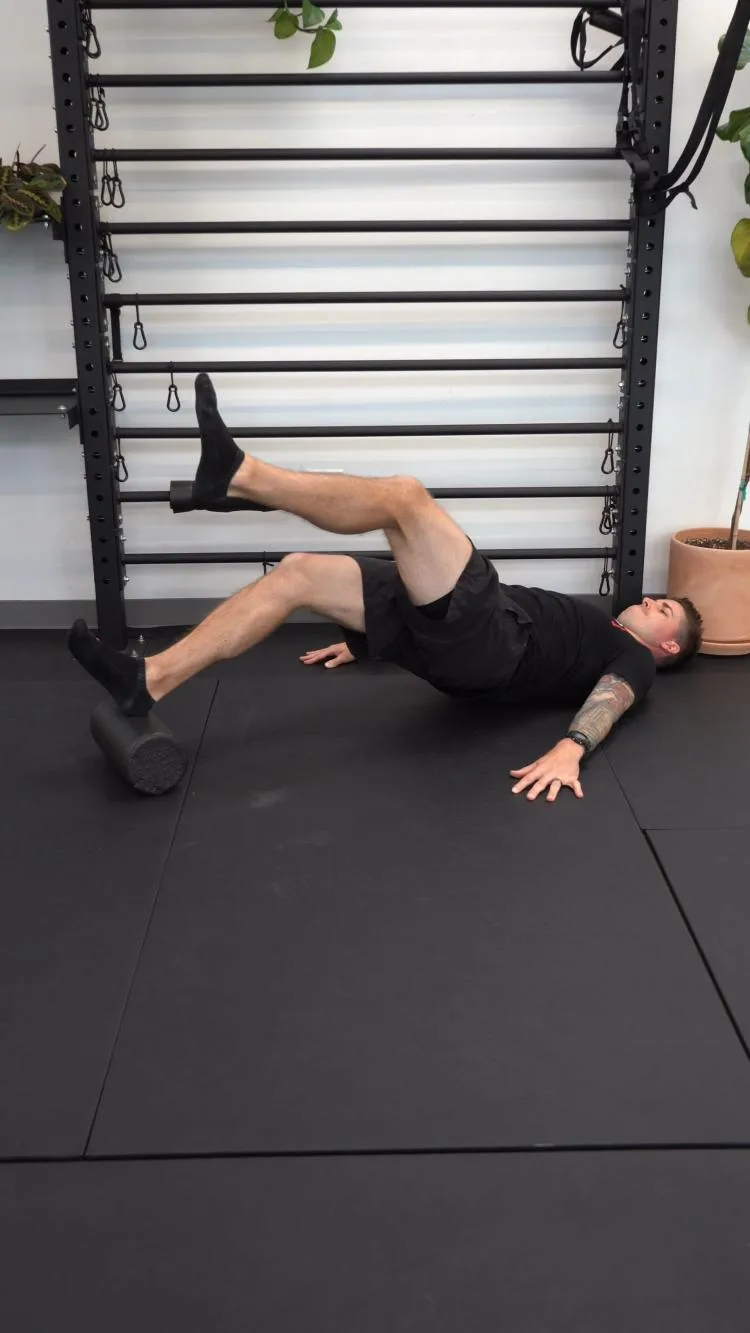
Eccentric Single Leg Hamstring Curl - Foam Roller
View exercise instructions
- HOW: Get set-up laying flat on your back with your heels on a foam roller. Begin the exercise by bridging up and lifting your hips off the ground. Hold this position as you bend your knees bringing your feet towards your butt. While keeping your hips as high off the ground and parallel to it as you can, lift one leg up and then slowly straighten your leg that is still on the foam roller. Repeat.
- FEEL: You will feel the muscles behind your thigh, knee, hip, and butt muscles working hard with this exercise. You may also feel your core and back muscles working too, but do not compensate too much with your back.
- COMPENSATION: Limit excessive arching of your back, keep your hips level with the ground. Do not let your hips drop very fast during the eccentric curl out as you straighten your leg.
Tempo is also something beneficial for tendon-based rehabilitation. Dealing with some tendon issues? Read this article!
If you are new to the strength and conditioning world, or just getting into exercise, you definitely will want to understand the concept of progressive overload. Listen to our podcast that will help you understand this important aspect of exercise!
LISTEN: HOW TO IMPLEMENT PROGRESSIVE OVERLOAD TO YOUR TRAINING ROUTINE!

If you have enjoyed this podcast and want more information on load management, check out this article as well!
Does Your Nutrition Meet Your Goals?
You can't have hypertrophy without enough calories. You need to fuel yourself properly in order to prevent injuries while trying to gain muscle. If you are trying to follow a nutrition plan that is designed to help you lose fat, you will fall short of your goals of building muscle. Choose one goal at a time to maximize your results.
You will need to be in a caloric surplus to gain muscle and the best approach is to take it slowly. Like we learned with childhood fables, slow and steady wins the race. In an effort to keep your body fat percentages low while being in a surplus, aim to have a caloric surplus of 250-500 calories per day.
How you break down these calories is going to affect your muscle gain and your overall body composition. Protein has the largest effect on gaining muscle compared to the other macronutrients, which are carbohydrates and fat. While in a surplus of 250-500 calories per day, aim to have 1.6 g/kg be your maximum target (Kreider 2019). There's no need or benefits going beyond this number, and your calories will be better used elsewhere.
After setting your target goal for protein, pay attention to your consumption of fat. Some research shows .8g/kg to be a minimum target for fat since it is important in maintaining hormonal health and building cell membranes (Kreider 2019).
The last macronutrient to plan for is everyone's favorite: carbohydrates. Although carbohydrates are activity-dependent, they function as the body's main source of energy. Carbohydrate consumption is often based on the preference of the individual, but a minimum target should be no less than 3g/kg if your goal is to build muscle (Kreider 2019).
Closing Thoughts
- Increasing volume over time is going to have the largest effect on gaining muscle.
- Spread this volume across multiple days instead of one long workout where you are blasting a muscle to help prevent injuries.
- Train 1-2 reps short of failure to help prevent injuries. Training to failure has a place, but it should be reserved for advanced trainees or towards the end of a training program.
- Use tempo to ensure your target muscles are lifting the weight, instead of using momentum.
- Set up your nutrition plan to be in a caloric surplus while prioritizing your intake of protein.
Learn How To Train For Longevity and Eliminate Injury Risk
Fitness is not about using such a high intensity that you are unable to get off the floor afterward. We are all about hard work, however, we want to make sure you are able to work out across the lifespan both safely and effectively. The number one reason why people no longer participate in an exercise program is due to injury, let's prove that statistic incorrect by using a fitness program with the intended goals of getting you in shape while avoiding injury! To do so, the first 4 weeks are meant to load your tissues to create a movement base this ready to take on the next 8 weeks. Let's also make sure that we are not just addressing the physical you but are helping you become healthier by giving you methods to decrease your internal load via positive self-talk and gratitude practices.
References
- Haun CT, Vann CG, Roberts BM, Vigotsky AD, Schoenfeld BJ, Roberts MD. A Critical Evaluation of the Biological Construct Skeletal Muscle Hypertrophy: Size Matters but So Does the Measurement. Frontiers in Physiology. 2019;10. doi:10.3389/fphys.2019.00247
- Schoenfeld BJ. The Mechanisms of Muscle Hypertrophy and Their Application to Resistance Training. Journal of Strength and Conditioning Research. 2010;24(10):2857-2872. doi:10.1519/jsc.0b013e3181e840f3
- Schoenfeld BJ, Grgic J. Does Training to Failure Maximize Muscle Hypertrophy? Strength & Conditioning Journal. 2019;41(5):108-113. doi:10.1519/ssc.0000000000000473
- Kreider RB. Essentials of Exercise & Sport Nutrition: Science to Practice. United States: Lulu Publishing Services; 2019.
About The Author
Ryan Nosak, MS, CSCS, SCCC
Prehab Writer & Content Creator
 Ryan was born and raised in Throop, Pennsylvania and he has worked in the world of fitness since he was 15 years old. Ryan realized he had a deep affinity for strength training and how it can alter the human mind, body, and spirit. He began his coaching career in high school by coaching his friends through strength training sessions, which inspired him to pursue a career in strength and conditioning.
Ryan spent 10 years as a Division 1 strength and conditioning coach with stops along the way at Penn State, Tennessee State, Vanderbilt, Robert Morris, Charlotte, and DePaul. He is a Certified Strength and Conditioning Specialist and operates his own training practice, RyNo Strength, out of Studio DelCorpo in Chicago, IL. He specializes in fat loss, body composition, strength, and sports performance training programs.
Ryan received his Bachelor’s Degree in Kinesiology from Penn State and a Master’s in Sport Management from Western Carolina University. In his free time, Ryan enjoys training for bodybuilding, eating at the amazing restaurants in Chicago, and spending time with his wife and dog.