


On this page 6 sections
Your guide
What you'll learn
You probably have been told that you don’t spend enough time stretching. Whether it was by a coach, a physical therapist, or a doctor; you’ve probably heard that you could have prevented an injury by stretching more. You may have also been told that if you don’t start stretching more, you will get hurt again! Like most people, you probably took the time to go through a full stretching routine before your next couple of workouts but slowly returned to your old habit of not stretching. Well, I am here with some good news: you don’t need to spend more time stretching! This probably comes as a shock to a lot of you, so let’s tackle the myths behind the benefits of stretching one by one, ultimately helping you answer the question, "How much do I need to stretch?".
Stretching Differences: Static vs. Dynamic
First, let’s make sure we establish a few definitions. Static stretching is a passive stretch of tissue through a full range of motion in a relaxed state. This is what we typically think of when someone says “stretching” and includes holding a stretched position for a long period of time (typically around 30 seconds). Examples include: bending forward to touch your toes, stretching your calf off the end of a step, or holding your elbow over your head with the opposite arm. In contrast: dynamic stretching is an active movement that typically takes you through a larger range of motion. This can include examples such as a walking lunge, bodyweight calisthenics, and many yoga positions that require sustained active holds. This article attempts to debunk the myths associated with static stretching without discouraging dynamic stretching which is entirely different. For the rest of this article, I will use the term “stretching” in place of static stretching as described above.
Improve Your Mid Back Mobility With Our Program!

When we think of the thoracic spine one word comes to mind; neglect. Thank you for striving to replace that word by completing this program! The thoracic spine is structurally designed to allow mobility to happen. If this area becomes neglected, the lower back and shoulders can become angry neighbors. The solution becomes restoring peace in the neighborhood by owning thoracic mobility. The block party is 8 weeks away and you are hosting the thoracic spine, get ready to impress your neighbors!
World's Greatest Stretch
- HOW: Follow along with the detailed video tutorial for all movement cues. This is a dynamic stretching routine, meaning you will be moving from different positions rather than just holding one position (which is more of a static stretch). We call this the World's Greatest Stretch as it allows you to move through different, full body positions, and enhances mobility in many different areas of the body as a result!
- FEEL: During various positions of this stretching routine, you will feel stretching through your hamstrings, mid back, hip flexors, and even portions of your low back such as your quadratus lumborum!
- COMPENSATION: Do not try to "overstretch" with these movements. Allow your body to stay within whatever range feels best for you! As you perform this stretching routine more regularly, you will find that your mobility will improve as a result!
Hip 90/90 Internal Rotation Stretch - Dynamic
Begin in a seated position with one leg in front of your knee bent and your lower leg on the ground. The other leg is bent at the side. From here, rotate towards the side leg and slowly return back to the starting position. Repeat for the prescribed amount of reps.
Exercise 01 of 04
Exercise demonstration
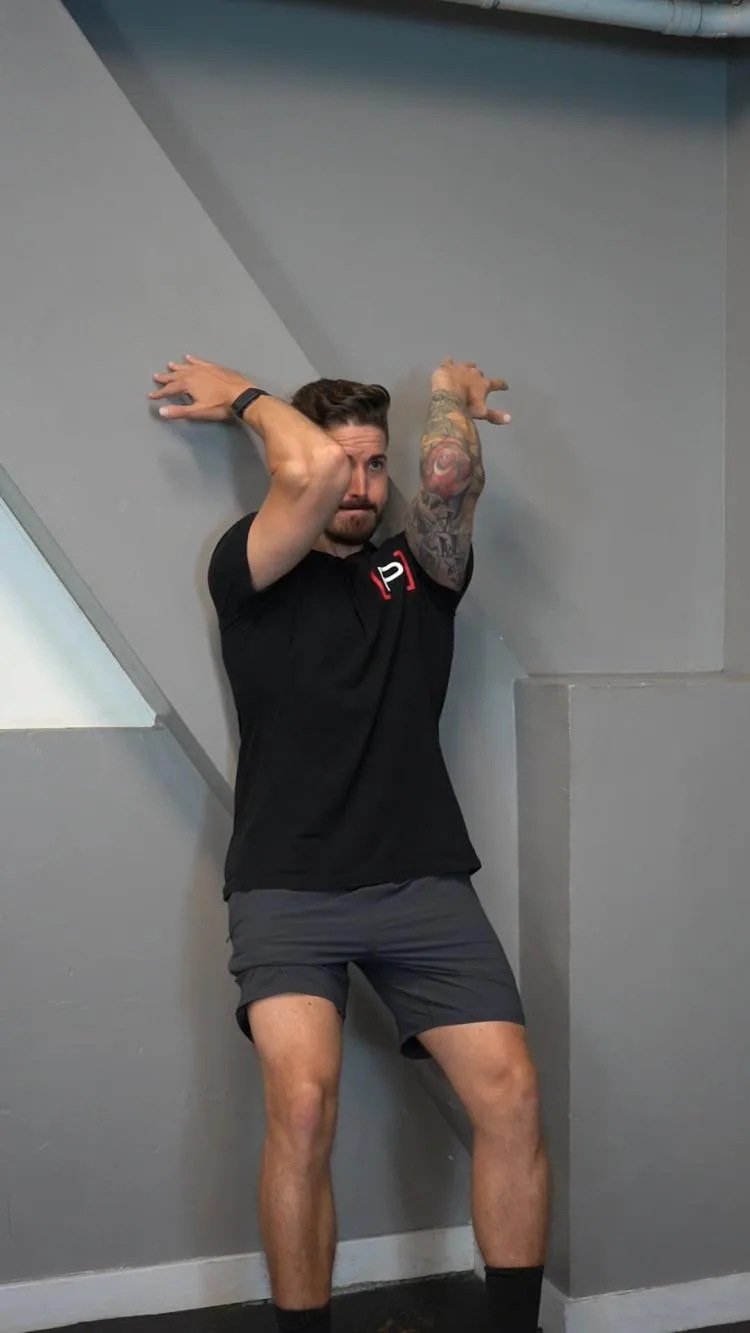
Lat Stretch - Dynamic
View exercise instructions
- HOW: Lean against a wall with your back flat and feet out with a slight bend in your knees. Raise both arms up as you rotate your hands out. Try to get your elbows to touch each other. Do this in a slow and controlled motion.
- FEEL: You should feel a stretch in your lat muscles.
- COMPENSATION: Keep you back and head flat on the wall.
Does Stretching Prevent injuries?
No! A variety of research trying to establish a link between decreased flexibility and increased injury risk has been conducted without any notable success. Many of these studies have focused on the sit-and-reach test which involves measuring how far forward one can reach their hands while sitting on the floor with legs extended. This is considered to be a measure of hamstring and low back flexibility and is recommended by The American College of Sports Medicine (ACSM) as part of a physical fitness testing battery.
A BETTER Way to Stretch Your Hamstring
A study of 37 Australian professional footballers sought to establish a link between preseason sit-and-reach testing and hamstring injuries and found no correlation between the two. The same study did however find a significant association between preseason hamstring muscle weakness and hamstring strains.
A similar study of 450 amateur soccer players in the Netherlands also found no correlation between the sit and reach test and hamstring injuries. In another study, the authors found that adding the Nordic hamstring exercise significantly reduced players risk of sustaining a hamstring injury.
Taken together, this research allows us to firmly say that taking the time to stretch your hamstrings will not decrease your risk of injury!

Will It help my performance?
No! You may need a certain level of flexibility to partake in some sports. For example, a baseball pitcher can’t throw a ball without the flexibility to reach behind his head and throw a strike and a dancer can’t reach her leg above her head without the requisite hip motion. However, these motions are accomplished through practice and repeatedly performing the movement, not by stretching into that movement. Numerous studies have shown that among participants increased flexibility is not associated with improved performance. These include studies of players in American football, Australian Football, Soccer, and Sprinting. One thing that has been consistently shown to improve performance in these and a variety of other studies is strength training!
LISTEN: ACUTE: CHRONIC WORKLOAD RATIOS

Is there any downside to stretching?
Unfortunately, yes! Recent research established that just 10 sessions of hamstring stretches, performed for a typical rep scheme of 3x30 seconds, decreased hamstring strength by an average of 7%! Furthermore, this also decreased functional athletic performance measured by distance on a single leg triple hop test! Given previous research establishing the links between strength and decreased injury risk, as well as strength and improved performance, the authors concluded that static stretching is likely to increase injury risk and decrease performance. It is crucial to note here that these negative effects were not found in a group that performed 10 sessions of dynamic stretches!
Is there ever a time to stretch?
Yes! If your goal is to be able to touch our toes – stretch! If your goal is to reach behind your head – stretch! If you are trying to improve your knee extension after a surgery– stretch! Essentially, if you are stretching for the explicit purpose of being able to reach into a further range of motion then by all means go ahead and stretch! However, if you are looking to improve your performance and decrease your risk of injury the science says strengthen, don’t stretch! Below are some examples of static stretches:
Exercise 02 of 04
Exercise demonstration
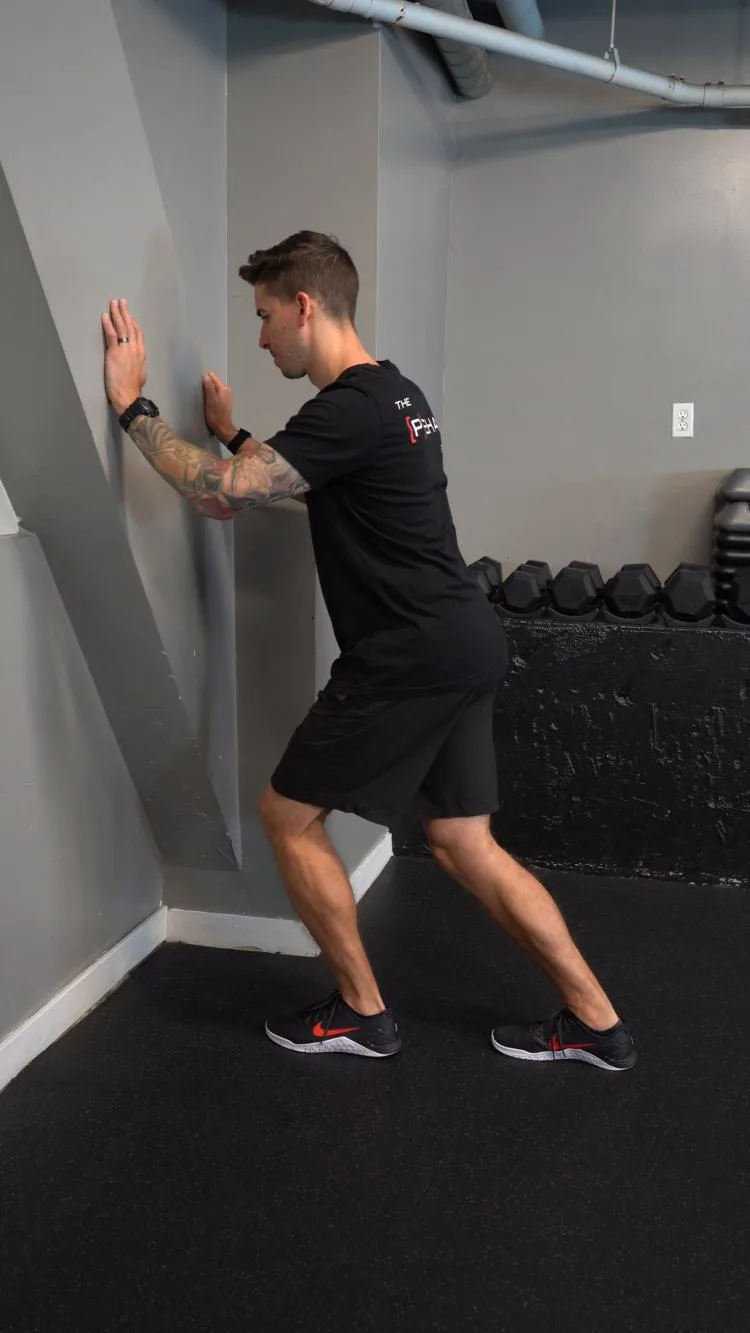
Wall Calf Stretch - Knee Bent
View exercise instructions
- HOW: Get set-up standing with a wall in front of you and place your hands on the wall. Take a step back with the side you plan to stretch, let the knee be bent and keep it bent. While keeping the foot you stepped back with flat on the ground, knee bent, and toes facing 12 o’clock, slowly lean and shift your weight forward until you feel a stretch.
- FEEL: You should feel a stretch in the calf of the foot that is behind you, specifically lower in your calf above your ankle. You shouldn’t feel pain or a pinch in front of your ankle.
- COMPENSATION: Be sure to keep your back foot facing 12 o’clock, do not let your foot turn out or in. Try to keep your heel down. Be sure to keep the knee bent
Exercise 03 of 04
Exercise demonstration
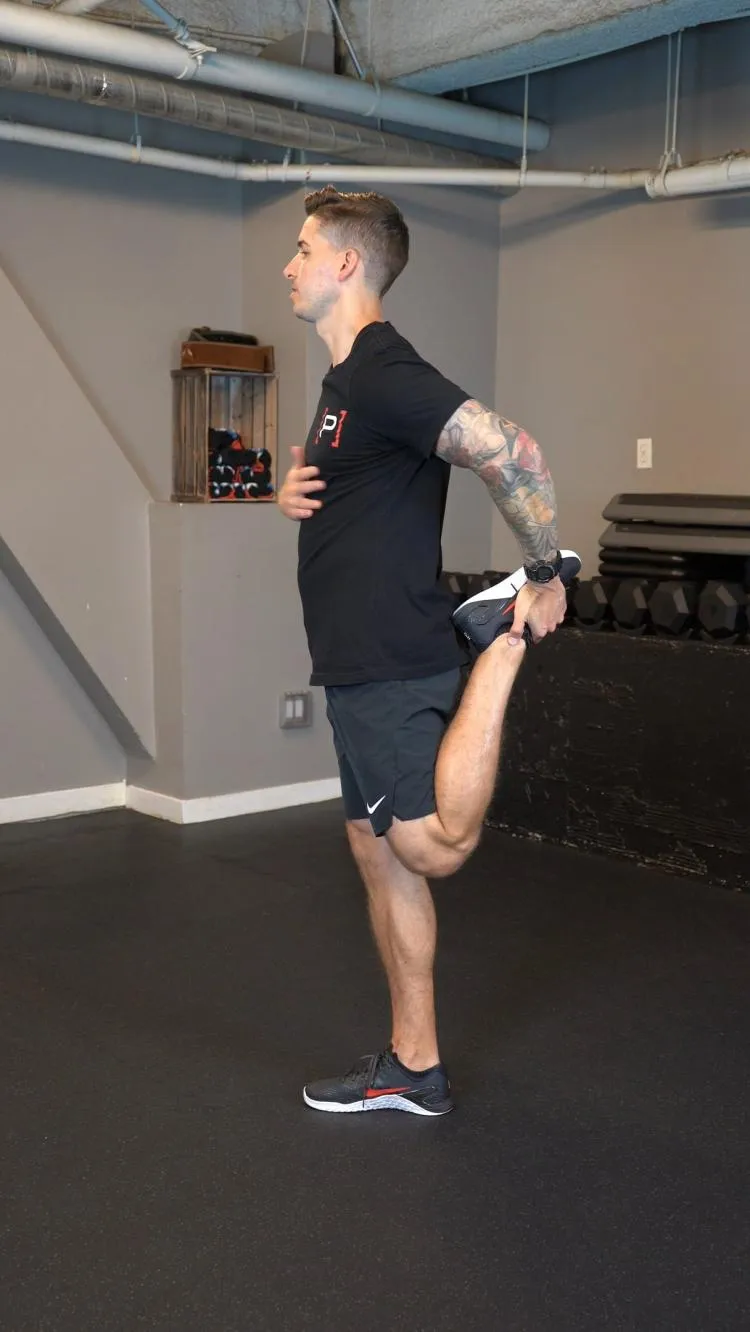
Standing Quadriceps Stretch
View exercise instructions
- HOW: Get set-up standing. On the side, you want to stretch, grab your foot and pull it back towards your butt by bending your knee. Keep a flat back, squeeze your butt muscle to push your hip forward, and have your knee directly below your hip. Hold this position.
- FEEL: You should feel a stretch on the top of your thigh in your quadriceps.
- COMPENSATION: Do not lean side to side or lose your balance, do not arch your back, do not let your knee flare out to the side excessively
Exercise 04 of 04
Exercise demonstration
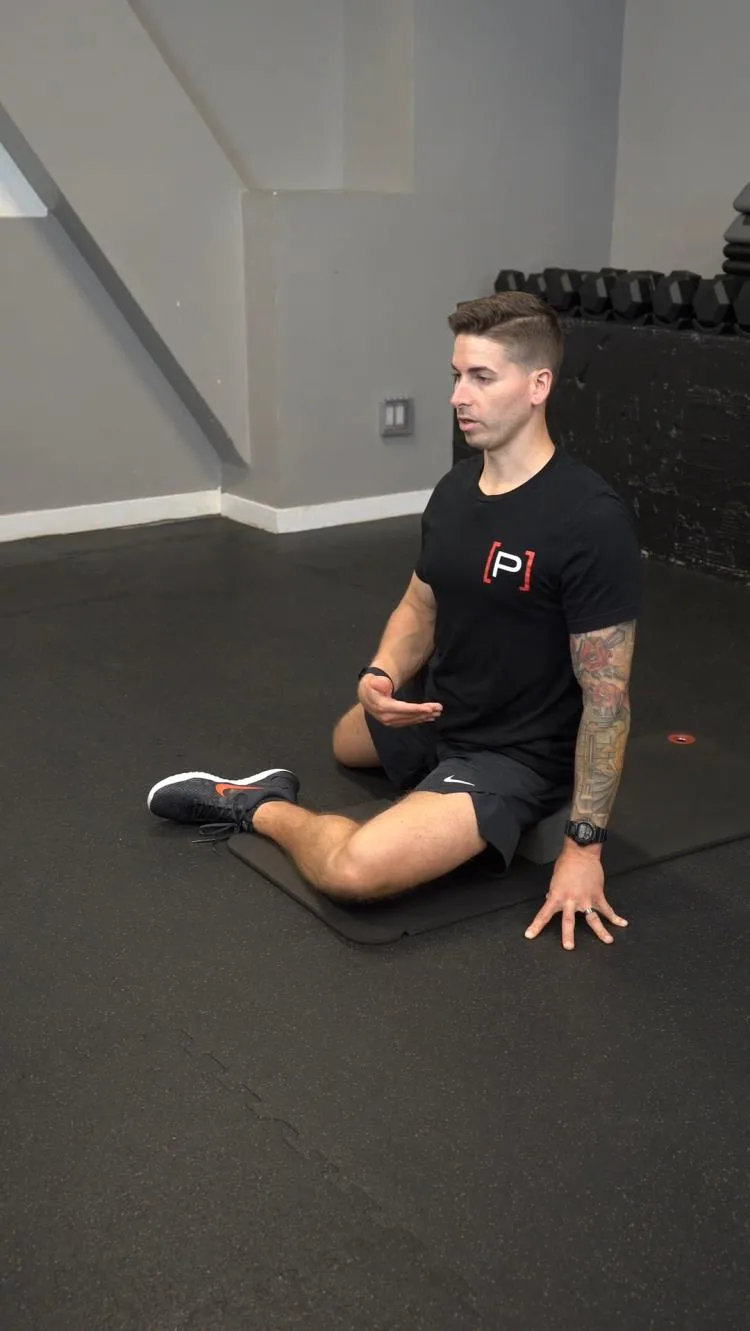
90/90 Hip Stretch
View exercise instructions
- HOW: Get set-up in a 90/90 position, you can use a yoga block or something else under your front hip to get into the correct position (follow video for tips and details). Once set-up, keep your thighs, knees, and feet flat against the ground, lift your chest up to make your torso long, shift your weight forward until you feel a stretch and hold that position.
- FEEL: You should feel a stretch in the back of your hip and your butt on the front thigh. You may feel a stretch inside your thigh and groin on the back leg.
- COMPENSATION: See video for tips and details, the most important thing is having a long torso and relatively straight back as best as you can especially when you shift your weight forward. We want to move through our hip and not our low back
Closing Thoughts
The proposed benefits of stretching are simply not backed by any science. However, research has shown that strength training both improves athletic performance and decreases injury risk. If you are looking to prepare for your sport or a strength training session it is best to go through a dynamic warmup routine that prepares you for the movements you intend to perform. Hopefully, this article saves you some time in the gym and spares you the guilt over skipping your pre-workout stretches!
No More Stiffness Between Your Shoulder Blades!
Enough is enough! It is time to get rid of that nagging tightness that won't go away between your shoulder blades. This thoracic spine mobility program is the ultimate guide to unlocking your stiff mid back and maximizing your mobility!
About The Author
Tommy Mandala, PT, DPT, SCS, OCS CSCS
Prehab Writer & Content Creator
 Tommy Mandala is a Doctor of Physical Therapy, Board Certified Clinical Specialist in Sports & Orthopedics, and Certified Strength and Conditioning Specialist in New York City. He is the founder of ALL IN ACL, a digital coaching platform dedicated exclusively to helping ACLers return to the life they had before their injury with full confidence in their knee. Prior to that, he worked in the sports clinic at Hospital for Special Surgery, the #1 Orthopedic Hospital in the country. While there, he had the opportunity to hone his skills as an ACL specialist working closely with world renowned surgeons and evaluating patients from all over the world. He completed his sports residency training at the University of Delaware where he had opportunities to work with many of their Division I sports teams as well as the Philadelphia 76’ers NBA G-league affiliate, the Delaware Blue Coats. He also trained at Champion Sports Medicine in Birmingham, Alabama where he had the opportunity to learn from researchers in the American Sports Medicine Institute. Currently, Tommy works exclusively with ACLers through his digital coaching model. While many of these clients are athletes, Tommy works with ACLers of all different abilities helping them to build the strength they need to overcome this unique injury. One of his favorite aspects of his job is taking active clients who have never been a “gym person” before and showing them the amazing things that happen when they learn to strength train.