


On this page 4 sections
Your guide
What you'll learn
Looking for exercises to fix flat feet? We got you! But before we get into the exercises that can help address this "problem", we first want to address that flat feet in and of itself is NOT a diagnosis and NOT the sole cause of your pain! Pain is multi-factorial and while having "flat feet" or dynamic overpronation can place the most stress on certain structures, our bodies are extremely strong and capable of handling that stress most of the time. That being said, this article is going to show you a series of exercises that will not only help strengthen your foot arch but even potentially reverse the appearance of your flat feet!
Do You Really Need To Fix Flat Feet?
Flat feet get blamed for a myriad of conditions. Plantar fasciitis, Achilles tendonitis, patellofemoral pain, knock knees - you name it. And while having flat feet may in fact be associated with many of these conditions, it's near impossible to put the sole blame of the condition or diagnosis on simply having flat feet. In many situations, it could be argued that the condition (ie plantar fasciitis) may have occurred first and contributed to the development of flat feet! More on this in a bit. So, if we can't place the blame solely on our flat feet for our pain, do flat feet need any fixing? We would argue no you don't more than we would suggest yes!
Build A Stronger Foot To Improve Your Overall Foot Health!

The Foot & Ankle complex connects your leg to the environment. It acts to translate and accept forces from the leg to the ground and from the ground to the leg. Whether your goal is to decrease discomfort, improve walking ability, or prevent future foot & ankle injuries from happening you're in the right place!
Think about this - your flat feet didn’t just develop overnight. It took years and years for you to even notice you had flat feet. My guess is that you didn’t even notice them until someone told you, or you started developing pain and someone said it was because of your flat feet. Our bodies get into trouble when the loads we place on them are more than what they can handle. When it comes to “flat feet”, this could be after changing into a new pair of shoes that have more “give” than your older pair, thus allowing your foot to pronate more and stress certain tissues more than what they are used to. Or it could be that your training volume increased as you prepped for an upcoming race or event, and certain tissues were stressed more than what they are used to.
READ: Running After A Stress Fracture

When it comes to “fixing” your flat feet, we can work on those external factors discussed above while at the same time strengthening those same structures that need to have more strength and capacity to handle the loads that you are placing on them. The following exercises will do just that. Strengthening some of your foot intrinsics while also improving ankle ROM to potentially alleviate excessive stresses on certain foot structures. Give em a shot, they’re harder than they look!
Flat Feet Explained: Tips for Pain Relief
Address Mobility
The number one cause (or result?) of flat feet is a lack of ankle dorsiflexion mobility. Ankle dorsiflexion is the ability of your ankle to point upwards. In a standing position, this is our knees going past our toes. When we take steps, go up or downstairs, or even squat or lunge, our ankles go into relative dorsiflexion with each step or rep. As you can imagine, ankle dorsiflexion occurs a lot in day-to-day life!

If you have limited ankle dorsiflexion, your body will find a way to compensate to achieve the task at hand. Our bodies are smart and if we have to go down a few flights of stairs, we're going to do it! This means that to get our knees over our toes when we are going downstairs, that motion must come from another body region. That region is your arch!
Your arch will dynamically collapse (what it's supposed to do and is normal) and allow your foot to pronate to give you that extra range of motion. When this is repeated over and over again, eventually it can lead to the arch sitting in a lower position - ie flat feet!
To address these ankle dorsiflexion mobility deficits, we want to improve the mobility of two different structures:
- The calf muscle or gastroc-soleus complex
- The ankle joint or the talocrural joint
Exercise 01 of 04
Exercise demonstration
Ankle Mobility
Sample Ankle Dorsiflexion Mobility Overhaul Exercise
This is one of the easiest ways to work on your ankle mobility. The beauty of this exercise and demonstration is that you get to personalize and individualize the movement to your needs! You can also read further information on a blog we have that includes specific exercises to help improve stiffness of the foot and ankle! Follow along with Craig as he shows you:
- Different angles to address
- Being mindful of the position of your arch
- What to do with your heel
- How it sound feel and what you’re looking for

Exercise 02 of 04
Exercise demonstration
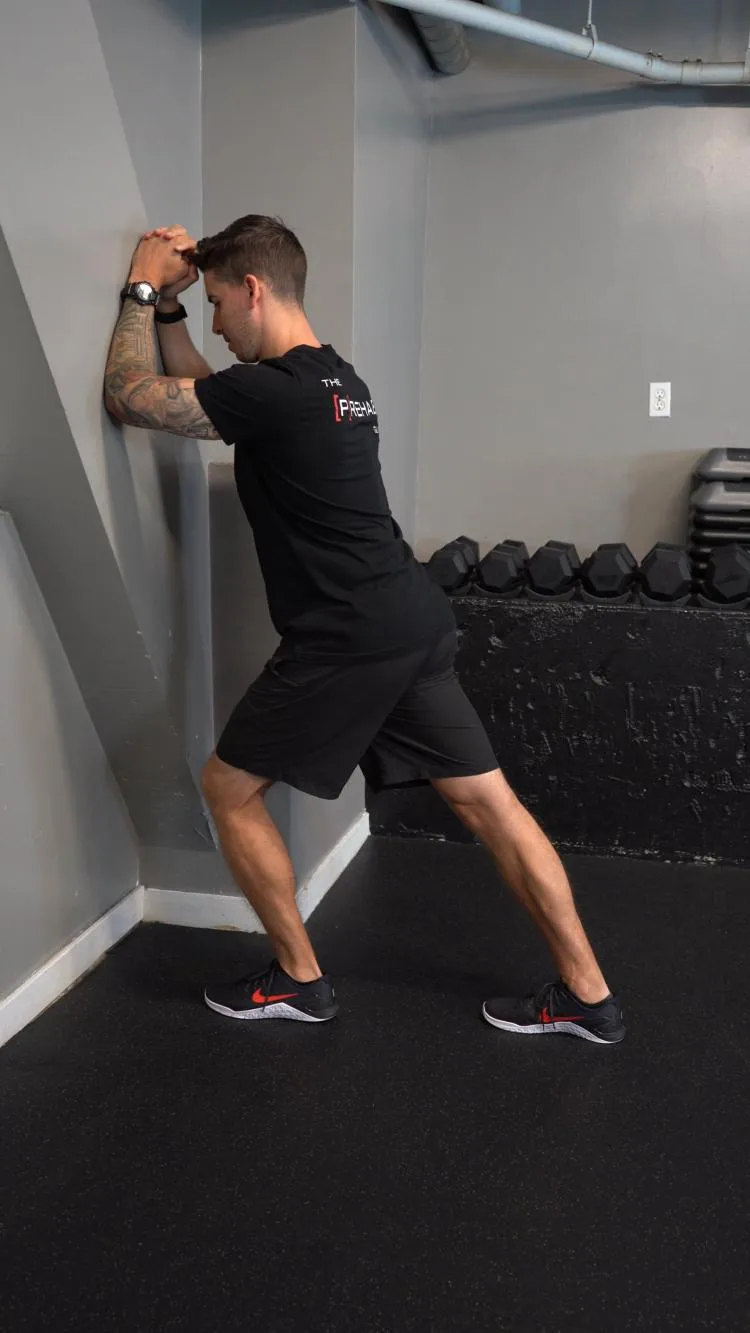
Wall Calf Stretch - Knee Straight
View exercise instructions
- HOW: Get set-up standing with a wall in front of you and place your hands on the wall. Take a step back with the side you plan to stretch. While keeping the foot you stepped back with flat on the ground, knee straight, and toes facing 12 o’clock, slowly lean and shift your weight forward until you feel a stretch.
- FEEL: You should feel a stretch in the calf of the foot that is behind you, specifically behind and below your knee and potentially right above your ankle. You shouldn’t feel pain or a pinch in front of your ankle.
- COMPENSATION: Be sure to keep your back foot facing 12 o’clock, do not let your foot turn out or in. Try to keep your heel down. Keep the knee straight
Perform Strengthening Exercises
While mobility work is absolutely critical to "fixing" a flat foot, all the mobility work in the world wouldn't do anything if the muscles themselves that take the loads when the arch collapses or pronates are not strong enough! Strengthening these muscles takes some isolated work at first to learn how to maintain a strong and stable arch known as an active short foot. But the real key to strengthening your feet is to actually use the muscles in your feet during any and all standing exercises (duh!). This may seem obvious, but it's extremely easy to stand on one leg, squat, or lunge without an active short foot. So once you've mastered the short foot holds exercise below, maintain an active short foot with all the other standing single leg exercises that follow!
Exercise 03 of 04
Exercise demonstration
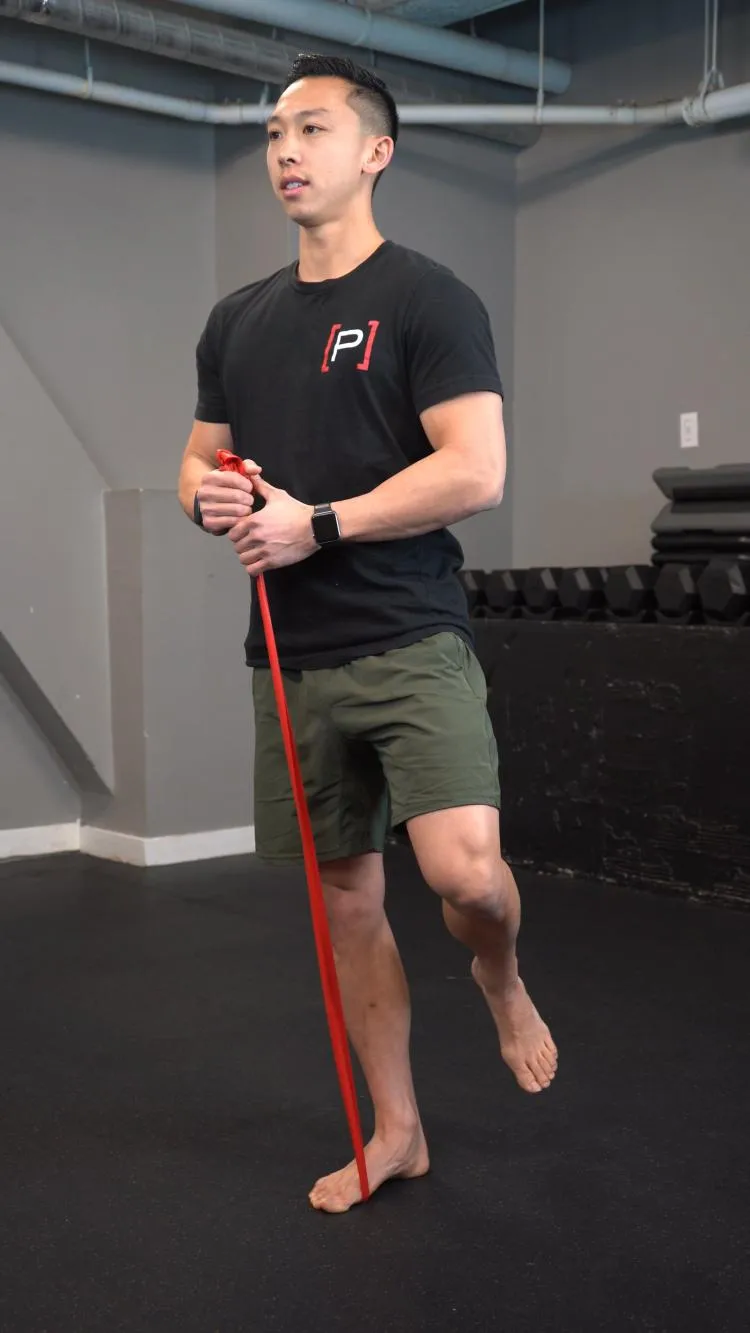
Single Leg Short Foot Hold - Band
View exercise instructions
- HOW: Get set up standing with a theraband under the knuckle of your big toe on one side. Begin the exercise by lifting your arch and assuming optimal foot/ankle position, then balance on that leg for that time prescribed.
- FEEL: You should feel all the muscles in your foot, your arch, and your calf working with this exercise. After some time passes, you may also feel your hip on the same side you're balancing on working as well.
- COMPENSATION: Do not lose optimal foot/ankle position, don't let your arch fall, don't let the knuckle of your big toe lift off the ground. Maintain single leg balance with optimal pelvis and trunk control/position.
Exercise 04 of 04
Exercise demonstration
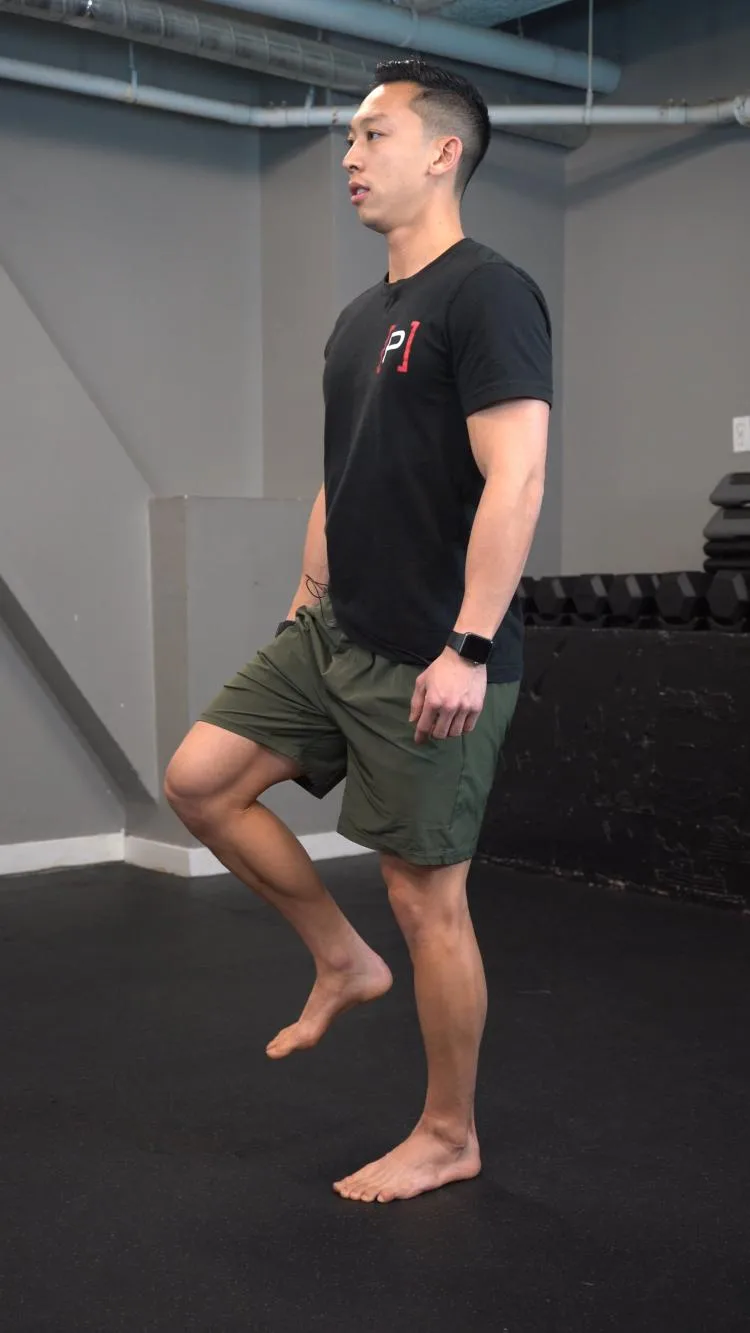
Single Leg Woodpecker
View exercise instructions
- HOW: Get set up balancing on one leg with good arch position. Begin the exercise by leaning forward and shifting your weight and center of gravity towards your toes. Go just until the point that you can control and not let your heel lift off the ground. Push the front of your foot into the ground to return to starting position and repeat.
- FEEL: This should feel like a control exercise, specifically your calf and foot muscles working to control your center of gravity shifting forward. You should also feel your calf and foot intrinsic muscles working to return your body to starting position.
- COMPENSATION: Keep your body straight, don't fold at your hips or arch your back with this exercise. Use your calf and foot muscles to do the work.
Closing Thoughts
By addressing ankle mobility deficits and strengthening the muscles of your arch, there is a high chance you work on decreasing the amount of stress placed on any tissues in your foot or lower leg that may be stressed due to overpronation, or flat feet. And hopefully, after reading this article, you will know that you are more than your anatomy! Simply having flat feet isn't a death sentence!
Take Control of Your Foot & Ankle Health
The foot and ankle programming you need at the tip of your fingers is HERE. Learn step-by-step progressions from Doctors of Physical Therapy and Strength & Conditioning Specialists to optimize your foot and ankle health.
About The Author
Michael Lau, PT, DPT, CSCS
Prehab Co-Founder & Chief Product Officer
 Michael was born and raised in Northern California but now currently resides in Sunny SoCal ever since attending the University of California, Los Angeles as an undergraduate majoring in physiology. After his undergraduate studies, he received his Doctorate in Physical Therapy from cross-town rival the University of Southern California. As a licensed physical therapist with a strong background in strength and conditioning, Michael likes to blend the realms of strength training and rehabilitation to provide prehab, or preventative rehabilitation, to his patients. A common human behavior is to address problems after they become an issue and far often too late, which is a reactionary approach. He believes the key to improved health care is education and awareness. This proactive approach-prehab-can reduce the risk of injuries and pain in the first place. He is a huge proponent of movement education and pain science. Clinically, he has a special interest in ACLR rehab and return to sport for the lower extremity athlete.