


On this page 5 sections
Your guide
What you'll learn
Trendelenburg gait, otherwise referred to as a hip drop or trunk lean with walking are all compensatory movement patterns that may lead to back pain, hip pain, knee pain, or SI joint pain over time. There are many reasons this may occur, some of which include pain secondary to a recent injury or surgery, poor hip strength, limited mobility, inhibited hip musculature, developed movement compensations, and much more. It is important to be aware of this movement impairment, as this can lead to problems up and down the kinetic chain. This article will demonstrate excellent exercises to fix your Trendelenburg gait starting with activation, followed by strengthening, and finally movement re-training!
What is a Trendelenburg Gait?
Quick History Lesson: In 1895 Freidrich Trendelenburg described the Trendelenburg sign as weakness of hip abductor muscles in reference to congenital dislocations of the hip and progressive muscular atrophy. Fast forward to today: most orthopedic and physiotherapy textbooks describe this sign as a test of hip function.
Apley’s system of orthopaedics wrote: “Normally each leg bears half the body weight. When one leg is lifted the other takes the entire weight. As a result, the trunk has to incline towards the weight-bearing leg. This is achieved by the hip abductors; their insertion is fixed and the pull is exerted on their origin. Consequently, the pelvis tilts, rising on the side not taking weight. When this mechanism fails, Trendelenburg’s sign is positive. The pelvis drops instead of rising on the unsupported side.”
What is MVIC? You will see this term "MVIC" used a couple of times throughout the article. MVIC is an acronym that represents the term "Maximal Voluntary Isometric Contraction". This is the greatest amount of tension a muscle can generate as well as sustain for an allotted amount of time.
Trendelenburg and compensated Trendelenburg [Fix your Pelvis Drop!]
Shown here are 2 movement strategies, both of which are most commonly caused by weakness and/or poor motor control of the hip abductors (particularly the gluteal muscles):
1. The first strategy (Trendelenburg) shown here is a manifestation of a pelvic drop, in which the pelvis on the same side as the limb that is swinging forward (swing phase) will DROP. This is because the recruitment of the hip abductors of the stance limb (the leg in contact with the ground) is less than optimal to maintain a level pelvis.
2. The second strategy (Compensated Trendelenburg) shown here is a manifestation of a trunk lean towards the stance limb. This movement strategy brings my center of mass over my base of support (the stance foot). This is a compensatory strategy to decrease the external moment (demand) that gravity will put on my hip abductors aka making it easier for the hip abductors on that side to support the pelvis!
In a normal gait pattern, the trunk and pelvis are stable meaning there will be less than 5 degrees of movement in the frontal plane (from side to side). If one begins to walk with a Trendelenburg for an extended period of time, it may lead to low back pain.
The Ultimate Hip Programming At Your Fingertips

The Hip [P]tehab Program is a physical therapist developed, step-by-step program that teaches you how to optimize your hip health. This program will bulletproof your hips for anything life throws at you! Learn more HERE!
Exercise 01 of 07
Exercise demonstration
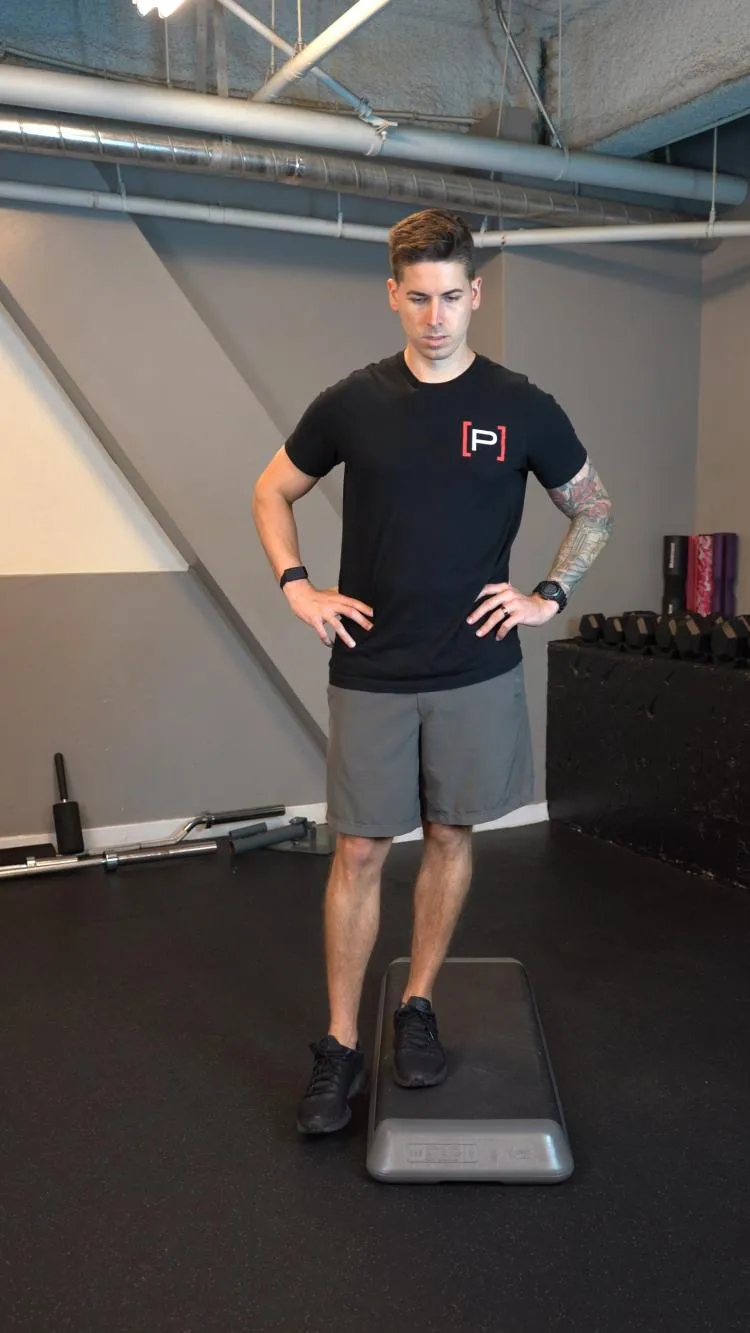
Hip Hike
View exercise instructions
- HOW: Start by standing on one leg on a box or small elevated surface with your hips even and parallel to the ground. Let the foot that is in the air fall towards the ground by performing a hip drop followed by a hip hike. Repeat
- FEEL: You will feel the muscles on the outside of the hip working that is still grounded.
- COMPENSATION: Try to limit motion to hip hiking and dropping, nothing else.
Why is the recruitment of the gluteal muscles so difficult? One reason is the poor representational area in the primary motor cortex for these muscles! Here is a great way to improve muscle recruitment of the hip abductors, particularly the gluteus medius! Evidence suggests that static isometric glute med toque is a poor predictor of frontal plane pelvic drop. You only need average glute med strength to prevent a Trendelenburg gait pattern yet so many people present with this movement pattern. Hence, it is not so much strengthening, but motor control training is important to prevent this compensatory movement pattern. This dynamic exercise helps with not only strength but also MOTOR CONTROL of the hip abductors.
To perform this exercise:
✅ Elevate the leg opposite to the one you want to work on. Allow a majority of your weight to be accepted through the leg that is in contact with the floor.
✅ Focus on using your hip abductors to bring the pelvis back to a neutral alignment. Use a mirror to allow yourself to perform this with optimal form and progress to the point where you no longer require visual cues.
✅ If strength and endurance are the goal then repeat until fatigue!
✅ If Motor Control is the goal: REPEAT REPEAT REPEAT for numerous repetitions to make those neuroplastic changes in the brain! This is the only way to increase representation in your primary motor cortex!
Exercise 02 of 07
Exercise demonstration
Fixing Your Pelvic Drop & Why It's Important
Teaching a movement is divided into 3 parts: Activation, Strengthening, & Movement Training. This exercise would be categorized as an activation drill. Note: Bolga et al did a study on Pelvic Drop determining a 57-59% MVIC- That’s Great activation folks!
LISTEN: HOW TO BEGIN STRENGTH TRAINING

Strengthen the Hips!
Gluteus medius strength is important in an applied sports setting, evidence suggests that unilateral hip abduction weakness has been associated with an increased risk of injuries in sports such as soccer, ice hockey, and running. The weakness here has also been associated as the cause of knee, hip, and low back pathologies. In support of this, it has been shown that athletes with stronger hip abduction strength are less likely to be injured compared with athletes with weaker hip abduction strength.
Here are 3 great exercises to improve strength here:
✅ Supine to Side Plank (AKA Side Plank w/ Hip Abduction): 89–103 % MVIC (Maximal Voluntary Isometric Contraction) -NR Boren et al.
✅ Side-Lying Hip Abduction: 56% MVIC - NR Boren et al.
✅ Clams: 62–77% MVIC -NR Boren et al.
There is evidence to suggest that strengthening on its own will not help with poor movement patterns such as Trendelenburg or dynamic knee valgus. You need to also train the muscles to activate at the right time which we call “Motor Control.”
Exercise 03 of 07
Exercise demonstration
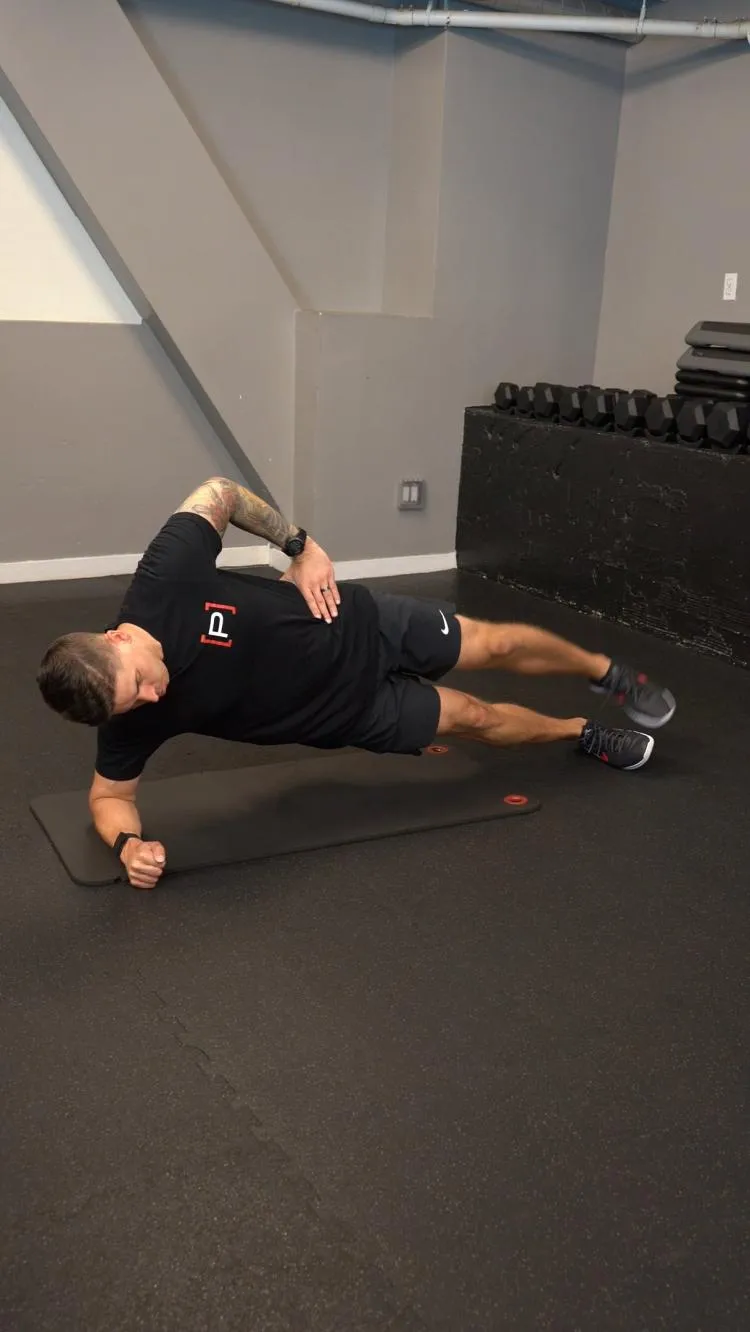
Side Plank - Hip Abduction
View exercise instructions
- HOW: Get set-up on your side with your elbow directly under your shoulder and your forearm supported on the ground. Have your feet stacked and supported on the ground with the knees straight. To begin the exercise, push your hips up and forward as high as you can and hold this position. Then lift your top leg up towards the ceiling while keeping it straight and in line with your body, lower and repeat.
- FEEL: This should feel like a full-body exercise. Your shoulder and shoulder blade muscles will be working as well as your hip, back, and stomach muscles. You will especially feel your right hip and core muscles working if you’re laying on your right side. Follow the video for other cues and tips.
- COMPENSATION: Do not let your hips or shoulder sag, do not let your body rotate.
This exercise has actually shown in studies to have the highest EMG activity for the gluteus medius, which is an important muscle to train in order to fix your Trendelenburg gait. Check out the infographic below!
Best Exercises For The Glute Med

Exercise 04 of 07
Exercise demonstration
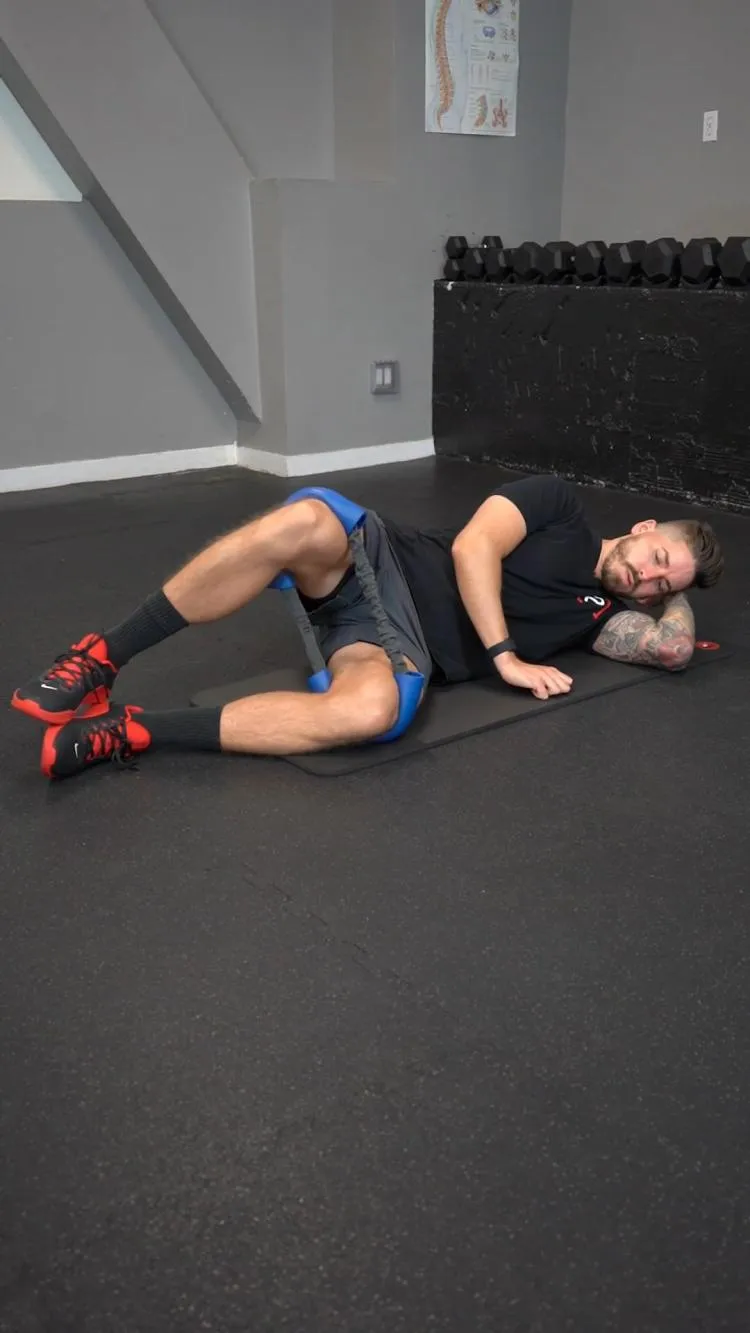
Side Lying Clam - Band
View exercise instructions
- HOW: Begin by lying on your side with your leg together. Slightly bring your knees up towards your chest. Loop a band around both knees. From here, use the top knee to push against the resistance while your feet stay together. Bring that knee up as far as you can until you start to open up your hips and rotate back.
- FEEL: You should feel your hip muscles working.
- COMPENSATION: Don’t lean back and open up your hips as you push against the band.

Strengthening + Movement Re-Training
Once you begin to strengthen a particular area, you also want to move into more functional movement patterns that are translatable to the activities you perform on a daily basis. This progression is essential to ensure that quality movement patterns stick long-term!
Exercise 05 of 07
Exercise demonstration
Captain Morgan

View exercise instructions
- HOW: Get set-up standing near a wall, place one knee and thigh up against the wall with your thigh about parallel to the ground. Try to be standing tall or leaning slightly into the wall, then push your knee into the wall as hard as you can and also push with the leg that is in contact with the ground.
- FEEL: You will feel your hip and butt muscles working on the leg that is in contact with the ground. You will also feel your hip and butt muscles on the side that is pushing against the ball against the wall.
- COMPENSATION: Do not lose knee position on the wall, do not lean away from the wall or lean back, try to not let your knee excessively bend on the side that is in contact with the ground.
While maintaining this, let your hip/pelvis sink on the side further away from the wall followed by lifting your hip back up to push harder into the wall, and repeat.
Exercise 06 of 07
Exercise demonstration
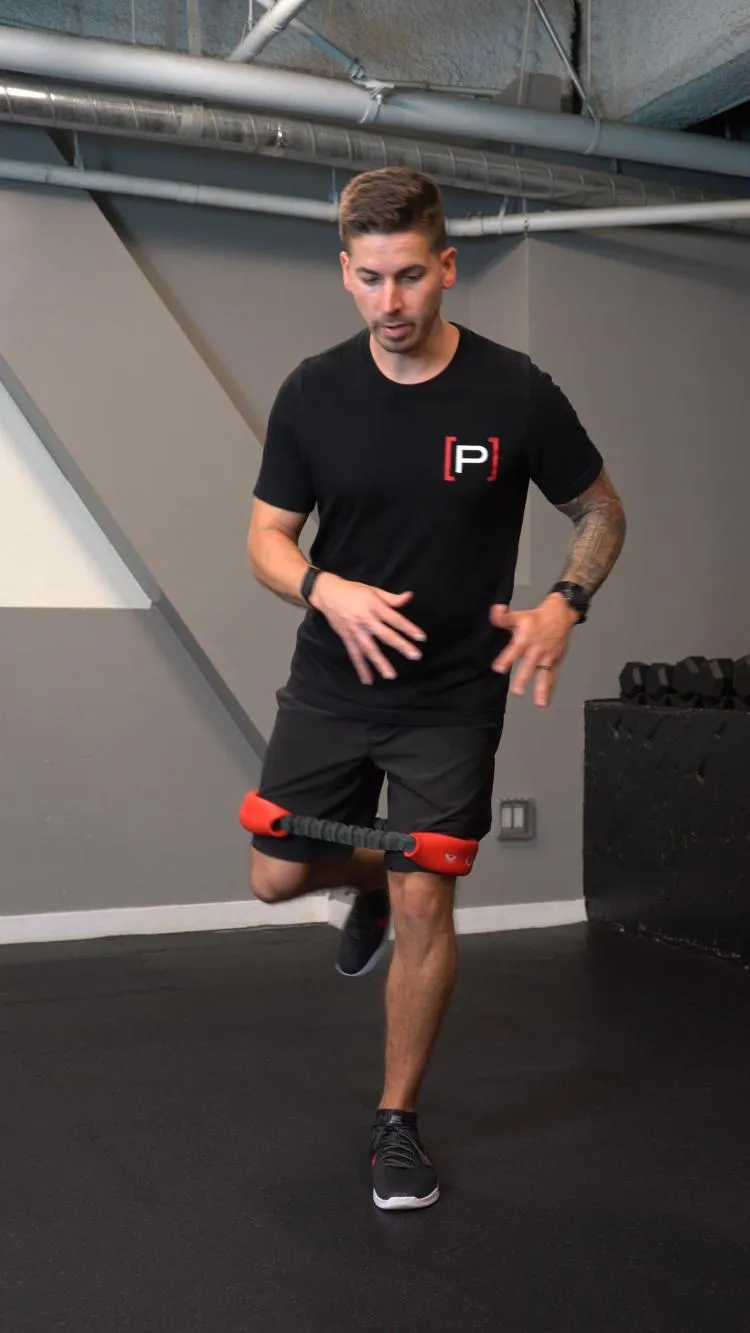
Single Leg Fire Hydrant - Feed In, Feed Out, Band
View exercise instructions
- HOW: Get set-up standing on one leg with the hip and knee slightly bent while holding a clam motion with the other leg with a band on around your knee. While maintaining this motion, feed in and out of your hip by moving your pelvis on your hip. Think of if you were wearing a belt - you are turning your belt buckle in followed by turning out. Try to keep your pelvis and shoulders square as you rotate.
- FEEL: You should feel your hip muscles, especially the outside of your hip on the side you're standing on working to perform and control this motion. You will also feel muscles in the rest of your leg working including your calf and maybe your arch. You will also feel your hip working on the side that you have your leg in the air.
- COMPENSATION: Perform this movement slowly, keep a neutral trunk and low back position, try to perform strict rotation of your pelvis on your hip versus leaning side to side or bend more or less at your hip.
It is recommended to first activate the weakened area (to increase corticomotor excitability) -> strengthen -> then you can movement train. Because all the glute med strength in the world doesn’t matter if doesn’t activate at the appropriate time (AKA Motor Control). Here are 2 great exercises to challenge the muscle function of the hip abductors- primarily the gluteus medius. Remember- Keep your pelvis level, after all this is the Trendelenburg article!
Note: Feel free to hold these positions statically- this will facilitate “encoding” for cognitive processes which are thought to play an important role in helping the learner create a motor memory. Static holds require prolonged focus and concentration, thus strengthening the corticomotor pathway to create motor learning.
Note 2: research has shown the importance of strengthening not only the gluteus medius but also the quadriceps and the hamstrings. Increases in the strength of the muscles will result in a reduction of the degree of Trendelenburg gait.
Exercise 07 of 07
Exercise demonstration
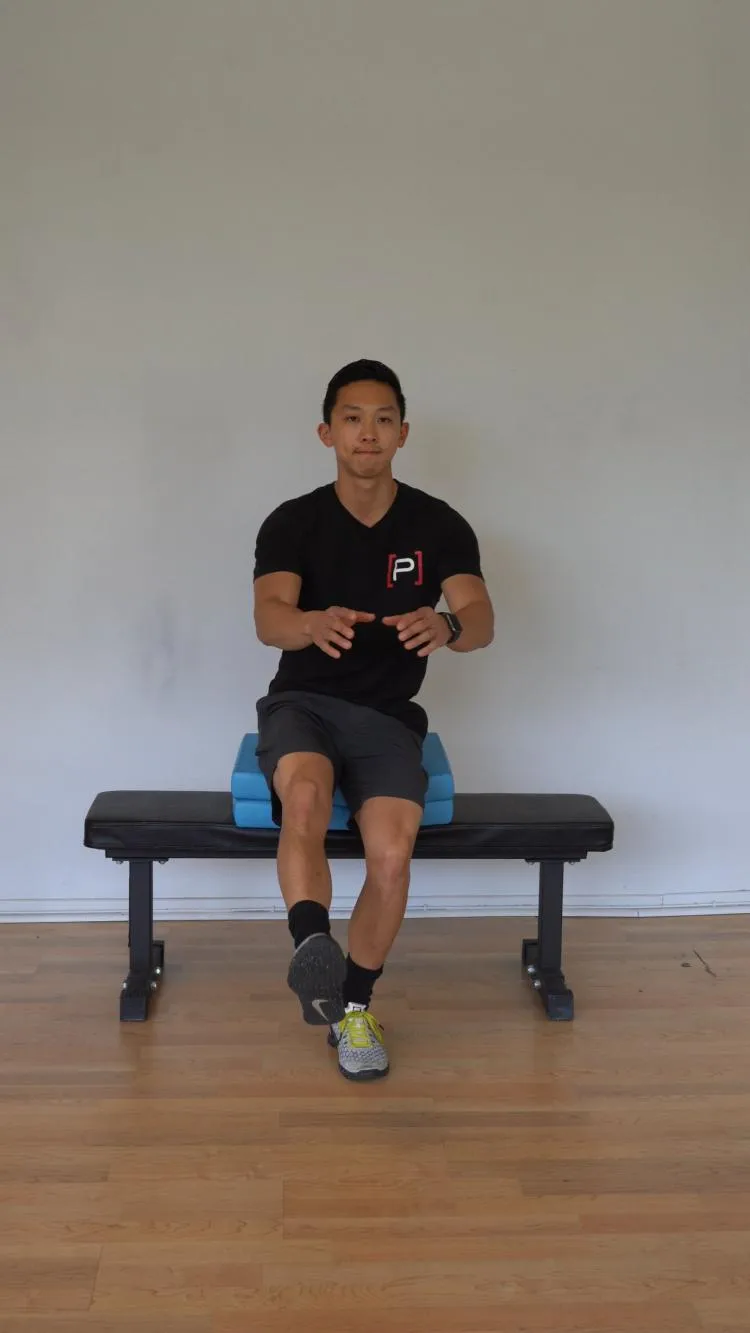
Single Leg Box Squat
View exercise instructions
- HOW: Set-up a box or object behind you, the taller it is the easier the exercise will be. Lift one leg straight in front of you, and then sit back with good squat form only on one leg, trying to be as controlled as you can. Sit down completely on the box, and then stand back up with the same leg. Repeat
- FEEL: You should feel all the muscles in the leg on the ground working.
- COMPENSATION: Avoid letting the knee cave in, and try your best to maintain a neutral spine throughout the movement, do not lean too much side to side, forward, or backward. Avoid using too much momentum to stand up or 'plopping' your weight onto the box
While the weakness of the hip abductors is a potential cause for medial knee collapse, a lack of motor control can also be the culprit of this poor movement pattern. This is especially prevalent among higher-end athletes who demonstrate medial knee collapse with functional activities. In this case, the athlete more times than not has more than adequate strength, yet they fail to utilize and demonstrate the neuromuscular control necessary to engage the hip abductors during tasks. To see if this is the case, give the athlete visual, verbal, or manual cues to facilitate hip abductor activation.
Single leg squat has shown to fire 52-82% MVIC of the Gluteus Medius‼️ -82%, BW Boren et al. -64% +/-24, BW Distefano et al. -52% +/- 22, BW Ayotte et al.
Note: This can also be used as a strengthening exercise once the athlete demonstrates good neuromuscular control...
Gluteus medius strength may be even more important in sports when the center of mass changes direction unexpectedly, requiring strength and stabilization during unilateral stance. Because of the nature of contact sports and the role of pelvic stability to maintain the summation of forces of movements that begin in the lower extremity, Gmed strengthening should be included in sports that require unilateral support, especially during body-to-body contact.
In these sports, unilateral gluteus medius strengthening while standing can be considered as sport-specific. For example, single-leg squats with external resistance can be included during the preseason or in-season for ice-hockey players but should not be a staple of an ice-hockey player’s general strength development. Some may take this idea further and prescribe such exercises on an unstable surface in an attempt to mimic the instability experienced during competition.
Closing Thoughts
The cause of both Trendelenburg and Compensated Trendelenburg is oftentimes due to inadequate gluteal function. There are a plethora of ways to strengthen the hip muscles, and there are always ways to make obtainable progressions. It is important to know what level of exercise you should start with, and to progress appropriately from there! This article demonstrated excellent exercises to fix your Trendelenburg gait initiating with activation, followed by strengthening, and finally movement re-training!
Take Control of Your Hip Health
To go from stepping to sitting we can thank the 27 muscles that cross the hip joint for their work. After thanking them, we should also thank your core, knees, feet, and really the rest of your movement system as they work together on a team to create movement. Perhaps, the best way to thank them is by giving them what they desire: strength and power!
REFERENCES
1.Cichanowski et al. Hip Strength in Collegiate female athelte’s with patellofemoral pain. 2007. 2.Fredericson et al. Hip Abductor Weakness in distance runners with iliotibial band syndrome. 2000. 3.Thorborg et al. Eccentric Hip Adduction and Abduction strength in elite soccer players and matched control. 2011. 4.Tyler et al. The association of hip strength and flexibility with the incidence of adductor muscle strains in professional ice hockey players. 2001. 5.Leetun et al. Core Stability measures as risk factors for lower extremity injury in athletes. 2004. 6. Burnet et al. Isometric Gluteus Medius Muscle Torque and Frontal Plane Pelvic Motion During Running 7. Macadam et al. An Examination of the Gluteal Muscle Activity Associated with Dynamic Hip Abduction and Hip External Rotation Exercise: A Systematic Review. 2015.
About The Author
Arash Maghsoodi, PT, DPT, CSCS
Prehab Co-Founder & Chief Marketing Officer
 Arash Maghsoodi received his Doctorate in Physical Therapy from the University of Southern California. For his undergraduate studies, he attended San Diego State University and studied Kinesiology. After sustaining a career-ending ankle sprain while playing collegiate soccer, he realized how disabling and life-altering injuries can be. Arash currently resides in beautiful Santa Monica, California. His clinical experience is primarily in the orthopedic and sports setting. He has treated a wide variety of conditions ranging from the post-operative individual to the professional athlete. Arash is keeping the family legacy of becoming a physical therapist, as his mother is a practicing clinician of 30 years in the Orange County area.