

On this page 8 sections
Your guide
What you'll learn
Normal ankle motion is so critical for the health and longevity of your body. The ankle moves your foot primarily into plantarflexion (toes away from you) and dorsiflexion (toes up towards the shin). For the sake of this article, we are going to discuss ankle dorsiflexion motion, and specifically how you can improve motion in this direction. Ankle plantarflexors (aka the calves) are a muscle group that often limit the dorsiflexion motion. Ankle dorsiflexion is crucial for squatting, going downstairs, jumping, and many other movements. This article will show you exercises for stiff ankles, by addressing limitations that may be present in the ankle joint and its surrounding muscles and tendons!
Stiff Ankles: Causes and Treatment Implications
Ankle Motions

Impaired or limited ankle dorsiflexion is thought to increase forefoot pressure due to an early heel rise during walking. Abnormal or faulty ankle movements are associated with problems of the foot and ankle including metatarsalgia, plantar fasciitis, Achilles tendinopathy, ankle sprains, and plantar ulceration. There are a few structures that can limit ankle dorsiflexion motion, including calf stiffness (gastrocnemius & soleus muscles), ankle joint restriction, or a boney block. If we are to really dig into this topic, a few studies have found that the medial gastrocnemius is the most common cause of reduced ankle dorsiflexion. However, there is no consensus on how to identify a stiff medial gastrocnemius.
Full Programming To Improve Your Ankle Mobility

Ask anyone in the industry, ankle dorsiflexion mobility matters. Without it, you run the risk of exposing other body regions to excessive strain due to compensatory strategies. This program is for anyone looking to improve their ankle dorsiflexion mobility. If your mobility is limited due to an injury/surgery in the past, or you’re just dealing with stiff ankles that are limiting your workouts and athletic performance, this program is appropriate for you as long as you have general workout experience! Learn more HERE!
Why does the ankle get stiff?
Think about how frequently you put your ankles into end-range dorsiflexion on a daily basis, probably not too often. Just like any other motion, the body will adapt, and if you don’t give it a reason to maintain dorsiflexion mobility, you'll lose it. Look at the shoes people wear on their feet, you may be surprised by how common large heel lifts are. This will ultimately place your foot into more of a plantarflexed position, limiting the amount of dorsiflexion your ankle actually moves into on a daily basis. The goal of this article is to improve those stiff ankles! After an ankle fracture that may or may not involve a surgical procedure, it is inevitable that the foot and ankle will become stiff. As this area of the body is immobilized, it does not have the freedom to move the way it usually does with daily activity, which therefore leads to tightness of the joint and surrounding soft tissue. Read more about what to do after an ankle fracture!

Soft Tissue Mobilization To Improve Ankle Stiffness
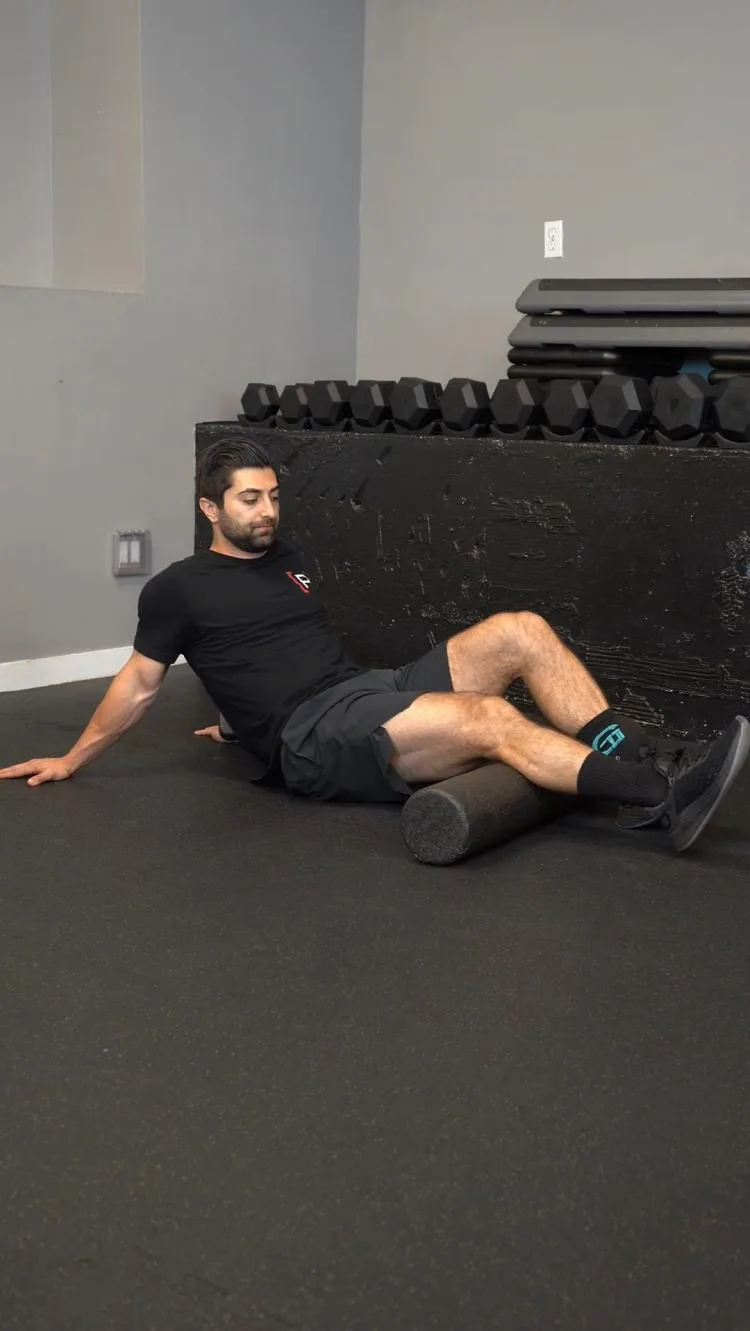
Below is an example of how you can utilize a foam roller to help you improve the soft tissue restrictions in the calf that may be contributing to your stiff ankles. As stated before, soft tissue restrictions are one of the causes of stiff ankles.
Exercise 01 of 05
Exercise demonstration
Calf Foam Rolling
View exercise instructions
Ankle Mobility Exercises To Improve Ankle Dorsiflexion
Stretching Exercises For Stiff Ankles
Stretching is the most common approach used to enhance the dorsiflexion range of motion. Stretching has been shown to increase flexibility and attenuate exercise-induced muscle soreness, which is why stretching is so common in the rehabilitative and training space. There are three main approaches to stretches include:
- Static Stretching
- Proprioceptive neuromuscular facilitation (PNF)
- Ballistic stretching
The most researched of the 3 is static stretching into dorsiflexion which we will cover in this article. This type of passive stretching has been shown to improve flexibility into dorsiflexion. Ballistic stretching is a type of dynamic stretching that involves a fast bounce which has not been shown to improve the dorsiflexion range of motion. PNF has also been shown to improve dorsiflexion range of motion, however, oftentimes requires assistance from another individual. The two common types of PNF stretching includes contract-relax and contract-relax agonist contract. Below are a few static stretches great for improving ankle mobility.
Exercise 02 of 05
Exercise demonstration
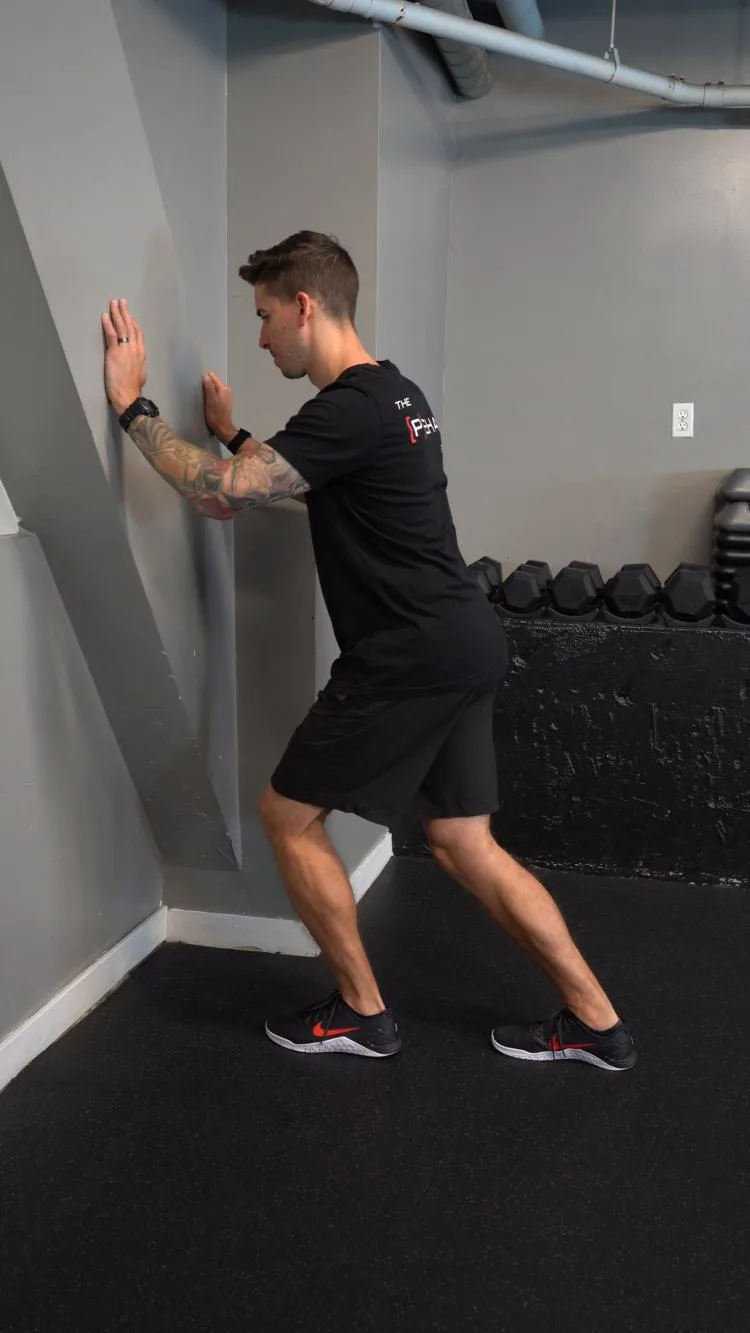
Wall Calf Stretch - Knee Bent
View exercise instructions
- HOW: Get set-up standing with a wall in front of you and place your hands on the wall. Take a step back with the side you plan to stretch, let the knee be bent and keep it bent. While keeping the foot you stepped back with flat on the ground, knee bent, and toes facing 12 o’clock, slowly lean and shift your weight forward until you feel a stretch.
- FEEL: You should feel a stretch in the calf of the foot that is behind you, specifically lower in your calf above your ankle. You shouldn’t feel pain or a pinch in front of your ankle.
- COMPENSATION: Be sure to keep your back foot facing 12 o’clock, do not let your foot turn out or in. Try to keep your heel down. Be sure to keep the knee bent
Sample Ankle Mobility Program Exercise Video
I like this stretch because it can often tell us whether the limitation is from soft tissue or the underlying joint. If you feel a pull in the calf and Achilles tendon, likely soft tissue is your barrier to getting into more dorsiflexion. If you feel a pinch at the front of your ankle then it is likely more of an ankle joint or boney limitation. Either way, you want to stretch into this position and re-assess to see if there was an improvement in mobility. The key here is to avoid collapsing your arch, which is why I bias the knee towards the pinky toe when prescribing calf stretches.
Exercise 03 of 05
Exercise demonstration
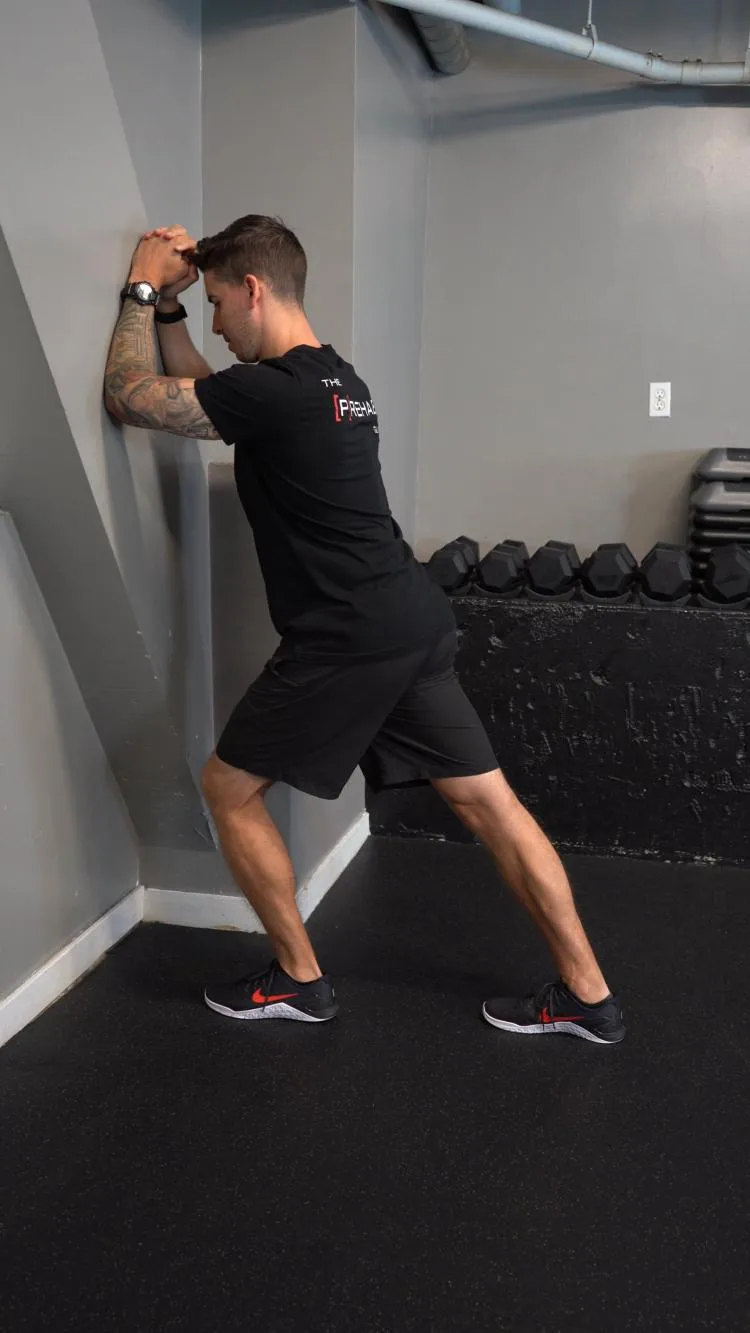
Wall Calf Stretch - Knee Straight
View exercise instructions
- HOW: Get set-up standing with a wall in front of you and place your hands on the wall. Take a step back with the side you plan to stretch. While keeping the foot you stepped back with flat on the ground, knee straight, and toes facing 12 o’clock, slowly lean and shift your weight forward until you feel a stretch.
- FEEL: You should feel a stretch in the calf of the foot that is behind you, specifically behind and below your knee and potentially right above your ankle. You shouldn’t feel pain or a pinch in front of your ankle.
- COMPENSATION: Be sure to keep your back foot facing 12 o’clock, do not let your foot turn out or in. Try to keep your heel down. Keep the knee straight

Static Ankle Mobilization
Limited joint mobility is another culprit of stiff ankles. Oftentimes, individuals may complain of pain right at the front of their ankle, especially when transitioning through the midstance portion of the gait cycle, which is when one transitions from putting their heel down to a flat foot position. This is because, at this point in the gait cycle, the ankle is in its maximum amount of dorsiflexion it will have throughout walking. The joint that is responsible for ankle plantar flexion and dorsiflexion is the talocrural joint. In regards to exercises for stiff ankles, there are great self mobility exercises one can perform to improve the quality of motion at this part of the body! This is, in my opinion, the best bang for your buck ankle stretch!
Exercise 04 of 05
Exercise demonstration
Ankle Dorsiflexion Mobilization
Get your foot set-up and supported on an elevated surface while balancing on the other leg. To perform the mobilization, bring your knee and shin bone forward over your toes while keeping your heel down on the ground. Begin loading more of your weight onto the elevated leg, until the back leg is light on the floor. You should feel a stretch in your calf and/or your ankle joint. Ensure that you keep your entire heel flat on the ground as best as you can.
Strengthen To Lengthen
Stretching of the calf is often recommended when the goal is to improve ankle range of motion through muscle-tendon length, however, stretching was shown to be no better than just performing eccentric exercises. This means when performing an eccentric exercise, go through the entire range of motion! You should be feeling a stretch in the calf at the end of the motion.
Exercise 05 of 05
Exercise demonstration
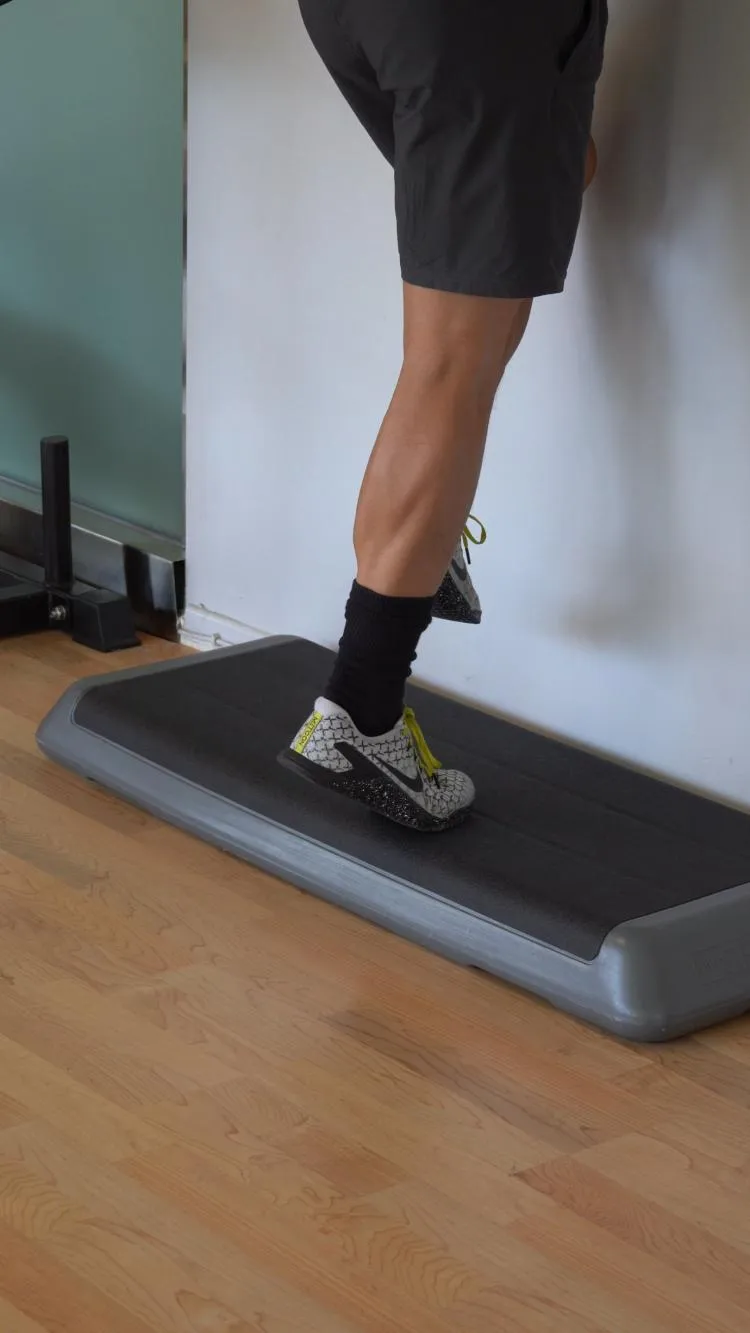
Single Leg Heel Raise Off Step
View exercise instructions
- HOW: Place a step in front of a wall or an object to use for balance. Using only one leg, step onto the box with the balls of your feet on the edge of the box, and let your heel hang off the box. While keeping your glutes and quads tight to keep your knee straight, lift your heel up in a slow and controlled manner, then slowly lower your heel back down to the ground. Repeat
- FEEL: You should feel your calf getting a workout, but also your glutes and quads working as well to help keep your leg straight.
- COMPENSATION: Do not let your knee bend as that is a different exercise. Make sure you go through your full range of motion at your ankle. This is not a balance exercise, so hold onto something to help with balance as the goal of this exercise is to strengthen your calf!
With the goal being to improve ankle mobility, make sure the heel gets as close as possible to the floor! Hold at the bottom for a second prior to returning back up into plantarflexion.
Closing Thoughts
To summarize the main points from this article, we discussed primarily exercises for stiff ankles related to ankle dorsiflexion mobility. There are a variety of reasons why one can develop stiff ankles, which include soft tissue restrictions of the calf musculature including BOTH the gastrocnemius and the soleus. It is important to assess the extensibility of both of these muscles! Secondly, the other culprits of limited ankle mobility include either joint mobility restrictions or a bony block, which is less common.
The Ultimate Programming For Your Stiff Ankles
Tasks such as squatting, going up and down stairs, walking over uneven ground, and pushing up onto our toes to reach an object overhead can feel extremely difficult if you are missing ankle dorsiflexion. Even keeping balance can become difficult! If you start to lose balance one of the first ways your brain will attempt to correct and keep you upright is using an ankle strategy that utilizes ankle dorsiflexion. The efficient movement relies on ankle dorsiflexion and this program is the guide to get you there.
REFERENCES
- You J-Y, Lee H-M, Luo H-J, Leu C-C, Cheng P-G, Wu S-K (2009) Gastrocnemius tightness on joint angle and work of lower extremity during gait. Clin Biomech (Bristol, Avon) 24(9):744–750.
- Aronow MS, Diaz-Doran V, Sullivan RJ, Adams DJ (2006) The effect of triceps surae contracture force on plantar foot pressure distribution. Foot Ankle Int 27(1):43–52
- Chimera NJ, Castro M, Davis I, Manal K (2012) The effect of isolated gastrocnemius contracture and gastrocnemius recession on lower extremity kinematics and kinetics during stance. Clin Biomech (Bristol, Avon) 27(9):917–923.
- Irving DB, Cook JL, Menz HB (2006) Factors associated with chronic plantar heel pain: a systematic review. J Sci Med Sport 9(1- 2):11–22.
- Crawford F, Thomson C (2003) Interventions for treating plantar heel pain. The Cochrane database of systematic reviews (3):CD000416.
- Pascual Huerta J (2014) The effect of the gastrocnemius on the plantar fascia. Foot Ankle Clin 19(4)
- Gurdezi S, Kohls-Gatzoulis J, Solan MC (2013) Results of proximal medial gastrocnemius release for Achilles tendinopathy. Foot Ankle Int.
- Laborde JM (2009) Midfoot ulcers treated with gastrocnemius- soleus recession. Foot Ankle Int 30(9):842–846.
- Patel A, DiGiovanni B (2011) Association between plantar fasciitis and isolated contracture of the gastrocnemius. Foot Ankle Int 32(1):5–8.
- Baumbach S (2016) Ankle dorsiflexion: what is normal? Development of a decision pathway for diagnosing impaired ankle dorsiflexion and M. gastrocnemius tightness. Arch Orthop Trauma Surg (2016) 136:1203–1211.
About The Author
Arash Maghsoodi, PT, DPT, CSCS
Prehab Co-Founder & Chief Marketing Officer
 Arash Maghsoodi received his Doctorate in Physical Therapy from the University of Southern California. For his undergraduate studies, he attended San Diego State University and studied Kinesiology. After sustaining a career-ending ankle sprain while playing collegiate soccer, he realized how disabling and life-altering injuries can be. Arash currently resides in beautiful Santa Monica, California. His clinical experience is primarily in the orthopedic and sports setting. He has treated a wide variety of conditions ranging from the post-operative individual to the professional athlete. Arash is keeping the family legacy of becoming a physical therapist, as his mother is a practicing clinician of 30 years in the Orange County area.