

On this page 7 sections
Your guide
What you'll learn
Step up and step down exercise variations are amazingly simple, yet truly effective in lower extremity rehab. Step-ups will always be a staple drill in rehabilitation and strength and conditioning programs. Considering the unilateral, weight-bearing nature of the step-up, it effectively challenges recruitment patterns analogous to those encountered during routine activities of daily living and sport. Adding variability to the classic step ups and downs is key to movement proficiency and developing a well-rounded athlete. In addition, the step down is a great way to promote eccentric strength in our lower body, as well as joint stability and control with movements that translate to our activities of daily living as well. In this article, we are going to show you the best step exercises!
The Importance of The Step Up and Step Down Variations
Step ups and step downs are both amazing exercises for prehab and rehab purposes alike. But in order to truly maximize your gains in the gym or clinic, you need to perform them correctly!! Yes, stepping up and down off an extremely tall box looks impressive and all, but can you actually control it? Unless your goal is to get in some cardio, you need to really focus on form and control in the step up and down.
First, don't blaze through step exercises; focus on an extremely slow and controlled descent (eccentric control). Your knee should never collapse and be medial to the ankle (unless doing a transverse step down which we'll talk about later). You should feel the burn in your glutes and quads as you try and stabilize your pelvis during the descent. Developing eccentric control is crucial, especially for quadriceps or patellar tendinopathy prehab.
Second, only use a box height that you can control. You should be able to control the descent throughout the entire range of motion. Most of the time with step exercises, you'll find that you can control the descent initially, but as the quad demand increases (as knee flexion angle increases), you'll lose control of the descent. If you can't control the end range of the descent, you're using a box that is too high!
Finally, don't cheat and push off with the opposite leg! The leg on the box should be doing all the work, both raising (concentric) and lowering (eccentric). Don't push off the ground with that back leg!
Dealing With Knee Pain From Steps? Conquer Steps With Our Program!

Knee pain can often be provoked when individuals are negotiating stairs, either up, down, or both. The good news is that our program can help you enhance knee strength, stability, and mobility so you can master step negotiation! The Knee Prehab Program is a physical therapist-developed, step-by-step program that teaches you how to optimize your knee health. This 3-phase program will expose you to various knee and lower body strengthening and stabilization exercises supported by science. This program will bulletproof your knees for anything life throws at you! Learn more HERE!
The Step Up
The step-up explicitly demands single leg postural stability and coordination as well as dynamic control of the pelvis and trunk. The step-up also serves as an adequate stimulus to foster endurance and strength of the lower extremity and can easily be progressed or regressed depending upon the goal or ability of who is performing this exercise!
The 5 MOST IMPORTANT Exercises for Runners
Now that you have an introduction to what entails an optimal step up exercise, let us show you some of our favorites!
Exercise 01 of 02
Exercise demonstration
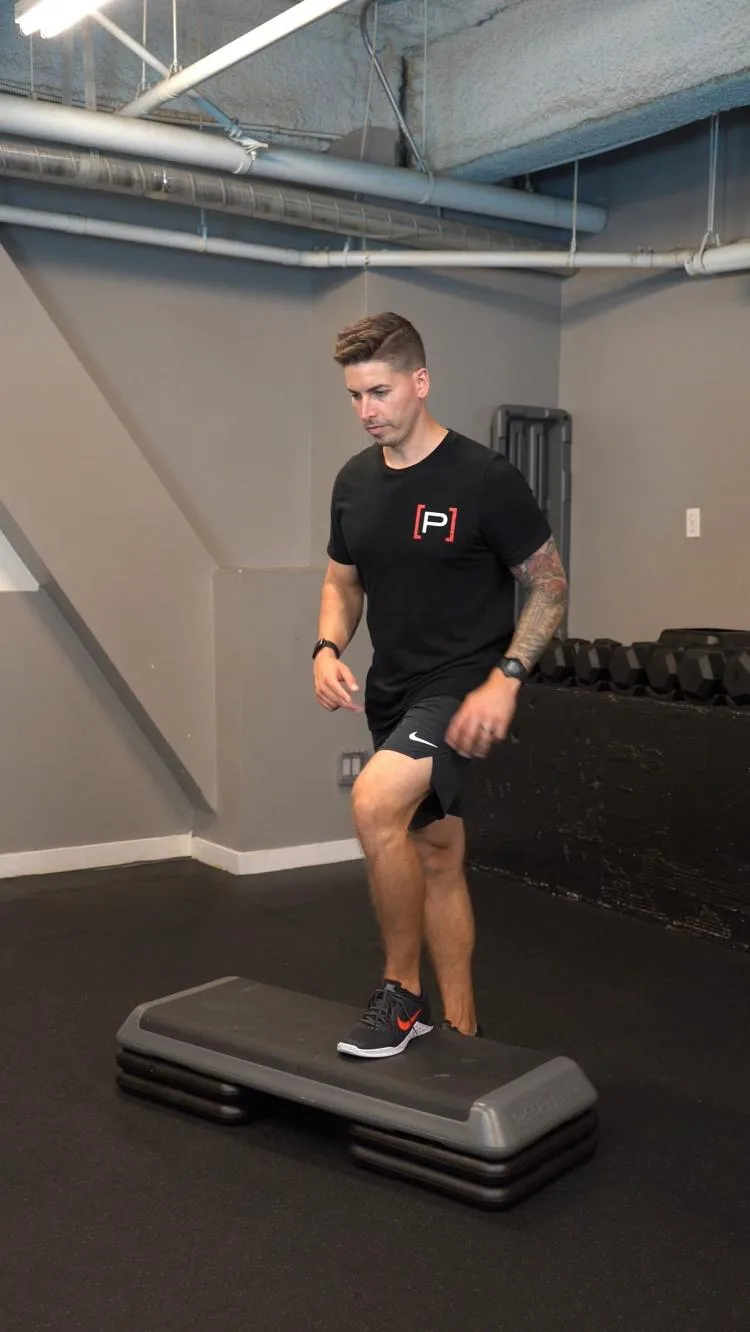
Anterior Step Up
View exercise instructions
- HOW: Stand behind the box/step. With the side you want to perform the exercise on, step up onto the surface, and then step back down with the opposite leg.
- FEEL: You should feel the thigh muscles and the butt muscles working in the leg that you are stepping up with.
- COMPENSATION: Avoid letting your knee cave in as you step up and step down. As you step up, make sure you have equal weight distribution throughout your whole foot.
Curtsey + Transverse Step Ups
Yes, knee valgus is one of the more common positions of an ACL injury, and during early rehab for an ACL, it's probably best to avoid a valgus position and teach your patient "ideal" lower extremity alignment. But once they're out of early rehab and in more strength and conditioning-focused programs, teaching the patient to control knee valgus is an absolute must. It is a position that they will undoubtedly find themselves in during competition, no matter how well-trained they are in their cutting mechanics. Therefore, it is imperative to teach them to get in and out of a knee valgus position with control.
READ: RUNNER'S KNEE CAUSES AND TREATMENT

While there are tons of ways to train this, some of my favorite exercises are curtsey lunges and transverse step up/downs. The curtsey lunge involves dynamically coming in and out of hip internal rotation and adduction. Learning to control the pelvic drop on top of the femur during the curtsey lunge is something that is imperative for advanced athletic movements. The transverse step up should start with pure hip rotation and minimize any transverse loads on the knee. Similar to the curtsey lunge, we are controlling the pelvis on top of the femur. I believe you can load this pattern, but when it comes to actually encouraging valgus in the step down, I believe this should only be done unloaded.
Teach your patient proper lower extremity alignment and cutting tasks, but also teach them how to move in and out of valgus as it's a position they will 100% find themselves in during competition. Your job as a rehab specialist is to prepare the athlete for any demands they might find themselves in on the field.
Exercise 02 of 02
Exercise demonstration
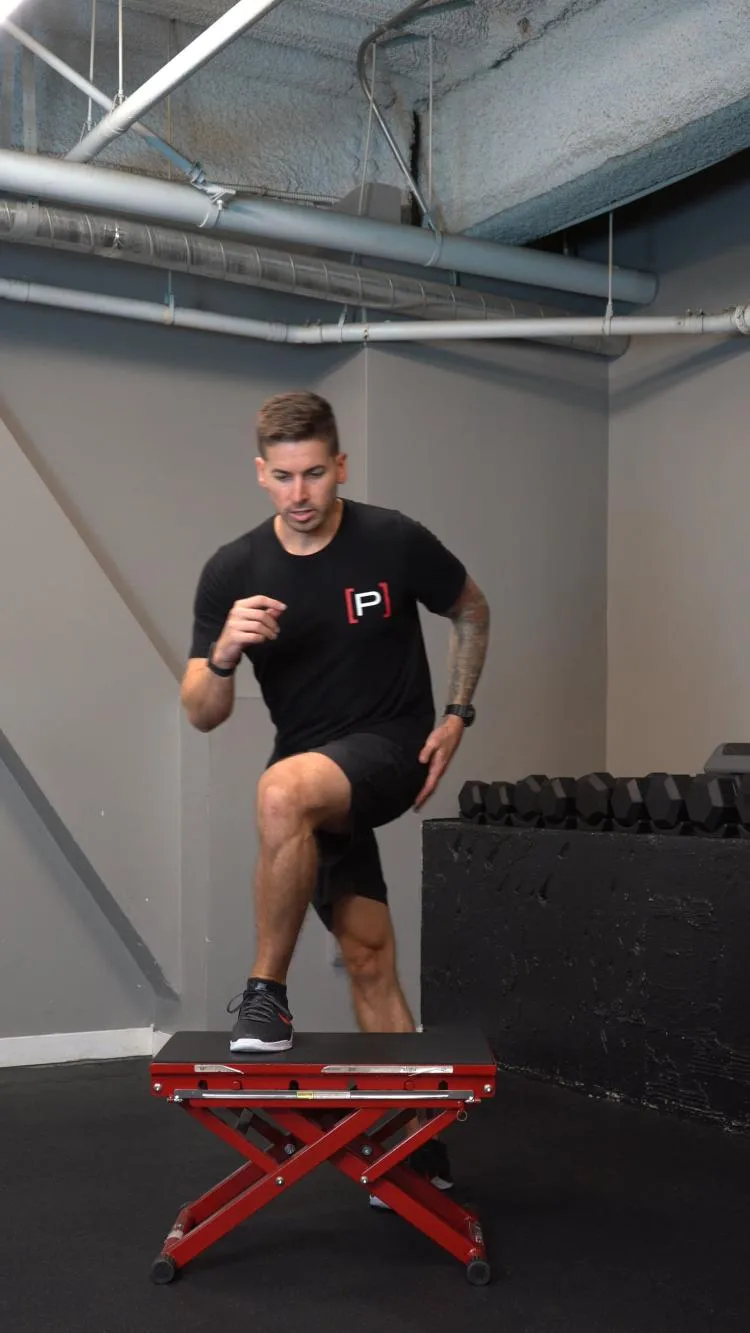
Curtsey Step Up
View exercise instructions
- HOW: Stand in front of an elevated surface. Begin the exercise by stepping up onto the elevated surface and over and beyond the other foot (if stepping up with the left, place the left foot to the right of your right foot). Stand tall on the elevated surface with both feet, return to starting position and repeat.
- FEEL: You should feel your hip and thigh muscles on the leg that you're stepping up on, especially the muscles on the outside and back of your hip working.
- COMPENSATION: Maintain good trunk control, control the movement and don't take advantage of momentum to step up. Do not lean excessively forward or side-to-side
Encouraging Knee Valgus
Follow along in this video as we highlight examples of step ups that move through the knee valgus in a controlled movement!

Cross Over Lateral Step Up
A recent systematic review by Macadam et al in 2015 highlighted cross-over lateral step ups. They found that the cross-over lateral step up produced one of the highest Gluteus Maximus muscle activity (103 +/- 63.6%) in their review. Something to note in this exercise is that it does require a lot of gluteus medius activity as well, as you must be able to maintain good pelvis and knee stability. The elevated femur starts in a relatively adducted and internally rotated position and moves into abduction and external rotation. So we're also adding a frontal and transverse plane component to the normally sagittal plane step up/down. All the same guidelines apply to cross-over lateral step ups as the normal step ups/downs that we highlighted above.
Yoak Step Ups
If you want to challenge your balance, you need to add demands to the task that decrease your stability. Perturbations are an effective way to add instability to your exercise. Perturbations are awesome because they provide constant variability. Research has shown the variability of practice can lead to greater skill acquisition and retention. A perfect example of this is golf - it gets easier to hit the same shot after practicing with the same club over and over at the range. However, it becomes more difficult on the course when you change clubs, shot angles, and distances. I really like using the yoak with a step up exercise to add another dimension to the balance demands. Hikers can definitely appreciate this exercise and should add it to their training!
Quick tips for doing this exercise :
- The faster you move through the step up and step down, the greater the perturbation
- If this exercise gets easy, make it harder and speed things up!
- This exercise is meant to challenge your balance! You can only learn by adjusting your performance when it is challenged! As you can see, I even lose my balance!
Getting Stronger? Now On To Step Downs
Step downs are a staple in our lower extremity rehab progressions and for good reason. You can isolate/bias one leg without any "cheating" using the other leg like on squats, deadlifts, or the lunge variations we have discussed. Furthermore, depending on which direction you step, you can preferentially bias either the glutes or the quads, or workaround people's mobility constraints like a lack of ankle dorsiflexion.
It all comes down to simple biomechanics and lever arms - if you know your biomechanics you know movement! If you want to:
➡️ Target the knee: Go with anterior step downs
➡️ Target the hip: Go with lateral or posterior step downs
What's The Difference Between Going Backward? Sideways? Forward?
⬇️ Posterior Step Downs. With knee patients, I will typically start with posterior step downs as the demand is less on the knee and more on the hip. The trunk will flex forward naturally to keep your center of mass on the box, thus utilizing the glutes/hip more in addition to shortening the lever arm on the knee. For hip patients, this is a good starting place as well.
➡️ Lateral Step Downs. Due to the step down occurring more in the frontal plane than the sagittal plane, this exercise will place more demand on the hip ABductors. The big keys here are to ensure your hips stay level and do not drop. Imagine wearing a belt and keeping it straight the entire time. Furthermore, do not reach the ground. Lower yourself. Love using this for both hip and knee patients.
⬆️ Anterior Step Downs. Opposite of the posterior step down, the trunk has to stay more upright to keep the center of mass on the box. Furthermore, there will be more anterior knee translation as well as ankle dorsiflexion required with this variation. Thus, this is a more advanced progression for knee patients. And YES, I want the knee to translate forward past the toes here as we need to build tissue resilience and load tolerance. For someone with ankle mobility deficits, I often program in some sort of anterior reach such as an anterior step down to load the ankle into dorsiflexion after mobilizing it.
Step Downs Anterior vs Lateral vs Posterior - Whats The Difference?
Closing Thoughts
The step up and step down variations of exercise are both excellent movements that should be incorporated into any strength-specific or rehab program! The single-leg control, strength benefits, and translation to daily activities make these such awesome exercises. Be sure to focus on the control and form with these techniques as we harped on above, as with any movement that you incorporate into your routine. As you see fit, progress yourself and get creative!
Dealing With Knee Issues?
The knees are true hard-nosed blue-collar workers! They get the job done when the hips and ankles may be taking some extra rest breaks. In this program, you will learn how to restore mobility, learn to get your powerful quadriceps cooperating with you, along with starting the journey to addressing the hip and ankle. Get started with us HERE.
About The Author
Michael Lau, PT, DPT, CSCS
Prehab Co-Founder & Chief Product Officer
 Michael was born and raised in Northern California but now currently resides in Sunny SoCal ever since attending the University of California, Los Angeles as an undergraduate majoring in physiology. After his undergraduate studies, he received his Doctorate in Physical Therapy from cross-town rival the University of Southern California. As a licensed physical therapist with a strong background in strength and conditioning, Michael likes to blend the realms of strength training and rehabilitation to provide prehab, or preventative rehabilitation, to his patients. A common human behavior is to address problems after they become an issue and far often too late, which is a reactionary approach. He believes the key to improved health care is education and awareness. This proactive approach-prehab-can reduce the risk of injuries and pain in the first place. He is a huge proponent of movement education and pain science. Clinically, he has a special interest in ACLR rehab and return to sport for the lower extremity athlete.