

On this page 6 sections
Your guide
What you'll learn
Sure, Osgood-Schlatter disease is a hard name to say, but sometimes it’s an even harder condition to know how to manage and treat effectively. Great news is, this condition is very treatable with physical therapy and many young athletes come back stronger and healthier following rehab for Osgood-Schlatter disease as a result. What's not to love about that! Let’s dive into what exactly this diagnosis means, who it affects and why, and the best exercises for Osgood-Schlatter disease to keep you active and doing what you love!
What is Osgood-Schlatter disease?
Before jumping into the best exercises to manage symptoms and pain associated with Osgood-Schlatter disease, it's important to understand the mechanism behind this condition and why it presents the way that it does. Having a sound understanding of this diagnosis makes it easier for us to provide beneficial treatment strategies and exercises to mitigate symptoms.
As a child grows, so do their muscles and bones. As the femur bone of the upper leg gets longer, sometimes the quadriceps muscle (also known as the thigh muscle) has a hard time keeping up with this rapid rate of growth. This results in the quadriceps muscle repetitively pulling on the patellar tendon (located at the front of the knee), and this increased tension on that tendon can cause localized irritation at the growth plate of the tibia. This repetitive strain causes inflammation, swelling, and commonly a painful “bump” at the site of the tibial tuberosity (1). With all this being said, growth spurts can definitely result in some growing pains (no pun intended)!
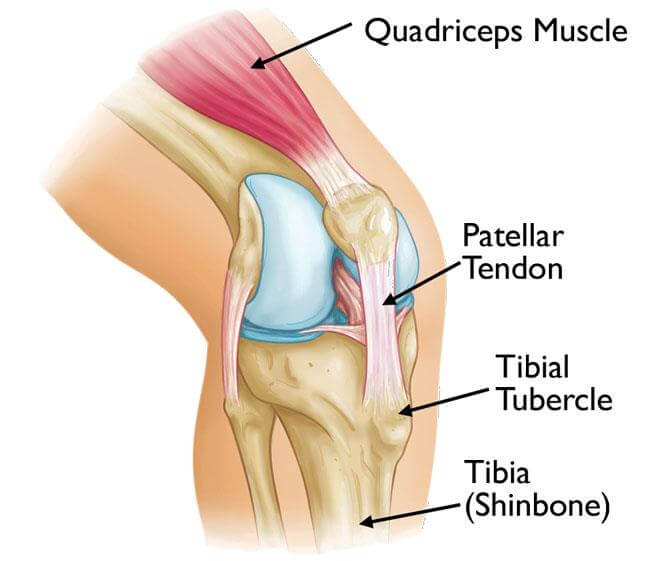 From Orthoinfo
So who does Osgood-Schlatter disease most commonly affect? In most cases, we see this occur in adolescents who partake in:
- Running related sports
- Basketball
- Volleyball
This is due to the addition of repetitive loading of the lower extremity with these particular sports. Wanna hear some really great news? Osgood-Schlatter disease typically fully resolves with the closing of the growth plate in later adolescent years, and 90% of individuals respond extremely well to appropriate exercise prescription, modalities, and functional strengthening (1). Prior to the closing of the growth plate, is important to find ways to manage and improve symptoms during the adolescent years so that children can stay active and maintain a healthy lifestyle during this critical time.
Dealing With Knee Pain From Osgood Schlatter? We Have The Solution For You!

The Knee Rehab Program is a physical therapist developed, step-by-step program that teaches you how to optimize your knee health, including management of conditions such as Osgood Schlatters. This program will expose you to various knee and lower body strengthening and stabilization exercises supported by science. Learn more HERE!
What Exercises Can Be Done for Osgood-Schlatter Disease?
We are so glad you asked! The treatment of Osgood-Schlatter disease depends on each specific case, although several things can be done for all cases to ensure that you set yourself up for success when tackling these growing pains. In regards to participation in sport, activity modification may be needed including limiting jumping, hopping, running or anything that is causing repetitive load to the quadriceps muscle.
Remember, this is not a "forever" activity modification, just temporary to allow for inflammation management at the site.
Stretching is also very important in the management of Osgood-Schlatter disease. Yes, I said it, you need to stretch (cue the eye roll)! While I know it often feels difficult to prioritize stretching, stretching needs to be a part of rehab for Osgood-Schlatter disease, but also needs to be a part of everyday life to stay active and healthy. With Osgood-Schlatter disease, it's critically important to stretch the entire leg including the hamstring muscle group, the calf muscles, the ITB, and the quadriceps muscle group. Take note: it's especially important to stretch the quadriceps muscle on the front of your thigh to decrease pulling on the patellar tendon (2). Remember, stretching should feel comfortable and should not increase pain. Curious about how often you should be stretching? Check out this podcast for all the answers!
LISTEN: HOW MUCH SHOULD WE STRETCH

Exercise 01 of 07
Exercise demonstration
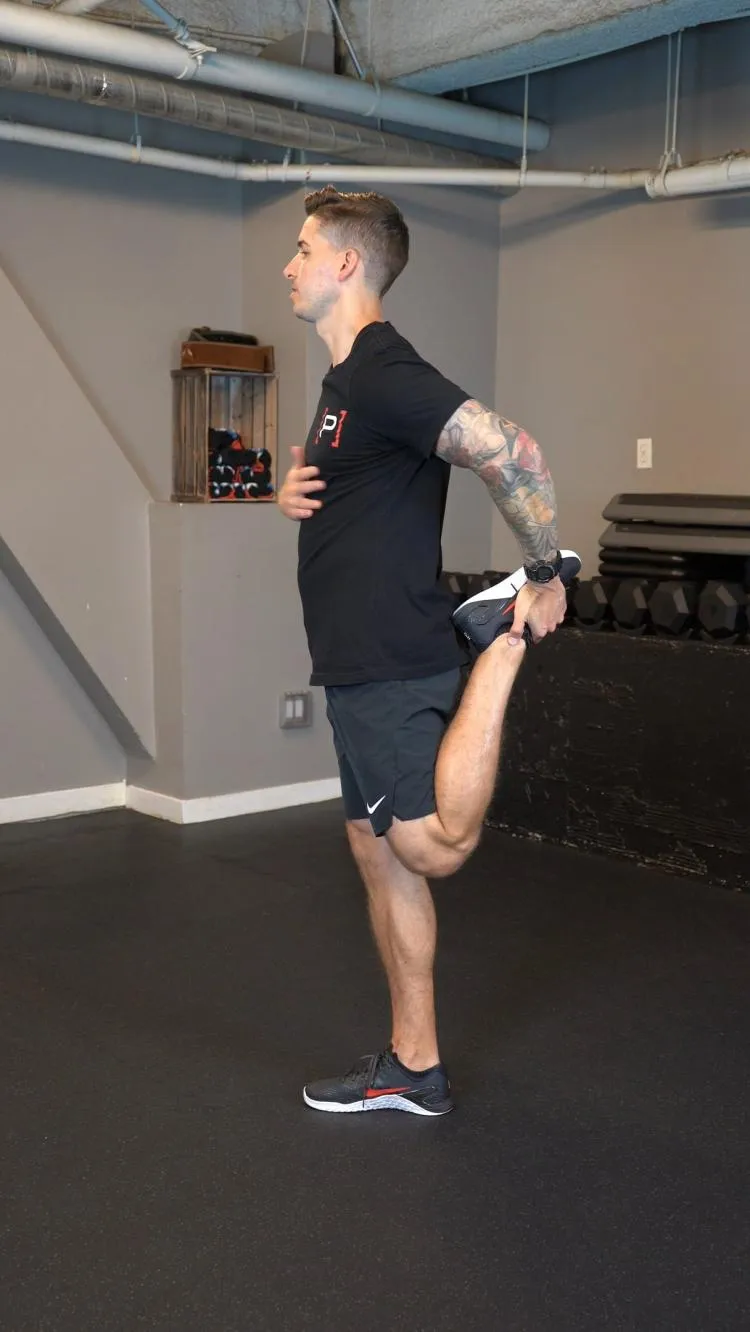
Standing Quadriceps Stretch
View exercise instructions
- HOW: Get set-up standing. On the side, you want to stretch, grab your foot and pull it back towards your butt by bending your knee. Keep a flat back, squeeze your butt muscle to push your hip forward, and have your knee directly below your hip. Hold this position.
- FEEL: You should feel a stretch on the top of your thigh in your quadriceps.
- COMPENSATION: Do not lean side to side or lose your balance, do not arch your back, do not let your knee flare out to the side excessively
READ: THE BEST SINGLE LEG STRENGTHENING EXERCISES

On top of strengthening the hip muscles and hamstring, it's also important to strengthen the thigh muscle in a way that is appropriate and pain-free. One of the best ways to strengthen the quadriceps muscle in the early stages of rehab is through isometric loading. It has been shown that isometric loading of a tendon helps to improve tendon strength, and tendon integrity, and reduces pain (3). Want to know more about tendon injuries? Read up HERE! Check out these videos below for some of the best exercises for Osgood-Schlatter disease in the early stages of quadriceps strengthening.
Exercise 02 of 07
Exercise demonstration
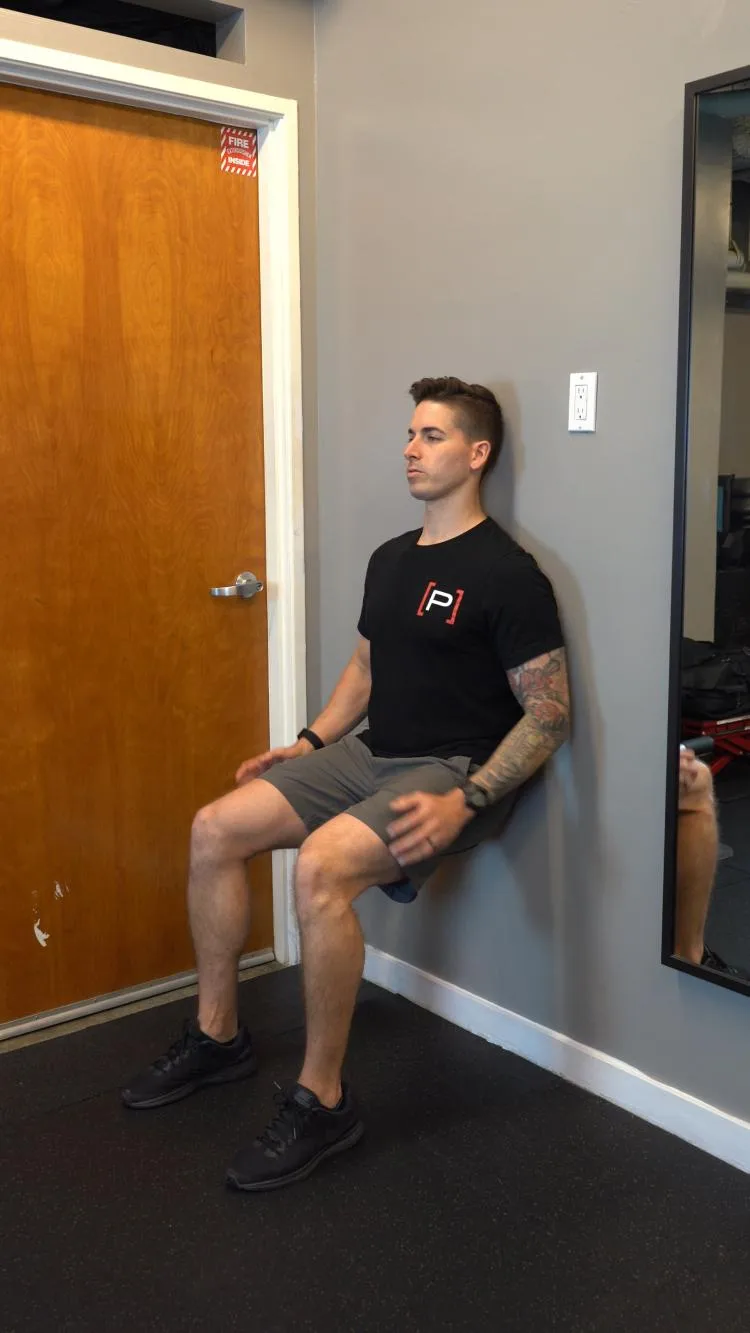
Wall Sit - 90 Deg
View exercise instructions
- HOW: Get set-up with your back against a wall with your feet about a foot away from the wall. Lower your hips down against the wall until your thighs are parallel to the ground, hold this position.
- FEEL: You will primarily feel the muscles on top of your thigh working hard, you may feel some pressure in the front of your knee.
- COMPENSATION: Do not lean side to side, make sure your feet are shoulder width apart and they are far enough from the wall, otherwise your knees may be very over your toes, which will put more pressure on the knees unless desired.
With this exercise, keep your back fixed against the wall and walk your feet out in front of you. This will ensure that you do not place too much stress on your knees when you perform this exercise. Eventually, you will want to add stress slowly to the front of your knees to re-expose them and promote load tolerance; however, early on in rehab, you do not want to aggravate any discomfort at the knees. Once wall sits start to feel easy and are able to be performed with little to no pain, try this next video to up the game!
Exercise 03 of 07
Exercise demonstration
Single Leg Wall Sit

View exercise instructions
- HOW: Get set-up with your back against a wall with your feet about a foot away from the wall. Lower your hips down against the wall until your thighs are parallel to the ground, then lift one foot off the ground and hold this position.
- FEEL: You will primarily feel the muscles on top of your thigh and your butt muscles working hard, you may feel some pressure in the front of your knee. Your hips will be working hard to keep your waist parallel to the ground as well.
- COMPENSATION: Do not lean side to side, do not let your hip drop, make sure your feet are shoulder width apart and they are far enough from the wall, otherwise your knees may be very over your toes, which will put more pressure on the knees unless desired.
Sample Knee Prehab Program Exercise Video
This exercise can be further progressed by adding a band around your knees or by coming up onto your toes.
Fixing Your Knock Knees With Two Exercises
Exercise 04 of 07
Exercise demonstration
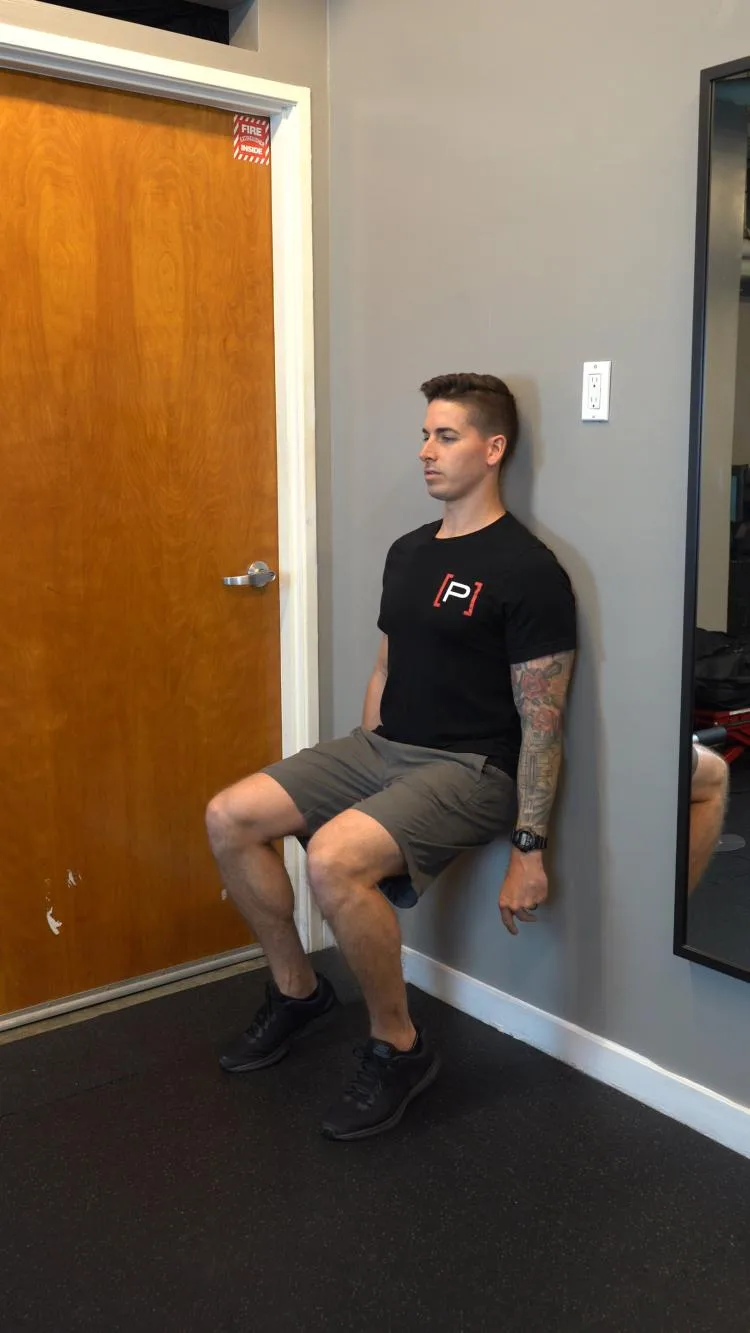
Wall Sit - On Toes
View exercise instructions
- HOW: Get set-up with your back against a wall with your feet about a foot away from the wall. Lower your hips down against the wall until your thighs are parallel to the ground, lift your heels off the ground, and hold this position.
- FEEL: You will primarily feel the muscles on top of your thigh and your calves working hard, you may feel some pressure in the front of your knee.
- COMPENSATION: Do not lean side to side, make sure your feet are shoulder width apart and they are far enough from the wall, otherwise your knees may be very over your toes, which will put more pressure on the knees unless desired. Do not lose heel height
As isometric exercises begin to be better tolerated, the athlete can progress to more active strengthening of the quadriceps muscle to appropriately strengthen the muscle group through its full length.
Exercise 05 of 07
Exercise demonstration
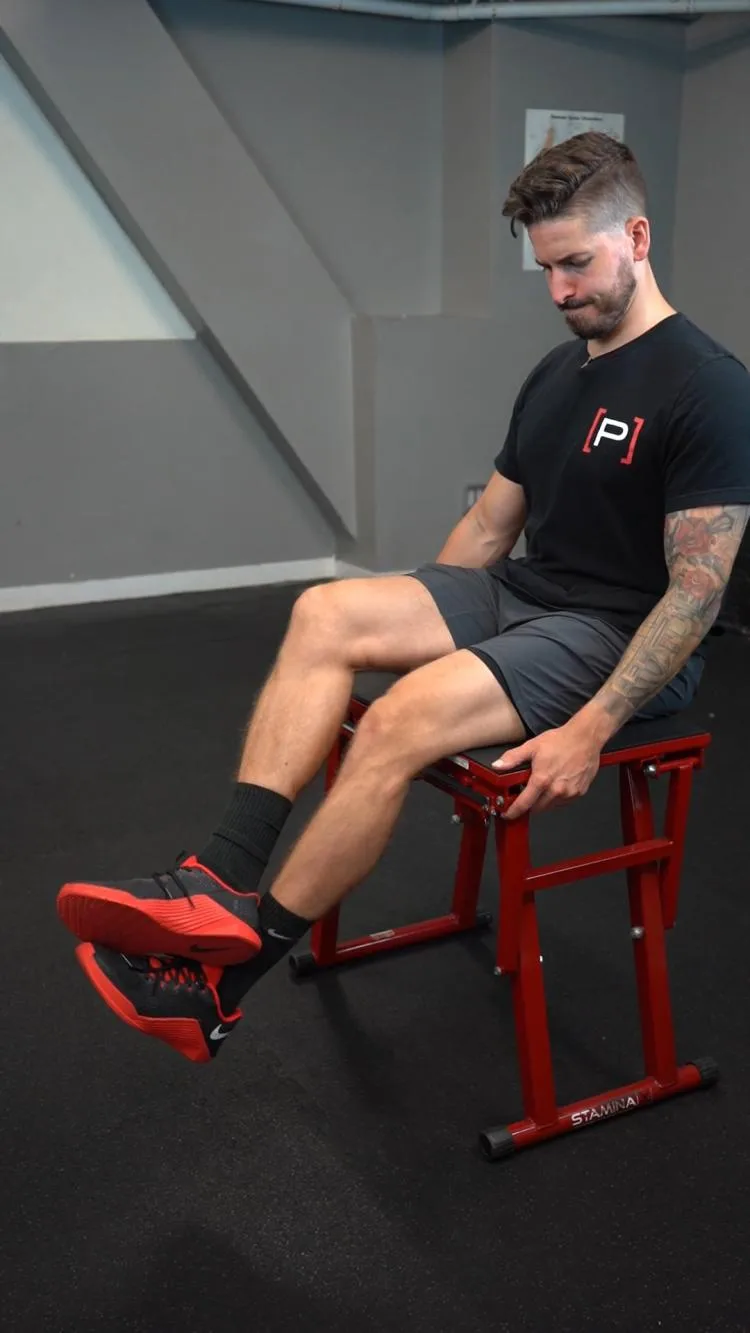
Eccentric Long Arc Quad
View exercise instructions
- HOW: Begin in an upright seated position with some clearance between your feet and floor. Kick one leg up all the way straight contracting your thigh muscles. Bring the other foot over the top of the straightened leg. The top leg should push down against the other leg creating resistance as you slowly lower the leg down to the starting position.
- FEEL: You should feel your thigh muscles working.
- COMPENSATION: Don’t lower the leg too fast.
Sample Knee Rehab Program Exercise Video
Eccentric muscle contractions occur when a muscle is lengthening against gravity, such as controlling your legs during a squatting motion. Eccentrics are one of the best exercises for Osgood-Schlatter Disease when appropriate and tolerated!
Exercise 06 of 07
Exercise demonstration
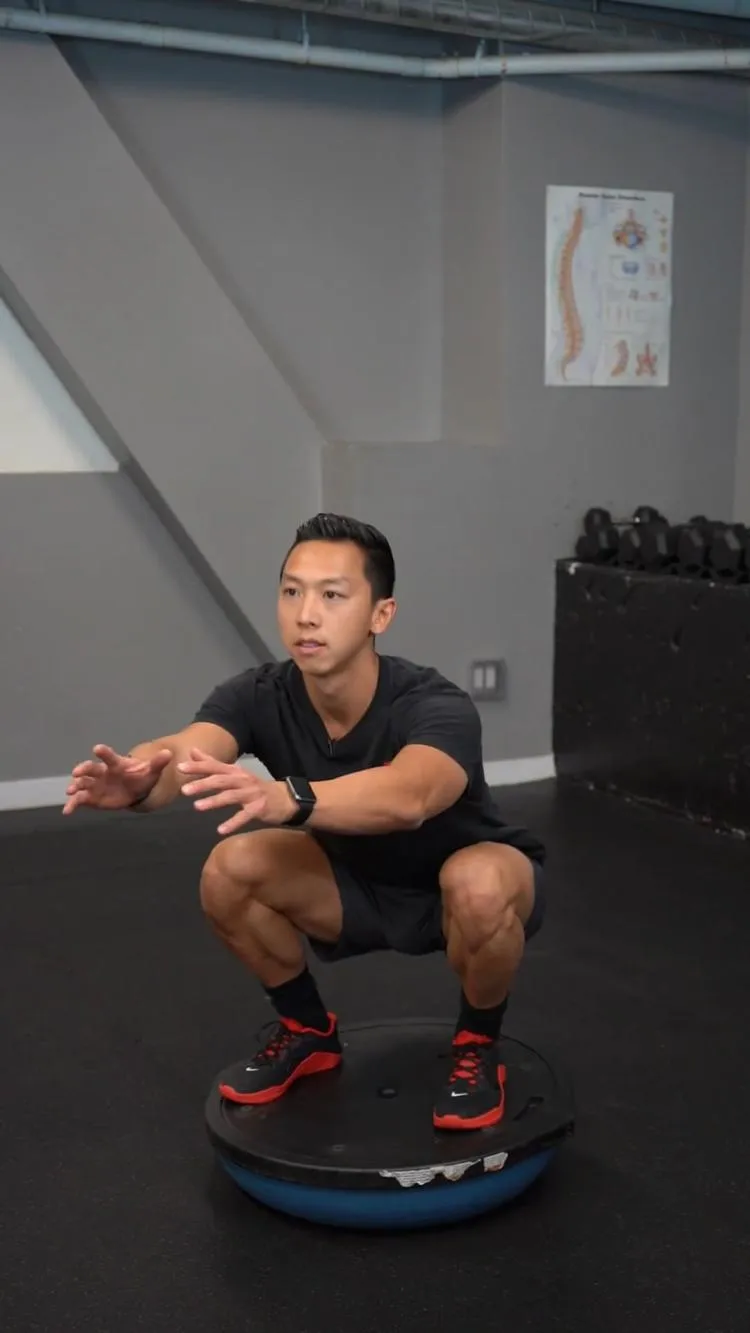
Squat - BOSU Ball
View exercise instructions
- HOW: Place a BOSU ball on the ground with the ball side down. If you need to, hold onto a wall or squat rack for support as you step onto the ball. Make sure your feet are as wide as you can comfortably go with your toes pointed forward. From here, bend your knees, hinge forward at the hips, and squat down and up for the prescribed amount of reps while balancing on the ball.
- FEEL: You should feel your leg muscles working.
- COMPENSATION: Stay centered on the ball while squatting. Keep your chest up as you squat down.
The use of a Bosu Ball or uneven surface is a fantastic way to begin to return an athlete to sport following Osgood-Schlatter disease. An uneven surface will challenge proprioceptive awareness as well as dynamic stability. Plus, it makes things a little bit more fun right? What's not to love!
Exercise 07 of 07
Exercise demonstration
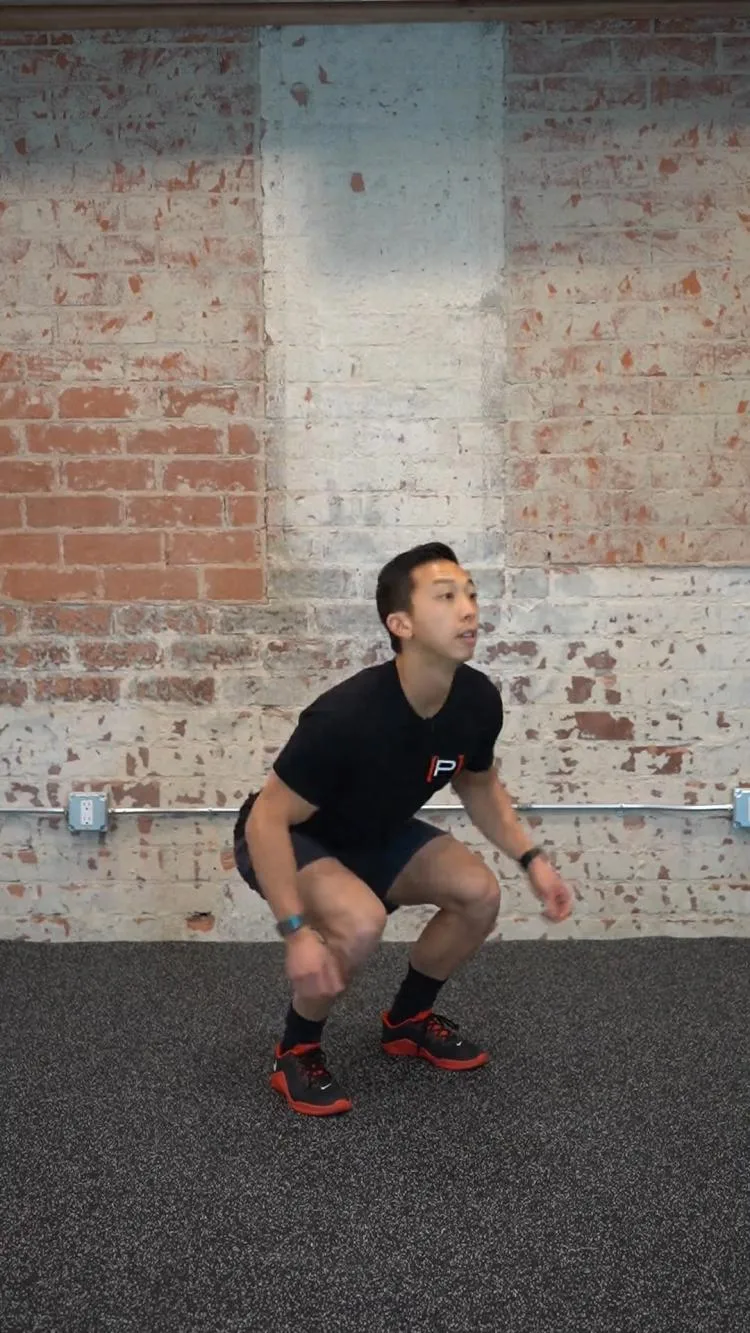
Squat Jumps
View exercise instructions
- HOW: Start a squat position with your knees bent and hips slightly hinged forward. Push into the ground and jump as high as you can creating the triple extension of your feet, knees, and hips. As you land go in directly into the squat position again and perform the prescribed amount of reps or time.
- FEEL: You should feel all of your lower body muscles working as you squat and explode up into a forceful jump.
- COMPENSATION: Keep your chest up. Jump and land in the same position.
Once appropriate, it's important to start loading the patellar tendon in a way that is functional and valuable for your specific sport. Squat jumps are a great exercises to begin with and can be progressed to box jumps, single leg jumps for height or distance...you name it!
Note: If you continue to have moderate to severe levels of pain with an exercise, you may not be ready to progress to the next exercise. Remember, it is crucial to listen to the signals your body is giving you! Train smarter not harder!
Does the Osgood-Schlatter Disease “Bump” Ever Go Away?
As a physical therapist, I often times get asked if the “bump” on the knee will ever go away. Typically, it depends on the severity of the Osgood-Schlatter disease and the severity of the “bump” that develops. The more severe the case, the more likely it is for the “bump” to stick around. This raised area at the tibial tuberosity is not harmful, and is caused by a combination of patellar tendon fiber malalignment and increased calcification at the tibial tuberosity due to heightened bone activation at the growth plate (4). While this bump may not go away entirely based on the severity of the condition, it’s important to understand that it is not limiting in regards to participation in sport or activity. Research has shown that 75% of individuals return to full activity without limitation due to symptoms (5). So embrace the bump if you've got one, you've got nothing to hide.
What Else Can I Do for Osgood-Schlatter Disease?
Several other things can be done to mitigate symptoms associated with Osgood-Schlatter disease. On top of being diligent about stretching and strengthening, it’s important to set yourself up for success in other aspects of life. This includes wearing supportive footwear when partaking in sports, eating a healthy diet, drinking plenty of water to help to manage systemic inflammation in the body, and getting adequate sleep. Yes, this does mean that getting appropriate amounts of sleep each night helps with tissue repair and healing (6). No Netflix TV show is as important as your health. Read this article to learn more about how to catch those quality Z's!
Key Takeaways For Osgood Schlatters Treatment

Closing Thoughts
Osgood-Schlatter disease is a very manageable and treatable condition that can be handled with proper strengthening, stretching, pain management, and activity modification as needed. It’s important to remember that even with expected tightness to the quadriceps muscle and the need to stretch it, you need to strengthen this muscle group as well to decrease the chance of further injury down the road. Do not let Osgood-Schlatter disease limit you from partaking in the activities you love, let the provided exercises serve as a guide to keep you healthy and active. Can't wait to see you out on the field
Take Control of Your Knee Health Today
The knees are true hard nosed blue collar workers! They get the job done when the hips and ankles may be taking some extra rest breaks. In this program, you will learn how to restore mobility, learn to get your powerful quadriceps cooperating with you, along with starting the journey to addressing the hip and ankle. In this program, you will learn how to restore mobility, learn to get your powerful quadriceps cooperating with you, along with starting the journey to addressing the hip and ankle.
REFERENCES
- Gholve, Purushottam Aa; Scher, David Ma,b; Khakharia, Saurabha; Widmann, Roger Fa,b; Green, Daniel Wa,b Osgood Schlatter syndrome, Current Opinion in Pediatrics: February 2007 - Volume 19 - Issue 1 - p 44-50 doi: 10.1097/MOP.0b013e328013dbea
- Antich, T. J., & Brewster, C. E. (1985). Osgood-Schlatter Disease: Review of Literature and Physical Therapy Management. Journal of Orthopaedic & Sports Physical Therapy, 7(1), 5-10. doi:10.2519/jospt.1985.7.1.5
- , et al. Isometric exercise induces analgesia and reduces inhibition in patellar tendinopathy.
- Weiler, R., Ingram, M., & Wolman, R. (2011). Osgood-Schlatter disease. Bmj, 343(Aug01 1), D4534-D4534. doi:10.1136/bmj.d4534
- Krause B. L. F.R.A.C.S. F.R.C.S. Ed. (Orth); Williams, J. P.R. M.B.E., F.R.C.S.; Catterall, A. M.Chir., F.R.C.S. Natural History of Osgood-Schlatter Disease. Journal of Pediatric Orthopaedics: January-February 1990 - p 65-68
- Walker, M. P. (2008). Cognitive consequences of sleep and sleep loss. Sleep Medicine, 9. doi:10.1016/s1389-9457(08)70014-5
About the Author
Dr. Lauren Lynass PT, DPT, CSCS
Certified Running Gait Analyst
Prehab Head of Videos & Content Creator
 Dr. Lauren Lynass is a Colorado girl at heart. While she grew up skiing, snowshoeing, and building snowman, she has traded in her snowy mountains for California beach life and currently lives with her husband and dog in their travel trailer "The Burrito." As a physical therapist, Lauren has experience working with pediatrics, runners, geriatrics, athletes, and itty bitty newborns. She is a Certified Strength and Conditioning Specialist, Level 1 Certified Running Gait Analyst, Dry Needling Certified, and uses her expertise to host sport specific strength and conditioning classes for local high school athletes. When Lauren isn't treating patients, you can find her running along the Cali coast, hiking with the pup and husband, or simply swinging in a hammock lost in a good book. She considers herself a life long learner and loves that being a physical therapist provides her with the opportunity to do so! She enjoys being a part of the Prehab Team as it allows her to collaborate with some of the very best in the field and empower others to take charge and ownership of their wellbeing.